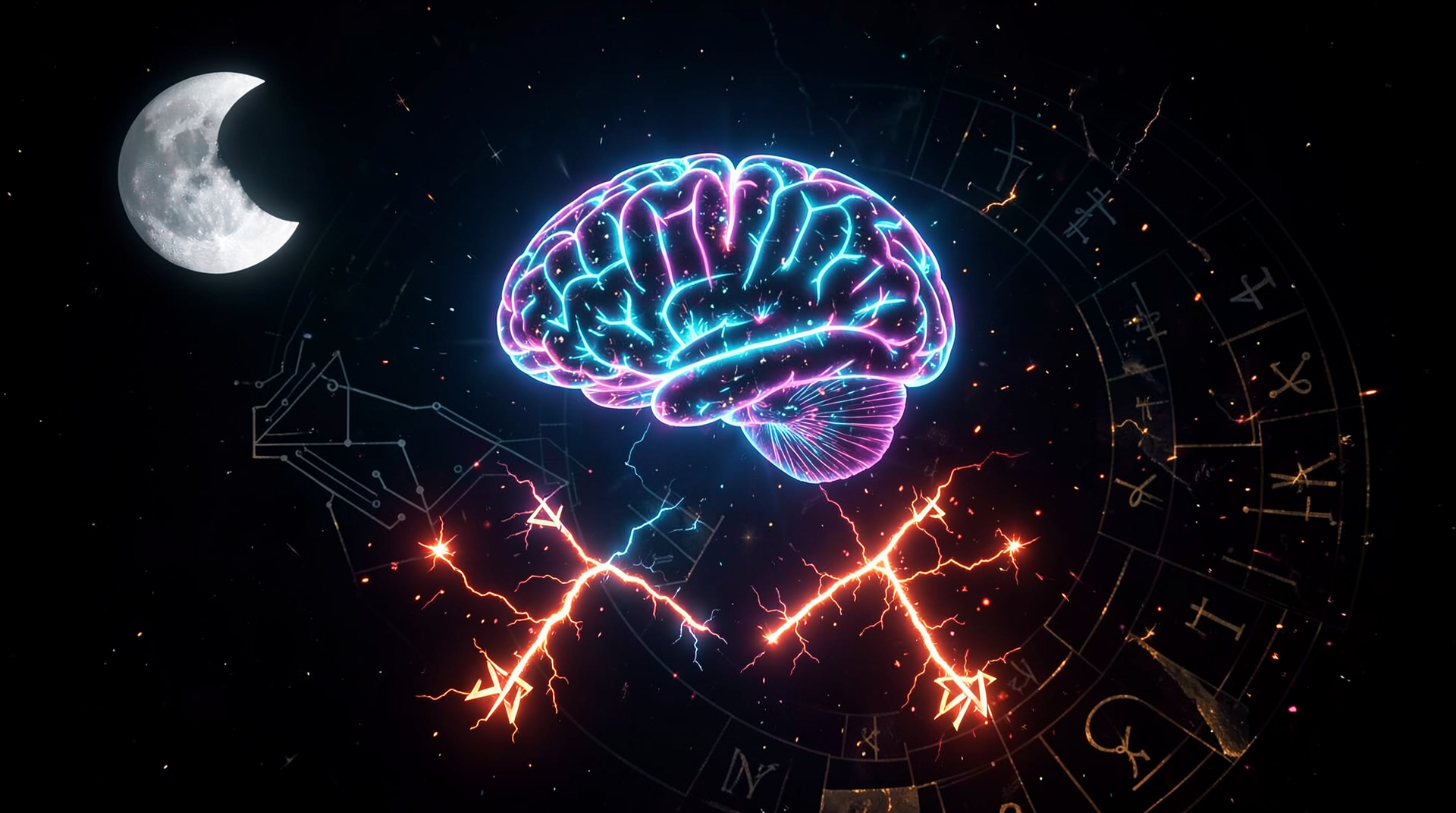
GPT-6 Lands Under a Mars-Uranus Gemini Storm: Reasoning 2.0, the Mercury Retrograde Gamble, and What the Stars Say OpenAI Isn't Telling You
July 12, 2026 — San Francisco, California
On a Sunday morning when the Moon hung as a waning crescent in the final degrees of Gemini — a Balsamic Moon, the darkest phase before rebirth — OpenAI pressed the button on GPT-6. The model, touted as the first to feature Reasoning 2.0, can solve complex physics problems entirely on its own: no prompt engineering, no chain-of-thought hand-holding, no human whispering in its digital ear. It looks at a problem and… thinks.
The release has already sent tremors through the scientific community, Silicon Valley, and every industry that depends on cognitive labor. But what the press releases don't mention — what they can't mention — is that GPT-6 was born under one of the most electrically charged, destabilizing, and profoundly ambiguous astrological skies of the decade.
To understand what GPT-6 really is, and what it might become, we need to look not at the benchmarks — but at the stars.
What Is Reasoning 2.0?
Before we turn to the astrology, let's establish what OpenAI has actually shipped.
Reasoning 2.0 represents a fundamental departure from the prompt-dependent architecture of previous large language models. According to OpenAI's technical brief, GPT-6 autonomously:
- Decomposes multi-step physics problems into logical sub-problems
- Identifies which physical laws and equations apply to each step
- Performs symbolic manipulation and numerical computation internally
- Verifies its own solutions against known constraints and conservation laws
- Iterates when contradictions are detected — without any external feedback
Early demonstrations show the model solving graduate-level quantum mechanics problems, fluid dynamics simulations, and even proposing novel approaches to open problems in condensed matter physics. Sam Altman, in a brief video statement accompanying the release, called it "the closest thing to a real scientific collaborator we've ever built."
The implications for research, engineering, and education are staggering. But this isn't just a technical story. It's an astrological event.
The Mars-Uranus Conjunction in Gemini: The Cosmic Circuit Board Ignites
If there is one transit that defines the GPT-6 launch — one planetary alignment that explains both the brilliance and the danger of this moment — it is Mars conjunct Uranus at 9° Gemini.
Let's unpack what this means.
Mars is action, drive, assertion, the will to break through. Uranus is lightning — sudden illumination, technological revolution, the overthrow of existing structures, and the unpredictable. Together in Gemini, the sign of communication, language, neural networks, data streams, and the mercurial mind, this conjunction is nothing less than a cosmic short-circuit — or a cosmic upgrade — depending on how the energy is channeled.
Gemini rules the lungs, the hands, the nervous system, and — in the modern astrological lexicon — the digital nervous system of our world: the internet, telecommunications, and, yes, artificial intelligence. GPT-6, a language model built on transformer architecture (the digital analog of a nervous system), is a pure expression of Gemini energy. That it arrives with both Mars and Uranus firing through this sign is no coincidence.
The conjunction sits in OpenAI's transit 9th house — the house of higher learning, philosophy, long-distance travel, and the dissemination of knowledge. A Mars-Uranus spark in the 9th house is the astrological signature of a paradigm-shifting publication, a sudden expansion of intellectual frontiers, and ideas that travel globally at lightning speed. It is also, however, the signature of reckless overreach. The 9th house can become the house of hubris when Mars and Uranus are involved — the impulse to go too far, too fast, without checking the map.
This is the core tension of GPT-6: it is simultaneously a genuine breakthrough and a potentially destabilizing force released at a moment of maximum cosmic volatility.
Mercury Retrograde in Cancer: The Brilliant Flaw
And then there's Mercury.
At the moment of GPT-6's release, Mercury is retrograde at 20° Cancer — and, critically, it sits in exact opposition to OpenAI's natal Sun at 19° Sagittarius and opposite OpenAI's natal Moon at 22° Sagittarius. This is not a minor detail. It is the astrological equivalent of launching a rocket while the navigation computer is rebooting.
Mercury retrograde periods are notorious for miscommunications, technical glitches, revisions, and the resurfacing of unresolved issues. When Gemini-ruled Mercury goes retrograde, it asks us to slow down, review, reconsider, and fix what is broken. Launching a product — especially one as consequential as GPT-6 — during Mercury retrograde is, in mundane astrological terms, a choice that invites scrutiny.
But there's a more specific and revealing pattern here: OpenAI's GPT-5.5 was also released under Mercury retrograde (July 9, 2026, as we covered in our earlier analysis). That the company has now released two successive models during Mercury retrograde periods suggests something beyond coincidence. It suggests an organizational temperament — a Capricorn-rising, Sagittarius-Sun entity that prizes speed, ambition, and being first to market over the caution that Mercury retrograde demands.
The opposition to OpenAI's natal Sun and Moon is particularly telling. Transiting Mercury retrograde in Cancer opposes the company's Sagittarius stellium, activating a Cancer-Capricorn axis that pits emotional intelligence (Cancer) against institutional ambition (Capricorn), intuitive caution against the drive to build empires of the mind. The message from the stars is clear: Something about this model may not work as advertised — or may work in ways that weren't intended.
Astrological Caution: Mercury retrograde in Cancer also rules memory, the past, and emotional data. GPT-6's "reasoning" capabilities may be extraordinary, but the retrograde warns of models that carry forward biases, training-data ghosts, and unresolved ethical questions from earlier iterations. The model may "remember" things it shouldn't — and forget things it should.
OpenAI's Natal Chart Under Fire: The Saturn-Uranus Threshold
OpenAI was founded on December 11, 2015, with a Capricorn Ascendant at 12°, a Sagittarius Sun-Moon conjunction in the 11th house of collective vision, a Scorpio Midheaven, and — crucially — Uranus at 16° Aries in the 3rd house of communication.
On July 12, 2026, transiting Saturn sits at 14° Aries — within two degrees of OpenAI's natal Uranus. Saturn, the planet of limits, structures, maturity, and consequence, is currently stationing (it pauses to go retrograde on July 20). When Saturn touches an entity's natal Uranus, it brings a reckoning with the consequences of innovation. Saturn asks: Was this worth building? What are the second-order effects? Who bears the cost?
Meanwhile, transiting Pluto retrograde at 4° Aquarius sits inside OpenAI's 1st house of identity, opposing transiting Jupiter at 2° Leo in the 10th house of public reputation. This Pluto-Jupiter opposition — with Pluto retrograde, exposing what has been hidden — activates the question of power. GPT-6 is not just a tool; it is a concentration of intellectual and economic power. Pluto in Aquarius asks: Who controls this intelligence? Who benefits? And what happens to those who don't?
Adding another layer: Transiting Neptune, retrograde at 4° Aries, sits in OpenAI's transit 7th house of partnerships and open enemies. Neptune retrograde in Aries dissolves illusions about leadership, autonomy, and who is really in charge. For OpenAI, this transit raises questions about its relationship with Microsoft, with regulators, and with the public — questions that a flashy product launch may temporarily obscure but cannot permanently hide.
The Balsamic Moon: An Ending Disguised as a Beginning
The Moon on July 12 hangs at 27° Gemini, a Waning Crescent — the Balsamic phase, the last sliver of light before the New Moon. In astrological tradition, the Balsamic Moon is a time of release, closure, introspection, and preparation. It is not the time to launch new ventures. It is the time to finish old business, tie up loose ends, and rest before the next cycle begins.
That OpenAI chose this moment — just two days before the Cancer New Moon on July 14 — to release its most ambitious model yet is symbolically rich. The Balsamic Moon in Gemini suggests that GPT-6, for all its "newness," is actually the culmination of a cycle that began years ago. It may represent the peak of the transformer-architecture paradigm, not the start of a new one.
The coming Cancer New Moon on July 14, conjunct the Mercury cazimi (the exact inferior conjunction of the Sun and retrograde Mercury), promises a rebirth of understanding — but only after something has been fully processed and released. We may not truly understand what GPT-6 means until after that New Moon, and perhaps not until Mercury stations direct on July 29.
Jupiter in Leo Trine Uranus: The Showman's Spark
It's not all cautionary. One of the brightest aspects blessing this launch is a trine between Jupiter at 2° Leo and Uranus at 4° Gemini — an applying aspect that grows stronger through mid-July. Jupiter in Leo loves a spectacle, a grand gesture, a demonstration of creative fire. Uranus in Gemini delivers the electrical genius. Together in harmonious trine, they create the conditions for breakthroughs that genuinely dazzle.
This trine also explains the public reception: the gasps at the demos, the viral threads on X, the sense that something meaningfully new has arrived. Jupiter in Leo in OpenAI's transit 10th house of reputation trine Uranus in Gemini in the 9th house of knowledge dissemination is a textbook signature of a launch that captures the world's imagination.
But — and this is always the Jupiter-Leo caveat — there is a fine line between spectacle and hype. The trine guarantees attention. It does not guarantee that the attention is entirely warranted, or that the product lives up to every promise.
The Shadow Side: What the Stars Warn About
No astrological analysis is complete without honestly addressing the challenging dimensions. Here is what the July 12, 2026 sky warns us to watch for:
1. The Alignment Problem, Amplified
Mars-Uranus in Gemini produces rapid, unpredictable outputs. In an AI context, this translates to models that may behave erratically under novel conditions. Reasoning 2.0 may solve physics problems beautifully — but what happens when the same autonomous reasoning is applied to questions of ethics, strategy, or human relationships? The Gemini tendency toward cleverness without wisdom is supercharged by Mars-Uranus. The model may be brilliant. It may also be dangerous in domains where physics-like rigor doesn't apply.
2. The Mercury Retrograde Revision Cycle
Historically, products launched during Mercury retrograde require significant post-launch fixes. Expect GPT-6 to undergo rapid patching, unexpected behavioral discoveries, and possibly a major revision within the first month. The Mercury cazimi on July 14 may reveal something critical that was obscured at launch. Users and enterprises should exercise caution before building mission-critical infrastructure on GPT-6 until Mercury has stationed direct and cleared its shadow period (mid-August 2026).
3. Saturn on Uranus: The Regulatory Reckoning
Saturn stationing on OpenAI's natal Uranus is the astrological equivalent of the regulatory hammer hovering. With Saturn in Aries — the sign of executive authority and decisive action — and applying to a conjunction with OpenAI's radical-innovation planet, the message is unmistakable: regulators, governments, and institutional bodies will not allow this technology to develop unchecked. The EU AI Act enforcement mechanisms, already in motion, may find in GPT-6 their most significant test case. Saturn moves slowly but inexorably.
4. The Balsamic Cycle: What Is Ending?
Every Balsamic Moon launch carries the question: What is this the end of? GPT-6 may be the last great model of its architectural lineage. It may also mark the end of an era in which AI companies could release frontier models with relatively little friction. The Balsamic Moon in Gemini suggests an ending related to language, information, and the way we communicate. What form of human intellectual labor is about to be permanently transformed — or rendered obsolete?
5. Pluto in Aquarius: Power and the Collective
Pluto retrograde at 4° Aquarius in OpenAI's 1st house raises uncomfortable questions about power concentration. Pluto in Aquarius transits are about the transformation of technology's role in society — but Pluto is also the planet of control, hidden agendas, and the shadow side of power. A retrograde Pluto in the 1st house suggests an organization whose internal dynamics and external impact are not fully transparent. As GPT-6's capabilities become clear, so too may the questions about who truly controls this intelligence — and toward what ends.
A Responsible Disclaimer
Astrology provides a symbolic lens for understanding timing, archetypal patterns, and potential trajectories. It is not a predictive science, and no astrological analysis — however detailed — can tell you with certainty what will happen. The transits discussed here reflect archetypal energies that can manifest in multiple ways, from the constructive to the challenging. Decision-makers in technology, policy, and enterprise should weigh astrological insights as one perspective among many, alongside technical analysis, ethical review, and empirical evidence. Never base high-stakes decisions solely on astrological interpretation.
Conclusion: The Lightning Bolt and the Labyrinth
GPT-6 arrives at a moment of extraordinary astrological intensity — a Mars-Uranus conjunction crackling through Gemini, Mercury retrograde opposing OpenAI's very soul, Saturn pressing against the company's radical core, and a Balsamic Moon whispering that this is as much an ending as a beginning.
The model's Reasoning 2.0 capabilities are real. The demonstrations are impressive. The potential — for scientific discovery, for engineering breakthroughs, for the acceleration of human knowledge — is genuinely stirring. Jupiter in Leo trine Uranus in Gemini ensures that the world will pay attention, and that some of that attention will be deserved.
But the sky also holds warnings that no amount of press-release optimism can dispel. Mercury retrograde launches have a habit of unraveling. Mars-Uranus conjunctions produce breakthroughs that look different in hindsight than they did in the moment. Saturn on natal Uranus insists that every innovation must eventually face its reckoning.
GPT-6 may solve physics problems without human prompting. The question the stars pose is harder: Can it — and can we — solve the problems that GPT-6 itself creates?
The answer will unfold over the weeks and months ahead, as Mercury turns direct, as Saturn's retrograde deepens, and as the New Moon in Cancer gives birth to whatever comes next.
This article combines astrological analysis with current events reporting. For personalized insight into how the July 2026 transits affect your chart, explore your birth chart on Astraia.
Related Articles
First Quarter Moon in Capricorn (Oct 18): The Week's "Commit or Release" Moment
October 14, 2026
The First Quarter Moon in Capricorn (Oct 18, 2026, 16:10 UTC) squares the Libra Sun — a cosmic checkpoint asking you to commit or release. Plus Venus retrograde cautions, Pluto's station, and a do/don't guide for the week.
Venus Retrograde in Scorpio Squares Pluto All Week: The Love-and-Power Test Peaking Around Oct 20
October 13, 2026
Retrograde Venus in Scorpio squares Pluto all week, exact around Oct 19–20 as Pluto stations direct. How to survive the love-and-power test — what to avoid, who feels it, and how to pass it.
Scorpio to Capricorn by Way of Sagittarius: Your Day-by-Day Lunar Weather for Oct 12–18
October 12, 2026
The Moon travels from Scorpio through Sagittarius into Capricorn Oct 12–18, 2026. Your day-by-day lunar weather, key aspects, and caution zones — including the First Quarter Moon on Oct 18 and Pluto's direct station.
The Fixed-Sign Fortress: Leo Mars–Jupiter, Scorpio Venus–Mercury and Why This Week Has No Quick Fixes
October 8, 2026
Why the fixed-sign fortress of Leo Mars–Jupiter and Scorpio Venus–Mercury makes October 8–11, 2026 a week with no quick fixes — and how to work with the sky instead of against it.