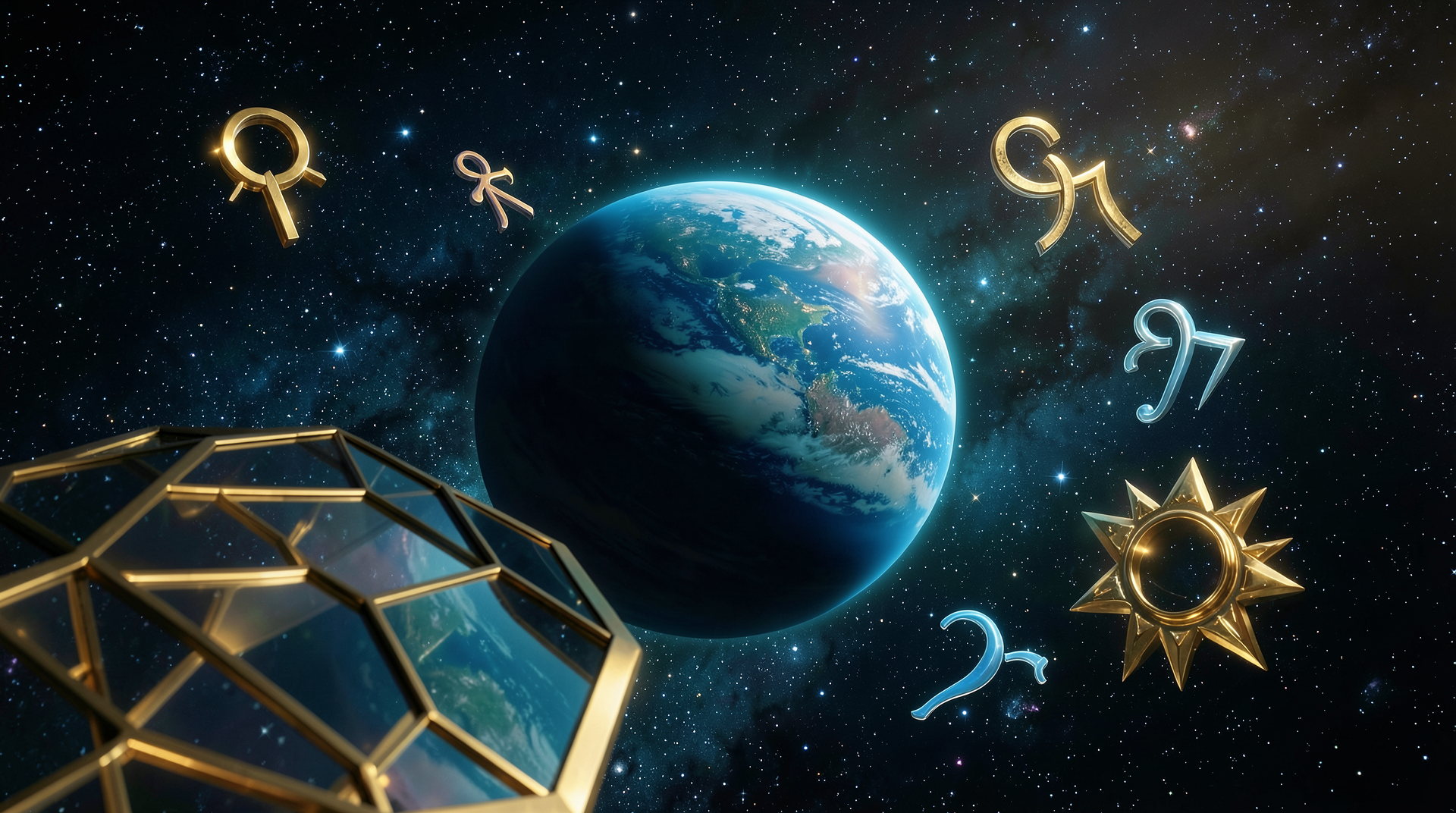
Water Worlds and the Search for Life: What K2-18b's Water Vapor Signal Really Means
The James Webb Space Telescope has done it again. In a major milestone for exoplanetary science, JWST's infrared spectrographs have confirmed the presence of water vapor in the atmosphere of K2-18b — a planet orbiting a red dwarf star roughly 124 light-years away in the constellation Leo. The signal is being hailed as the strongest "Earth-like" atmospheric signature yet detected beyond our solar system.
But before we pop the champagne corks and start planning our interstellar vacation, let's take a clear-eyed look at what this discovery actually means — scientifically, astrologically, and for humanity's place in the cosmos.
The Discovery: A Hycean World in Leo's Grip
K2-18b is no ordinary exoplanet. Discovered in 2015 by the Kepler spacecraft, this "Super-Earth" (or "Sub-Neptune") orbits within its star's habitable zone — the not-too-hot, not-too-cold region where liquid water could theoretically exist on a surface. At roughly 2.6 times Earth's radius and 8.6 times its mass, it sits in a category scientists call Hycean worlds: planets with thick hydrogen-rich atmospheres and vast global oceans, potentially covered entirely by water.
JWST's 2026 confirmation of water vapor — building on earlier, more tentative Hubble detections — marks a key step. The telescope also spotted signatures of carbon-bearing molecules, including methane and possibly dimethyl sulfide, a compound that on Earth is produced primarily by marine life. That's the detail that has astronomers excited, and also cautious.
The key point: Water vapor + carbon molecules ≠ life. K2-18b remains a candidate for habitability, not a confirmed home for biology.
The Astrological Blueprint of the Discovery
Every great discovery plants a seed in the cosmos at a particular moment — and the astrology of that moment tells a story. The initial detection of K2-18b's water vapor (September 11, 2019) cast a striking chart:
- Sun in Virgo at 18.59° in the 8th house — Virgo is the sign of the meticulous analyst, the scrutinizer of details; the 8th house is the realm of the hidden, the deep, the transformative unknown. A perfect signature for a breakthrough found through painstaking spectral analysis of a world we cannot see with our own eyes.
- Moon in Aquarius — the collective, futuristic Moon, signaling a discovery that belongs to all of humanity and points toward our shared cosmic future.
The JWST confirmation in late August 2026 carries its own symbolism. As the Sun completes its journey through Leo — the sign of the lion, the king, the place where this watery world resides in Earth's sky — we find Mercury racing ahead of the Sun, lending momentum to the news cycle. But the chart holds tension too: Neptune retrograde in Aries and a Mars square Neptune during this window.
Neptune rules oceans, dreams, and — crucially — illusions. In retrograde, its fog is even thicker. When Mars squares Neptune, impulsive action collides with delusion. Astrologically, this is a loud warning to separate evidence from enthusiasm.
The Caveats: Why "Water" Isn't "Life"
Here's where responsible science — and responsible astrology — must pull back the curtain:
K2-18b likely has no solid surface. Hycean worlds are thought to be covered by deep, crushing oceans beneath thick hydrogen atmospheres. There may be no shoreline, no beach, no place for a rover to land. "Earth-like" in this context means "has water in its atmosphere," not "resembles Earth."
The orbital environment is intense. K2-18b orbits closer to its red dwarf star than Mercury does to our Sun. Red dwarfs are prone to violent stellar flares that could strip atmospheres and bathe the surface (or ocean) in radiation. Life would need serious resilience to survive.
The habitable zone isn't the whole story. A planet being in the habitable zone doesn't mean it's habitable. Atmospheric composition, magnetic fields, tidal locking, and stellar activity all matter. Tidal locking likely gives K2-18b a permanent day side and night side.
The dimethyl sulfide signal is disputed. While exciting, the biosignature detection is at the edge of current instrument sensitivity. More observation is needed — JWST time is precious, and follow-up will take months or years.
Astrologically, this is precisely what Neptune retrograde warns us about: the dream is beautiful, but the dream's edges blur into fantasy. When Mars squares Neptune, enthusiasm without verification becomes hype. The cosmos is asking us to hold both possibilities — the wonder and the uncertainty — at once.
What This Means for Humanity (and the Zodiac)
Even with all the caveats, this discovery is genuinely historic. Water is the universal prerequisite for life as we know it. Finding it — along with carbon chemistry — around a rocky world in a habitable zone is a statistical stepping stone toward answering the oldest question: Are we alone?
For the collective, this resonates with Aquarian energy (the Moon's placement at the original discovery): the future is open, the boundaries of "us" are expanding to include whatever may swim, float, or grow in distant oceans. It shifts the cosmic conversation from if there are other habitable worlds to how many.
A Note of Caution
This is a moment to celebrate curiosity, not to plan an exodus. As exciting as K2-18b is, we remain decades — likely centuries — away from direct study of its oceans. And astrologically, with Neptune retrograde active through this period, the wisest course is to treat breakthroughs as guidance toward the next question, not as certain answers.
Astrology, like science, is a lens — it illuminates possibility, it does not decree certainty. Use this moment as inspiration, not as an excuse for grand decisions based on hype. Let the wonder of a distant, water-rich world remind you to look more carefully at the water in your own life: your emotions, your dreams, your deep intuition.
The Takeaway
The JWST's confirmation of water vapor on K2-18b is a triumph of human vision — a telescope built with patience, precision, and collective ambition (a Virgo-and-Aquarius story if ever there was one) peering into the invisible and finding moisture where we hoped there might be liquid.
The planet may not be a second Earth. It may not harbor life. But it tells us something profound: the universe is soaked in possibility. Water worlds are likely common. And where water flows, the potential for life follows — even if K2-18b itself turns out to be a sterile, storm-battered ocean.
Keep your eyes on JWST's next observations, keep your heart open to the mystery, and keep your skepticism sharp. The cosmos rewards both the dreamer and the skeptic — especially when they're the same person.
Disclaimer: This article blends scientific reporting with astrological interpretation for contemplative purposes. Astrology offers symbolic guidance and perspective — it is not a predictive science. No major life decisions should be made solely on the basis of horoscopes or planetary transits.
Related Articles
First Quarter Moon in Capricorn (Oct 18): The Week's "Commit or Release" Moment
October 14, 2026
The First Quarter Moon in Capricorn (Oct 18, 2026, 16:10 UTC) squares the Libra Sun — a cosmic checkpoint asking you to commit or release. Plus Venus retrograde cautions, Pluto's station, and a do/don't guide for the week.
Venus Retrograde in Scorpio Squares Pluto All Week: The Love-and-Power Test Peaking Around Oct 20
October 13, 2026
Retrograde Venus in Scorpio squares Pluto all week, exact around Oct 19–20 as Pluto stations direct. How to survive the love-and-power test — what to avoid, who feels it, and how to pass it.
Scorpio to Capricorn by Way of Sagittarius: Your Day-by-Day Lunar Weather for Oct 12–18
October 12, 2026
The Moon travels from Scorpio through Sagittarius into Capricorn Oct 12–18, 2026. Your day-by-day lunar weather, key aspects, and caution zones — including the First Quarter Moon on Oct 18 and Pluto's direct station.
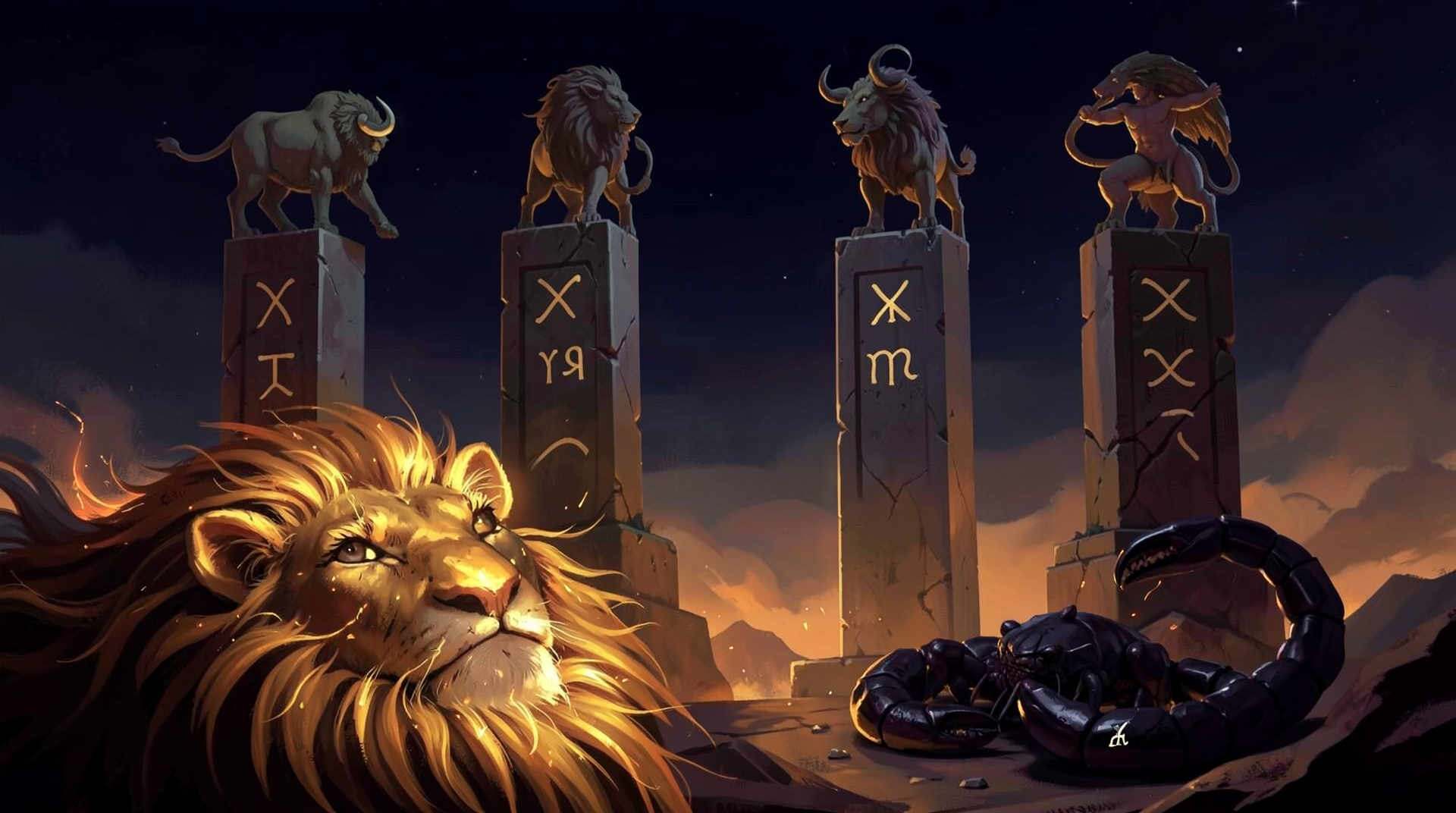
The Fixed-Sign Fortress: Leo Mars–Jupiter, Scorpio Venus–Mercury and Why This Week Has No Quick Fixes
October 8, 2026
Why the fixed-sign fortress of Leo Mars–Jupiter and Scorpio Venus–Mercury makes October 8–11, 2026 a week with no quick fixes — and how to work with the sky instead of against it.