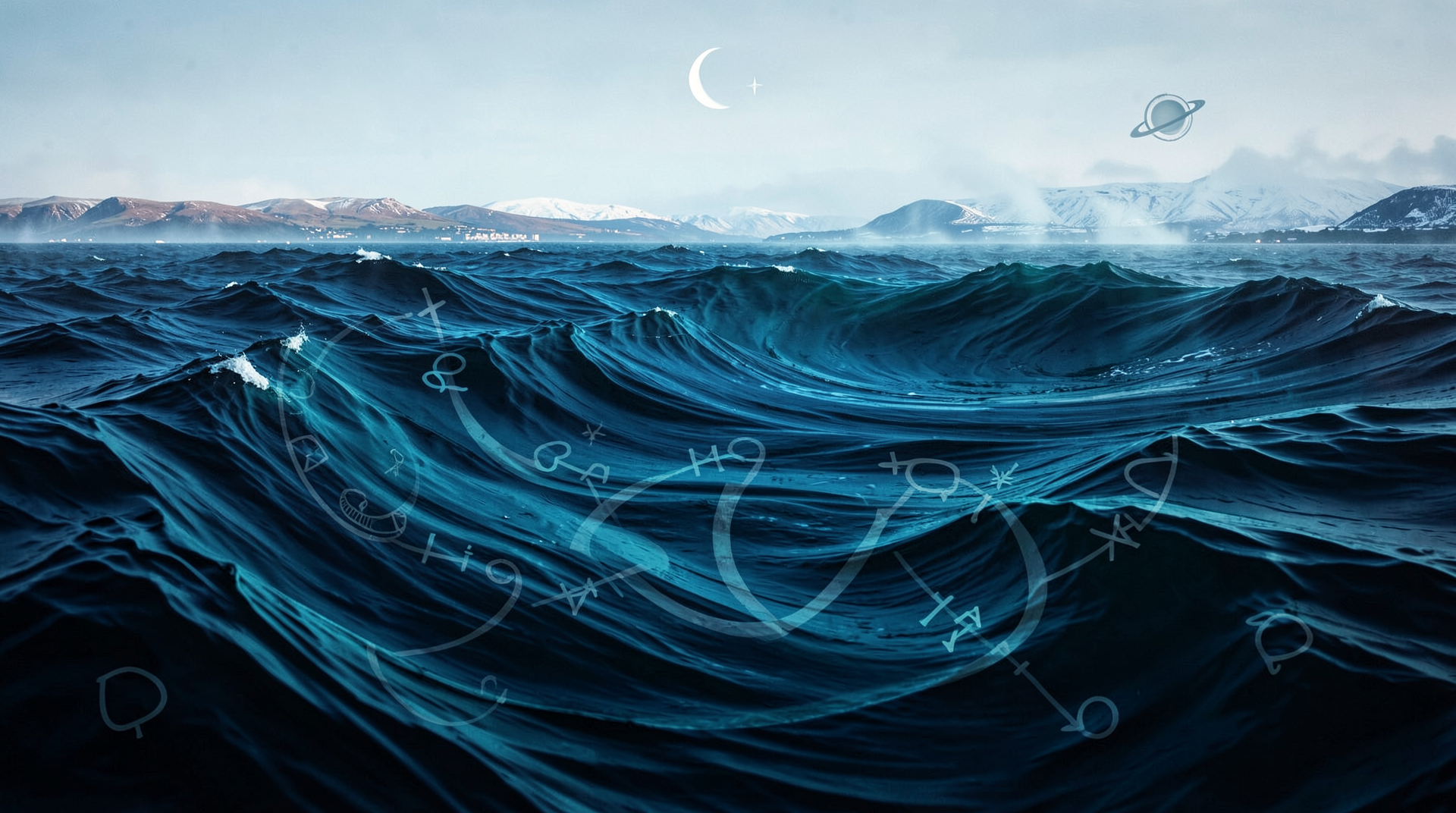
The Great Conveyor Stalls: AMOC Slows to a Critical Threshold — and the Astrology of Colder European Winters
The North Atlantic has carried the warmth of the tropics northward for millennia, a slow and mighty "conveyor belt" that keeps Western Europe mild while the same latitudes in Canada freeze. This week, oceanographers delivered a sobering bulletin: that current — the Atlantic Meridional Overturning Circulation (AMOC) — has slowed to what many consider a critical threshold, raising the possibility of dramatically colder winters across Europe in the years ahead.
It is a story of tides, currents, and fragile balance — so it is no surprise that the sky at this precise moment is full of water.
What the AMOC Actually Does
The AMOC is not a single river in the sea, but a vast, slow circulation. Warm, saline surface water flows northward from the tropics toward Greenland and the Nordic Seas. As it travels, it releases heat to the atmosphere — heat that is precisely what keeps London, Paris, and Lisbon far warmer than their latitudes suggest. When that water reaches the far north, it cools, becomes denser, and sinks, returning southward along the deep ocean floor. This sinking "engine" pulls the whole system forward.
When the engine weakens, the whole belt slows. And when it slows, less tropical heat reaches Europe — winters turn colder, storm tracks shift, sea levels rise along the eastern U.S. seaboard, and rainfall patterns across the Sahel and Amazon are thrown into flux.
The Critical Threshold Report
This week's report comes from a consortium of oceanographers monitoring the North Atlantic with moorings, satellites, and deep-water sensors. Their key findings:
- Measured slowdown: The current's strength has dropped to what several teams flag as a "critical threshold" relative to historical baselines, with some estimates suggesting the system is at its weakest in over a thousand years.
- Freshwater influx: Accelerated melting of the Greenland ice sheet is injecting fresh water into the North Atlantic, diluting the saltiness that drives deep-water sinking — the very mechanism that powers the conveyor.
- Tipping-point language: Scientists caution that the AMOC may be approaching a bifurcation point, beyond which it could undergo an abrupt, potentially irreversible collapse — a genuine "tipping point," not a gradual drift.
The most frequently cited consequence: colder and harsher European winters, alongside a cascade of effects on agriculture, energy demand, fisheries, and coastal communities.
The Sky Over the North Atlantic: An Astrological Reading
No degree of the zodiac is more native to this story than Cancer — the sign of water, tides, oceans, home, and homeland. And on the day of this report, the sky placed its most assertive water placement right at the center of the drama.
Mars in Cancer: The Troubled Waters That Run Deep
Mars — the planet of action, pressure, and force — sits in Cancer, a sign that governs the sea and the deep emotional-resource currents of a region. Mars here describes a forceful disturbance within the watery realm itself: pressure building inside the ocean, a churning of tides and currents, defensive and protective responses to a changing homeland. In classical water-sign symbolism, an agitated Mars in Cancer is exactly the image of a great current under strain — energy struggling to flow through a medium that is being altered from within.
The fact that this configuration coincides with the AMOC threshold warning is, for astrologers, a resonant (if sobering) signature: the "sea" is actively being stressed.
A Waxing Moon in Aquarius: The Water-Bearer Gathering the Climate
The Moon — which literally governs the tides — is waxing gibbous in Aquarius, the Water-Bearer. A growing moon in the sign that carries water for the collective suggests a swelling of communal awareness around water systems: melting ice, rising seas, shifting currents. The Moon's pull on this story is one of building public consciousness — the light on this issue is increasing, not diminishing, even as it brings uncomfortable truths to the surface.
Sun in Virgo: The Harvest That Hangs in the Balance
The Sun has entered Virgo, the sign of the harvest, agriculture, and practical systems. Virgo reminds us that the most immediate human cost of colder winters is the harvest: crop failures, food security, heating budgets, and the plain logistics of getting a population through a hard season. Virgo's analytical eye asks us to measure, prepare, and adapt — not merely to worry.
Saturn and Neptune, Both Retrograde in Aries: The Slowdown Within the Slowdown
Here is the deeper astrological counterpoint. Saturn retrograde in Aries symbolizes structural delays, halts, and the hard work of rebuilding foundations — mirrored in any stalled climate response. Neptune retrograde in Aries brings fog, confusion, and the risk of misreading data or being seduced by oversimplified narratives. Together, two retrograde planets in the same sign describe a moment when the usual forward momentum of policy is stalled, and clarity about the future is murky. This is not a sky that promises quick, decisive solutions — it is a sky that demands patience, honesty, and a willingness to live with uncertainty.
The Downsides: What This Report Does Not Guarantee
It is essential — especially under a foggy, Neptune-retrograde sky — not to overstate what is known.
- A threshold is not a collapse. Reaching a "critical threshold" in models is not the same as the current having already switched off. Many scientists remain confident the AMOC will not fully collapse this century, even under aggressive scenarios.
- Models disagree. Different climate models project widely different AMOC behavior; the observational record is short, and direct strength measurements only began in 2004.
- Colder winters are counterintuitive but real. Warming the planet while cooling one region seems paradoxical, yet it is precisely the regional shift that makes this story so easy to misread.
- Alarm fatigue is a real risk. Repeated dramatic headlines can dull public response, which is itself a danger — under a Saturn-retrograde sky, credibility is built slowly and lost quickly.
Warnings and Cautions
- Be wary of certainty, especially now. Neptune retrograde in Aries is the astrology of confusion — a poor time to accept sweeping, dramatic claims at face value. Look for replication, peer review, and honest uncertainty.
- Don't make life-changing decisions on a headline. Whether it's property, energy investments, or relocating, this is a moment for deliberation, not panic. Saturn retrograde rewards caution and penalizes impulsiveness.
- Expect policy delays. Saturn's retrograde motion suggests climate agreements and adaptation funding may face bureaucratic stalls or reversals in the months ahead — plan accordingly, personally and institutionally.
- Prepare, don't catastrophize. Virgo's practical lesson is the most useful one: stock resilience where you can, support adaptation planning, and treat cold-weather readiness as a real, if gradual, possibility.
A Responsible Disclaimer
Astrology offers a symbolic lens for reflecting on planetary events — it does not predict the weather, the oceans, or the decisions of governments. This article pairs scientific reporting with astrological interpretation for contemplation and perspective. It is not a substitute for climate science, and it should never be the sole basis for major financial, health, or life decisions. For reliable guidance on the AMOC, follow the work of NOAA, the Met Office, and the peer-reviewed scientific literature.
Conclusion: A Current We All Depend On
The AMOC has been called the climatic "heartbeat" of the North Atlantic — a slow, steady pulse that has kept Europe warm for as long as human civilization has known it. This week's report suggests that pulse has weakened to a place scientists can no longer ignore.
Astrologically, the sky mirrors the message: Mars churning in the waters of Cancer, a tidal Moon gathering in Aquarius, a Virgo Sun watching over the harvest, and two retrograde giants — Saturn and Neptune — reminding us that the road ahead will be slow, complex, and hard to see clearly. It is not a sky of catastrophe foretold, but of profound reckoning — a call to measure honestly, prepare practically, and hold both urgency and humility at once.
The great conveyor has slowed. What happens next depends, as ever, on the choices of those who understand the currents — both in the sea and in the sky.
Related Articles

First Quarter Moon in Capricorn (Oct 18): The Week's "Commit or Release" Moment
October 14, 2026
The First Quarter Moon in Capricorn (Oct 18, 2026, 16:10 UTC) squares the Libra Sun — a cosmic checkpoint asking you to commit or release. Plus Venus retrograde cautions, Pluto's station, and a do/don't guide for the week.
Venus Retrograde in Scorpio Squares Pluto All Week: The Love-and-Power Test Peaking Around Oct 20
October 13, 2026
Retrograde Venus in Scorpio squares Pluto all week, exact around Oct 19–20 as Pluto stations direct. How to survive the love-and-power test — what to avoid, who feels it, and how to pass it.
Scorpio to Capricorn by Way of Sagittarius: Your Day-by-Day Lunar Weather for Oct 12–18
October 12, 2026
The Moon travels from Scorpio through Sagittarius into Capricorn Oct 12–18, 2026. Your day-by-day lunar weather, key aspects, and caution zones — including the First Quarter Moon on Oct 18 and Pluto's direct station.
The Fixed-Sign Fortress: Leo Mars–Jupiter, Scorpio Venus–Mercury and Why This Week Has No Quick Fixes
October 8, 2026
Why the fixed-sign fortress of Leo Mars–Jupiter and Scorpio Venus–Mercury makes October 8–11, 2026 a week with no quick fixes — and how to work with the sky instead of against it.