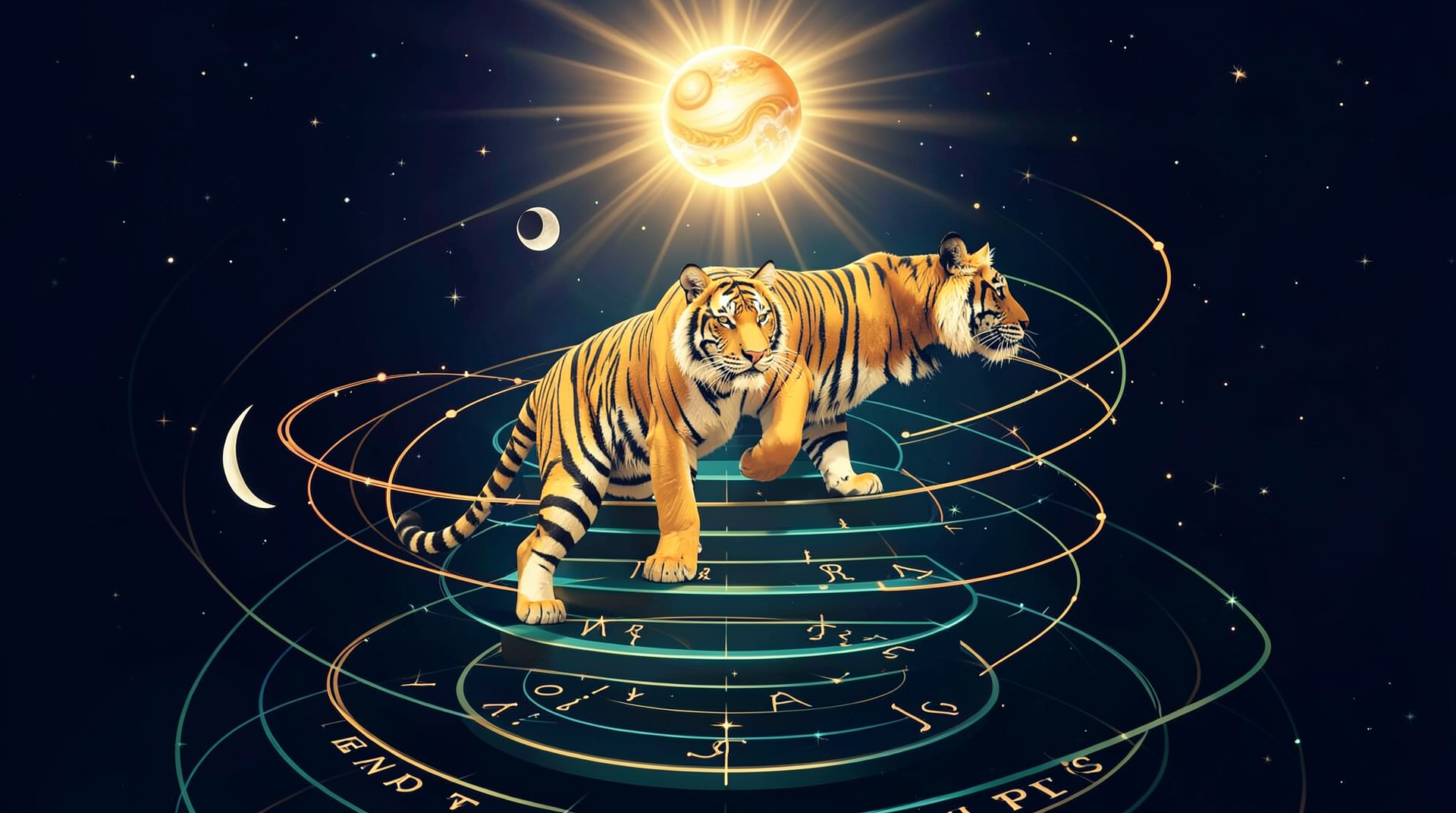
India's GDP Milestone: The Astrology Behind Three Consecutive Quarters of 7.5% Growth
India has done what few economies have managed in the post-pandemic era: maintain a blistering 7.5% GDP growth rate for three consecutive quarters. As official data confirms the streak — Q3 FY2025–26, Q4 FY2025–26, and Q1 FY2026–27 all clocking in at or above 7.5% — the world's most populous nation has solidified its position as the primary engine of global economic expansion. But beneath the spreadsheets and policy briefs, the sky tells a story of its own.
The confirmation lands on July 12, 2026, under a sky humming with rare and potent configurations — a moment when India's birth chart, cast at the stroke of midnight on August 15, 1947, finds itself in extraordinary conversation with the transiting planets.
The Numbers: What Three Quarters of 7.5% Actually Means
Before turning to the stars, the terrestrial picture deserves attention. India's economy — now the world's third-largest by nominal GDP after surpassing Germany in 2025 — has grown at a pace that outstrips every other major economy. China, grappling with demographic headwinds and property-sector stagnation, has settled into a 4–5% range. The United States and Eurozone economies hover between 1.5–3%.
Three consecutive quarters at 7.5% translates to:
- Manufacturing PMI remaining in expansion territory (above 50) for 36 straight months
- Services exports crossing the $400 billion annual threshold for the first time
- Foreign direct investment inflows exceeding $90 billion in the fiscal year
- Domestic consumption powered by a middle class that has swelled past 500 million
The International Monetary Fund's July 2026 World Economic Outlook update described India as "the defining growth story of the decade" — language that would have seemed improbable even five years ago.
India's Natal Chart: The Cosmic DNA of a Nation
To understand why these transits matter, we need to understand the chart they are activating. India's independence chart — cast for August 15, 1947, at 00:00 hours in New Delhi — is a document of extraordinary astrological tension and promise.
| Placement | Sign & Degree | House | Significance |
|---|---|---|---|
| Ascendant | 0° Gemini 52′ | 1st | Dual-natured identity, communicative, restless |
| Sun | 21° Leo 06′ | 4th | Pride rooted in homeland; sovereign fire |
| Moon | 27° Cancer 06′ | 3rd | Deep emotional intelligence; mass communication |
| Mars | 0° Cancer 34′ | 2nd | Mars in fall — the struggle to assert wealth |
| Saturn | 13° Leo 35′ | 3rd | Authoritative voice, disciplined messaging |
| Pluto | 13° Leo 13′ | 3rd | Transformative power of national narrative |
| Jupiter | 18° Scorpio 59′ | 6th | Growth through service, hidden resources |
| Uranus | 25° Gemini 10′ | 1st | Innovation woven into national identity |
| MC | 14° Aquarius 34′ | 10th | Progressive, technological public image |
Several features leap out. The Gemini Ascendant at the anaretic (final) degree speaks to a nation perpetually in dialogue with itself — multilingual, multi-faith, multivocal. The 3rd house stellium of Moon-Saturn-Pluto in Cancer and Leo describes a nation whose communication (3rd house) carries enormous emotional weight (Moon in Cancer) and transformative force (Pluto), tempered by Saturnian discipline.
But perhaps most telling is Mars at 0° Cancer in the 2nd house of wealth. Mars is in its fall in Cancer — it struggles here, its natural aggression and drive softened by Cancer's emotional sensitivity. This placement has historically manifested as India's long struggle to convert its immense human and cultural capital into economic might. The nation's relationship with wealth has been, for much of its history, characterized more by potential than realization.
That is precisely the placement being activated now.
The Transit Picture: July 12, 2026 — A Sky of Thresholds
The confirmation of India's GDP milestone arrives under a complex and potent sky. Here are the transits that matter most:
1. Jupiter at 2° Leo: The Great Benefic Enters the Lion's Den
Jupiter, planet of expansion, abundance, and optimism, has recently ingressed into Leo — and at 2° it sits poised to cross India's natal Mercury at 6° Leo, Venus at 15° Leo, and, crucially, the Saturn-Pluto conjunction at 13–14° Leo, all in the 3rd house of communication, trade, and national narrative.
Jupiter in Leo is dignified by triplicity (it rules the fire element at night, and India was born at night by local time). This is not Jupiter in its full domicile dignity (that belongs to Sagittarius and Pisces), but it is a placement of genuine strength. When Jupiter transits the 3rd house of a national chart, it amplifies:
- Trade agreements and commercial communication
- Transportation and logistics infrastructure
- Media and information technology
- The national "voice" on the global stage
Jupiter's transit across India's Saturn-Pluto conjunction over the coming months is particularly significant — it suggests the expansion of structural power. Saturn-Pluto conjunctions in a national chart represent concentrated, disciplined authority. Jupiter passing over them says: what was built through discipline now attracts abundance.
However, Jupiter's conjunction with natal Saturn also carries a warning: the temptation of overreach. Jupiter inflates whatever it touches, and Saturn-Pluto in the 3rd house can manifest as an overconfident national narrative, excessive government messaging, or a media environment that amplifies hubris. The line between confidence and arrogance is thin under this transit.
2. Transit Saturn at 14° Aries: Trine to Natal Saturn-Pluto — The Engine of Structural Maturity
This is, astrologically, the headline transit of India's economic moment.
Transit Saturn at 14° Aries forms an almost exact trine (120°) to India's natal Saturn at 13° Leo and Pluto at 13° Leo. A Saturn-to-Saturn trine occurs roughly every 7–8 years and represents moments when the structures you've built receive cosmic validation. For a nation, this transit speaks to:
- Institutional credibility recognized internationally
- Economic policy frameworks proving their worth
- Infrastructure investments maturing and yielding returns
- The "adulting" of a national economy
The trine to natal Pluto adds an additional layer: the transformation of power structures. Pluto in the 3rd house of a national chart governs the deep, underlying narratives a nation tells about itself. Saturn trining it from Aries — the sign of initiative, courage, and new beginnings — suggests that India is not merely growing; it is fundamentally reshaping how it understands its own economic agency.
The caution here is subtle but important. Saturn in Aries is in its fall. Saturn craves patience, structure, and deliberation; Aries demands speed, impulse, and action. The trine makes the energy flow easily — perhaps too easily. The risk is that structural reforms may be rushed or that economic discipline relaxes precisely when it is most needed. Saturn's trine is a blessing, but Saturn in Aries always carries the shadow of impatience.
3. Transit Sun and Mercury Retrograde Conjunct Natal Moon in Cancer
The Sun at 19° Cancer and Mercury (retrograde) at 21° Cancer both sit within orb of India's natal Moon at 27° Cancer — all in the 3rd house of communication, trade, and the information economy.
The Sun-Moon conjunction in a transit chart is a monthly occurrence (the New Moon), but its alignment with a natal Moon is personal and potent. For India, it describes a moment of emotional alignment between national sentiment and external reality. The GDP data, in this light, is not just a number — it is a felt validation.
But Mercury is retrograde. This is the complication. Mercury retrograde in Cancer in the 3rd house demands caution around:
- Data integrity and statistical reporting
- Economic messaging and government communication
- Trade negotiations and commercial contracts
- Transportation and logistics disruptions
The GDP confirmation arriving during a Mercury retrograde period is not necessarily suspicious, but it is astrologically notable. Mercury retrograde periods are times when information is reviewed, revised, and reconsidered. There may be subsequent revisions to the data — upward or downward. The advice from the stars: celebrate the milestone, but hold the champagne toast with one hand on the data spreadsheet.
4. Transit North Node at 0° Pisces in the 10th House
The North Node at 0° Pisces sits in India's 10th house of public standing, career, and global reputation. The North Node represents the direction of collective destiny — where we are being pulled, sometimes uncomfortably, toward growth.
At 0° Pisces in the 10th house, India's North Node transit suggests:
- A karmic pull toward global spiritual and cultural leadership
- The dissolving of old boundaries around national identity
- A public image increasingly associated with wisdom, creativity, and soft power alongside hard economic metrics
This is a long transit (the nodes take about 18 months to traverse a sign), but its activation at 0° — the "world point" of the zodiac — coinciding with the GDP milestone is no small synchronicity.
5. Transit Mars in Gemini Conjunct Natal Ascendant
Mars at 9° Gemini is within orb of India's Ascendant at 0° Gemini. Mars on the Ascendant is aggressive, assertive, and competitive. For a nation, it describes a moment of peak self-assertion on the world stage. India is not merely growing — it is demanding to be seen.
Mars in Gemini, however, is a scattered placement. The energy is mental rather than physical, distributed rather than concentrated. The risk is that India's economic momentum disperses across too many sectors, too many initiatives, without the focused power that Mars in a fixed sign (like Taurus or Scorpio) would provide.
The Waning Crescent Moon: Endings Before Beginnings
The Moon on July 12, 2026, at 19° Gemini is in its Waning Crescent phase — the final phase before the Cancer New Moon on July 14. In mundane astrology, the Waning Crescent (or Balsamic) Moon describes a period of completion, release, and preparation for a new cycle.
This is fitting. The GDP data confirming three consecutive quarters of 7.5% growth is, in a sense, the closing of one chapter and the threshold of another. The economic reforms launched in the wake of the pandemic — the Production-Linked Incentive schemes, the digital public infrastructure rollout, the infrastructure spending surge — are now bearing measurable fruit. The Balsamic Moon says: this cycle is complete; a new one is about to begin.
But the Balsamic Moon also carries a warning: it is a time for reflection, not action. Major decisions made under a Balsamic Moon often require revision when the new cycle begins. For policymakers, investors, and business leaders, the astrological wisdom is clear: absorb the data, celebrate the milestone, but delay major new economic initiatives until after the Cancer New Moon on July 14.
The Longer View: Jupiter's Journey Through India's 3rd House (July 2026 – August 2027)
The GDP milestone is not an endpoint but a waypoint. Jupiter's year-long transit through Leo and India's 3rd house (July 2026 through August 2027) promises continued expansion in:
- Digital infrastructure and AI: Jupiter in the 3rd house amplifies communication technology. India's push into sovereign AI, semiconductor fabrication, and digital public goods will receive cosmic tailwinds.
- Trade negotiations: The 3rd house governs bilateral and multilateral agreements. Expect major trade deals to accelerate.
- Education and skills: Jupiter, the traditional ruler of higher learning, in the 3rd house of basic education and skills training, suggests a boom in human capital development.
- Media and soft power: Indian cinema, music, and digital content — already global phenomena — will expand their reach.
However, Jupiter's transit over the Saturn-Pluto conjunction (exact in late 2026) will also bring tests. Jupiter inflates Pluto's shadow: power struggles over information, controversies around media ownership, and debates about free speech could intensify. The same transit that blesses communication can also amplify its distortions.
Saturn Retrograde on the Horizon: A Note of Caution (July 18, 2026)
Transit Saturn stations retrograde at 14° Aries on July 18, 2026 — less than a week after the GDP announcement. Saturn's station is always a moment of pause, and its retrograde through Aries (until December 2026) will retrace the degrees it has covered since March.
For India, Saturn's retrograde station at 14° Aries — the exact degree trining natal Saturn-Pluto — suggests that the structural achievements celebrated now will face a period of review and stress-testing in the months ahead. Saturn retrograde periods are not punishments; they are audits. The economic frameworks that produced 7.5% growth for three consecutive quarters will be examined, challenged, and refined.
Investors and policymakers should expect:
- Potential revisions to GDP methodology or data
- Stress tests on the banking and financial sector
- International scrutiny of India's economic claims
- A "cooling" period where growth may moderate before accelerating again
None of this negates the achievement. But Saturn never lets us rest on our laurels without first inspecting the foundation.
The Challenging Aspects: What the Sky Warns Against
No astrological analysis is complete without naming the shadows. Alongside the supportive trines and conjunctions, several challenging configurations demand attention:
Transit Neptune Opposite Natal Neptune (4° Aries – 8° Libra)
Transit Neptune at 4° Aries (retrograde) opposes India's natal Neptune at 8° Libra in the 5th house of creativity and speculation. Neptune-Neptune oppositions occur roughly every 82 years and describe moments of collective illusion or disillusionment. For India, this transit — building throughout 2026–2027 — warns of:
- Economic data that may obscure as much as it reveals: Neptune is the planet of fog, and its opposition to its natal position can blur the line between genuine growth and statistical optimism.
- Speculative bubbles in creative and tech sectors: The 5th house governs speculation, entertainment, and startups. Neptune's fog here could inflate valuations beyond sustainable levels.
- Confusion in international partnerships: Neptune in the 5th opposing natal Neptune in the 5th doubles the creative and diplomatic potential — but also doubles the risk of misunderstanding.
Transit Pluto in Aquarius Square Natal Jupiter in Scorpio
Pluto at 4° Aquarius forms a applying square to India's natal Jupiter at 18° Scorpio — an aspect that will tighten through 2026–2027. Pluto square Jupiter describes a battle between expansion and contraction, between optimism and the harsh realities of power. For India's economy, this transit could manifest as:
- Debt sustainability concerns (Jupiter expands; Pluto exposes)
- Geopolitical pressures that constrain economic choices
- The need to reconcile rapid growth with environmental and social costs
Mercury Retrograde (Until July 23, 2026)
We have already noted Mercury's retrograde in Cancer conjunct India's natal Moon. The period through July 23 demands extra vigilance around economic data, government communications, and trade negotiations. Mercury retrograde in a national 3rd house is not the time to sign major trade deals or launch new economic initiatives without exhaustive review.
The Saturn-Neptune Conjunction in Aries: The Bigger Picture
Looming over all of this is the once-in-36-year Saturn-Neptune conjunction building in Aries (exact in February 2027, but within orb throughout 2026). This conjunction — Saturn, the planet of structure, meeting Neptune, the planet of dissolution — in Aries, the sign of new beginnings — describes a global moment where old economic architectures dissolve and new ones struggle to be born.
For India, the Saturn-Neptune conjunction falls in the 11th house of the transit chart (groups, alliances, collective vision) and activates natal placements in complex ways. It asks: what economic dreams are worth building structures around, and which are mirages?
India's 7.5% growth trajectory places it at the center of this global drama. The nation is simultaneously building (Saturn) and dreaming (Neptune) its economic future. The astrology suggests the next 12–18 months will determine which parts of India's growth story are built on granite and which on sand.
Responsible Astrology: A Disclaimer
This article explores astrological correlations with economic events. Astrology is a symbolic language, not a predictive science. No astrological configuration can guarantee economic outcomes, and no investment or policy decision should be made solely on astrological grounds. The GDP data discussed here is publicly available and subject to revision by official statistical agencies. Astrological insights are offered as a lens for reflection, not as financial advice.
Conclusion: A Moment to Mark, Not to Rest
India's three consecutive quarters of 7.5% growth is a genuine achievement — one that the nation's birth chart, with its Gemini Ascendant and Cancer Moon, receives with a mixture of intellectual pride and emotional resonance. The transits tell a story of structural maturity (Saturn trine Saturn-Pluto), expansive communication (Jupiter entering the 3rd house), and karmic alignment (North Node in the 10th).
But the sky also sounds notes of caution: Mercury retrograde urges data vigilance; Neptune's opposition warns against economic fog; Pluto's square to natal Jupiter reminds us that growth always has a shadow; and Saturn's impending retrograde promises an audit of the very structures now being celebrated.
The Balsamic Moon under which this milestone is confirmed is, ultimately, a moon of endings and preparation. Something is concluding — perhaps the era in which India's economic potential was perpetually deferred. Something new is about to begin. The Cancer New Moon on July 14 offers the threshold.
The stars suggest that India's moment as the world's primary growth engine is not a fluke of quarterly data but a sustained alignment of structural forces — provided the nation navigates the fog, the retrograde, and the audit with the discipline that Saturn demands and the vision that Jupiter rewards.
Related Articles

First Quarter Moon in Capricorn (Oct 18): The Week's "Commit or Release" Moment
October 14, 2026
The First Quarter Moon in Capricorn (Oct 18, 2026, 16:10 UTC) squares the Libra Sun — a cosmic checkpoint asking you to commit or release. Plus Venus retrograde cautions, Pluto's station, and a do/don't guide for the week.
Venus Retrograde in Scorpio Squares Pluto All Week: The Love-and-Power Test Peaking Around Oct 20
October 13, 2026
Retrograde Venus in Scorpio squares Pluto all week, exact around Oct 19–20 as Pluto stations direct. How to survive the love-and-power test — what to avoid, who feels it, and how to pass it.
Scorpio to Capricorn by Way of Sagittarius: Your Day-by-Day Lunar Weather for Oct 12–18
October 12, 2026
The Moon travels from Scorpio through Sagittarius into Capricorn Oct 12–18, 2026. Your day-by-day lunar weather, key aspects, and caution zones — including the First Quarter Moon on Oct 18 and Pluto's direct station.
The Fixed-Sign Fortress: Leo Mars–Jupiter, Scorpio Venus–Mercury and Why This Week Has No Quick Fixes
October 8, 2026
Why the fixed-sign fortress of Leo Mars–Jupiter and Scorpio Venus–Mercury makes October 8–11, 2026 a week with no quick fixes — and how to work with the sky instead of against it.