Europe's Fever Chart: The Copernicus Climate Warning and the Astrology of a Continent at the Boiling Point
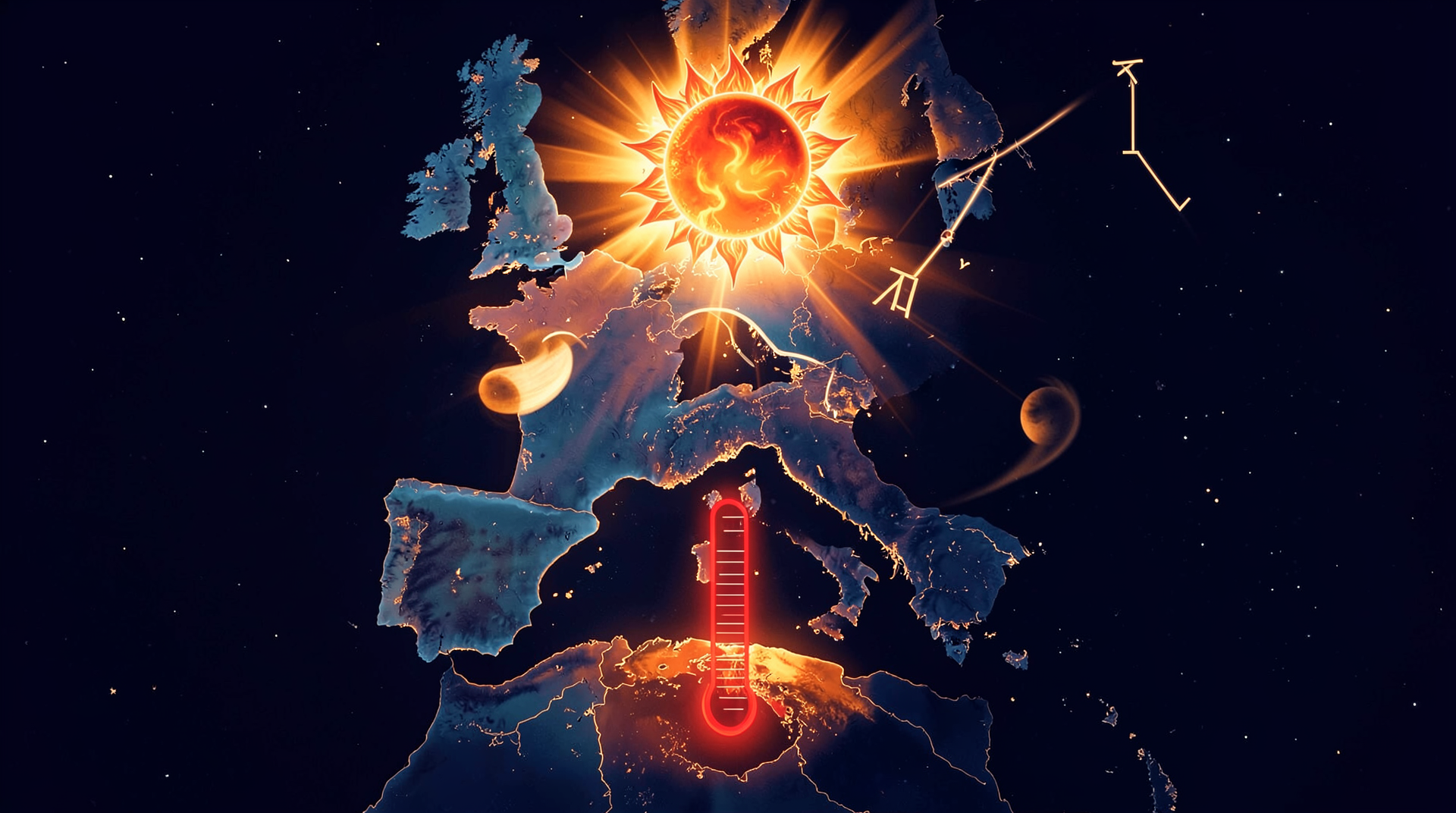
The Copernicus Climate Change Service (C3S) has just released its latest State of the Climate report, and the data is sobering: Europe is now warming at double the global average rate, cementing its status as the fastest-warming continent on Earth. The findings, published in early July 2026, reveal that the European land mass has already surpassed the 2.4°C threshold above pre-industrial levels — a milestone that arrives decades ahead of projections made just ten years ago.
This is not merely a scientific report. It is a planetary alarm bell. And when we examine the astrological architecture of this moment — the transits bearing down on the European Union's natal chart, the Saturn-Neptune convergence in Aries, the Mercury retrograde weaving through Cancer — a deeper, more symbolic story emerges. This article explores both the climate data and the cosmic signatures that frame Europe's accelerating fever.
The Copernicus Report: What the Data Actually Says
Named after Nicolaus Copernicus, the Renaissance astronomer who displaced Earth from the center of the cosmos — a fitting namesake for an institution tasked with reframing humanity's relationship to its home planet — C3S is the European Union's Earth observation programme, operated by the European Centre for Medium-Range Weather Forecasts (ECMWF).
The 2026 State of the Climate report confirms several stark realities:
- Europe's land temperature has risen by approximately 2.4°C above pre-industrial levels, compared to a global average increase of roughly 1.2°C.
- The past three summers (2024–2026) rank among the five hottest ever recorded on the continent.
- Southern Europe is experiencing an acceleration of desertification, with parts of Spain, southern Italy, and Greece now classified as semi-arid.
- Glacier loss in the Alps has reached a cumulative 65% reduction in ice volume since 2000.
- Marine heatwaves in the Mediterranean have tripled in frequency since the 1980s.
The report emphasizes that Europe's amplified warming is driven by a combination of factors: its high-latitude geography, the albedo feedback loop from melting Arctic ice, reduced aerosol cooling from cleaner air policies (a paradoxical side-effect of successful pollution controls), and atmospheric circulation shifts that trap heat over the continent for longer periods.
The implications are not abstract. They translate into failed harvests, deadly heatwaves, stressed energy grids, and coastal infrastructure threatened by rising seas. The climate is not "changing" — it has already changed. The question now is how much further, and how fast.
The EU's Natal Chart: An Aries Sun at the Threshold
To understand the astrological resonance of this moment for Europe, we turn to the birth chart most commonly associated with the European project: the Treaty of Rome, signed on March 25, 1957, at approximately 6:00 PM in Rome.
This chart places the Sun at 4.78° Aries — a cardinal fire sign, ruled by Mars, associated with initiative, sovereignty, and the pioneering impulse. The European Union was born with the astrological signature of a bold new beginning: an Aries Sun conjunct the Descendant (the point of partnership and relationship), suggesting a project defined by its relationships with others — both internally among member states and externally on the world stage.
The EU's natal chart also features:
- A Libra Ascendant at 0.30° — the sign of balance, diplomacy, and negotiation. The EU's entire institutional character is Libra: consensus-seeking, treaty-bound, perpetually weighing competing interests.
- A Cancer Midheaven at 0.35° — the public face of the EU is Cancerian: protective, nurturing, home-focused. This reflects the EU's self-image as a guardian of peace, prosperity, and social welfare.
- An Aquarius Moon in the 4th house — the emotional core of the EU is Aquarian: progressive, intellectual, and oriented toward collective ideals. Yet this Moon carries a certain emotional detachment, a tendency to process through systems and principles rather than through felt connection.
- Mars at 4.9° Gemini in the 9th house — the EU's action-drive is Mercurial: communicative, restless, intellectually curious, and at times scattered across too many priorities.
Crucially, the EU was born under a Waning Crescent Moon — a lunar phase associated with endings, release, and the wisdom that comes from letting go. This is not a chart of naive optimism. It is a chart that carries an innate awareness of impermanence and the need for periodic renewal.
Saturn and Neptune Converge on the EU's Sun: The Astrological Signature of 2026
Now we arrive at the heart of the matter. On July 3, 2026, two of the most symbolically potent planets in the solar system are positioned in direct relationship to the EU's natal Sun:
Saturn in Aries (14.3°) — The Reckoning
Transiting Saturn sits at 14.3° Aries, applying toward a conjunction with the EU's natal Sun (4.8° Aries) — a transit that is exact later in 2026. Saturn is the planet of limits, structure, consequence, and hard truths. When Saturn transits the natal Sun, it asks: What is real? What is sustainable? What must be confronted?
For the EU, Saturn's transit through Aries — and its approach to the natal Sun — represents a moment of institutional reckoning. The climate data from C3S is not merely a scientific document; it is Saturnian testimony. It says: Here are the numbers. Here is the bill. Here is what is actually happening, stripped of wishful thinking.
Saturn in Aries also squares the EU's natal Cancer Midheaven, creating tension between the public identity (protective, nurturing Europe) and the hard realities that must now be faced (resource scarcity, adaptation costs, political friction over climate policy).
Neptune in Aries (4.4°) — The Dissolution
More immediately striking is Neptune at 4.4° Aries, sitting just 0.37° from the EU's natal Sun at 4.8° Aries. This is an almost exact conjunction.
Neptune is the planet of dissolution, dreams, spirituality, confusion, and — crucially — climate. In mundane astrology, Neptune has long been associated with water, oceans, floods, and the blurring of boundaries. Its transit to the EU's Sun suggests a profound identity crisis: What is Europe becoming? What are its borders — physically, politically, climatically? What dissolves when the old certainties no longer hold?
The Neptune-Sun conjunction can manifest as:
- Inspiration and vision — the capacity to imagine a different future
- Confusion and denial — the temptation to look away from uncomfortable truths
- Dissolution of identity — the erosion of what was once solid and defined
In the climate context, this transit is hauntingly literal: Europe's physical geography is being reshaped by Neptune's domain — rising seas, melting ice, shifting coastlines. The "boundaries" that define the continent are not as fixed as they once seemed.
The Saturn-Neptune Convergence
What makes this moment extraordinary is the simultaneous application of both Saturn and Neptune to the EU's Sun. Saturn demands hard reality; Neptune dissolves the frame through which reality is understood. Together, they create a tension between facing the facts and losing faith in the narrative that gives those facts meaning.
This is the astrological signature of the Copernicus report: data that is simultaneously undeniable (Saturn) and existentially disorienting (Neptune).
Mercury Retrograde in Cancer: The Data Problem
Adding another layer of complexity, Mercury is retrograde at 25.7° Cancer as the report is released — and applying to a square with the EU's natal Mercury at 9.8° Aries.
Mercury retrograde periods are notorious for communication breakdowns, data errors, and the need to revisit and revise. In the context of climate science, this raises a cautionary note:
- Climate data, while robust, is always subject to refinement. The Mercury retrograde reminds us that all measurements are provisional — subject to revision, reinterpretation, and the discovery of previously overlooked variables.
- The square to natal Mercury can indicate miscommunication between scientists and policymakers, or between the EU's institutional messaging and how it is received by the public.
- Mercury Rx in Cancer (the sign of home, security, and emotional foundations) suggests that climate communication must speak to people's visceral sense of threat to home and safety — not just to abstract data points.
This is not to undermine the science. It is to say: the way this data is communicated, received, and acted upon is astrologically fraught with the potential for misunderstanding, polarization, and the need for careful, repeated clarification.
Mars Return and Uranus: The Urgency of Action
Transiting Mars at 3.3° Gemini sits almost exactly on the EU's natal Mars at 4.9° Gemini — a Mars Return. This is a moment of renewed energy, drive, and the impulse to act. Mars in Gemini is the energy of communication, travel, and technological solutions. Combined with transiting Uranus at 3.8° Gemini (also conjunct natal Mars), this adds a quality of sudden breakthrough, disruptive innovation, and the urgent need to try something different.
The Mars-Uranus conjunction in the EU's 9th house of international relations and long-distance travel suggests that climate action may accelerate through:
- Sudden technological breakthroughs
- Unconventional policy approaches
- International agreements forged under pressure
But Mars-Uranus also carries a warning: impulsive action, poorly coordinated responses, and the risk of accidents or miscalculations. The energy is volatile. It can catalyze rapid progress — or scatter efforts across too many directions.
Pluto Retrograde in Aquarius: The Long Transformation
Transiting Pluto retrograde at 4.8° Aquarius sits in conjunction with the EU's natal Moon at 2.3° Aquarius. Pluto transits to the Moon are among the most profound and uncomfortable — they dig into the emotional foundations, unearth what has been suppressed, and demand deep psychological transformation.
Pluto in Aquarius speaks to the transformation of collective systems, technology, and social structures. For the EU, this transit is a slow-burning process (Pluto moves at glacial speed) that is reshaping the emotional contract between the institution and its citizens. The climate crisis is the most powerful driver of this transformation: it exposes the vulnerabilities of existing systems and demands nothing less than a complete reimagining of how energy, food, transportation, and shelter are organized.
Pluto's retrograde motion suggests that this transformation is currently in an introspective, subterranean phase. The Copernicus data is part of the pressure building beneath the surface — pressure that will eventually force structural change.
Chiron at the Anaretic Degree of Taurus: The Wound of Worth
One final transit demands attention: Chiron sits at 0.43° Taurus, having recently entered the sign of the Bull. At this anaretic (0°) degree, Chiron is raw, newly arrived in unfamiliar terrain, and the wound it reveals is one of worth, value, and the material foundations of life.
Chiron in Taurus opposite the EU's natal Neptune in Scorpio asks uncomfortable questions: What is the true cost of the European way of life? What is the bill for decades of carbon-intensive prosperity? Who pays — and who has already paid?
The climate crisis is, at its core, a Chiron-in-Taurus wound: a wound to the Earth itself, to the soil, to the food systems, to the body of the planet. And Europe, as the fastest-warming continent, is the place where this wound is most acutely felt.
Cautions and Disclaimers: What Astrology Can and Cannot Tell Us
Before drawing conclusions, several important caveats:
Astrology is a symbolic language, not a predictive science. The correlations between planetary transits and climate events are meaningful within an astrological framework, but they do not substitute for climate science. The Copernicus data stands on its own empirical merits.
Climate models have their own uncertainties. Mercury retrograde periods remind us that all data is subject to revision. The long-term trajectory of warming is clear, but the precise regional impacts and timelines carry inherent uncertainty.
Astrology does not absolve human agency. The transits described here suggest pressures, tensions, and opportunities — but they do not determine outcomes. Europe's response to the climate crisis remains a matter of collective human choice: policy, investment, behavior change, and solidarity.
Difficult transits are not prophecies of doom. Saturn, Neptune, and Pluto transits are challenging but not fatal. They are invitations to grow, restructure, and transform. The Copernicus report is alarming — but alarm can galvanize action.
This is not financial, political, or personal advice. The astrological analysis offered here is for reflective and educational purposes only. Climate policy decisions should be made based on the best available science, economic analysis, and democratic deliberation — not on horoscopes.
The Copernicus Connection: Why the Name Matters
It is worth pausing on the name Copernicus, chosen deliberately by the EU for its Earth observation programme.
Nicolaus Copernicus (1473–1543) did not merely propose that the Earth orbits the Sun. He fundamentally de-centered humanity from its cosmic self-image. The Copernican revolution was a blow to collective narcissism: it revealed that we are not the fixed center around which everything revolves, but rather one part of a larger, more complex system.
The Copernicus Climate Change Service carries this philosophical DNA. Its data de-centers the present moment from the long arc of planetary history. It reveals that the climate system does not revolve around human convenience or economic growth. It insists that we are part of something larger — and that the something larger is changing in ways we did not anticipate and cannot fully control.
Astrologically, this is the Saturn-Neptune lesson: humility before forces larger than ourselves, combined with the clear-eyed (Saturn) recognition that we are nonetheless responsible for our choices.
Looking Ahead: The Transits to Watch
As Europe digests the Copernicus findings, several upcoming transits merit attention:
- Saturn conjunct EU natal Sun (exact late 2026/early 2027): The moment of hard reckoning. Expect major policy shifts, institutional stress tests, and difficult fiscal decisions related to climate adaptation.
- Jupiter ingress into Virgo (August 2026): Jupiter's entry into the EU's 12th house (and its natal Jupiter's sign) may bring hidden costs to light — but also practical, detailed solutions.
- Pluto's continued transit through Aquarius (2024–2044): A generational transformation of technology, energy systems, and collective power structures. The Copernicus report is one early data point in a much longer story.
Conclusion: The Fever and the Prescription
Europe is the fastest-warming continent on Earth. The Copernicus data makes this undeniable. The astrological transits of July 2026 — Saturn and Neptune converging on the EU's Aries Sun, Mercury retrograde complicating the message, Mars and Uranus demanding action, Pluto transforming the emotional contract — frame this moment as one of profound symbolic consequence.
The EU was born under an Aries Sun: the pioneer, the initiator, the one who goes first. Europe is now, climatically, going first — not by choice, but by circumstance. The question posed by the transits is whether the Aries initiative can be harnessed to lead the response, rather than merely suffering the impact.
The Copernicus report is a Saturnian document: these are the facts. But facts alone do not move nations. What moves nations is the Neptunian capacity to imagine a different future — and the Martian courage to build it.
Europe's fever is real. The prescription is not yet written. But the stars suggest that the time for writing it is now — and that the blank pages will not wait forever.
Disclaimer: This article blends climate science reporting with astrological interpretation. Astrology is a symbolic framework for reflection, not a predictive science. Climate policy and personal decisions should be grounded in the best available empirical evidence. The astrological insights offered here are for contemplative and educational purposes only.
Related Articles
The Moon's Wane Across 2026-W40: Aries Fire, Taurus Ground, Gemini Air, Cancer Water — Into the Last Quarter
October 4, 2026
Week 40 of 2026 sees the waning Moon tour all four elements — Aries fire, Taurus earth, Gemini air, Cancer water — reaching the Last Quarter on Oct 3 alongside Venus turning retrograde. Here's how to ride the release.

Chiron Hovers at 29° Aries: The Anaretic Degree on the Final Fall of the Aries Wound-Healing Era
October 3, 2026
On Oct 3, 2026, Chiron retrogrades to the anaretic degree of 29° Aries — the final fall of the eight-year Aries wound-healing era before its 2027 homecoming to Taurus.

The North Node Stations Direct at 29° Aquarius (Oct 3): A Karmic Pivot at the Threshold of Pisces
October 2, 2026
On Oct 3, 2026, the North Node stations direct at 29° Aquarius — the anaretic threshold crossing into Pisces. What this karmic pivot (and the Venus retrograde on the same day) means for you.
Sun Opposes Saturn on October 4 — the Day After the Last Quarter Moon: Libra Season's Accountability Check
October 1, 2026
The Sun opposes retrograde Saturn on October 4, 2026 — the day after the Last Quarter Moon in Cancer. What Libra season's accountability check means for relationships, work, and money, plus who feels it most and how to use it.