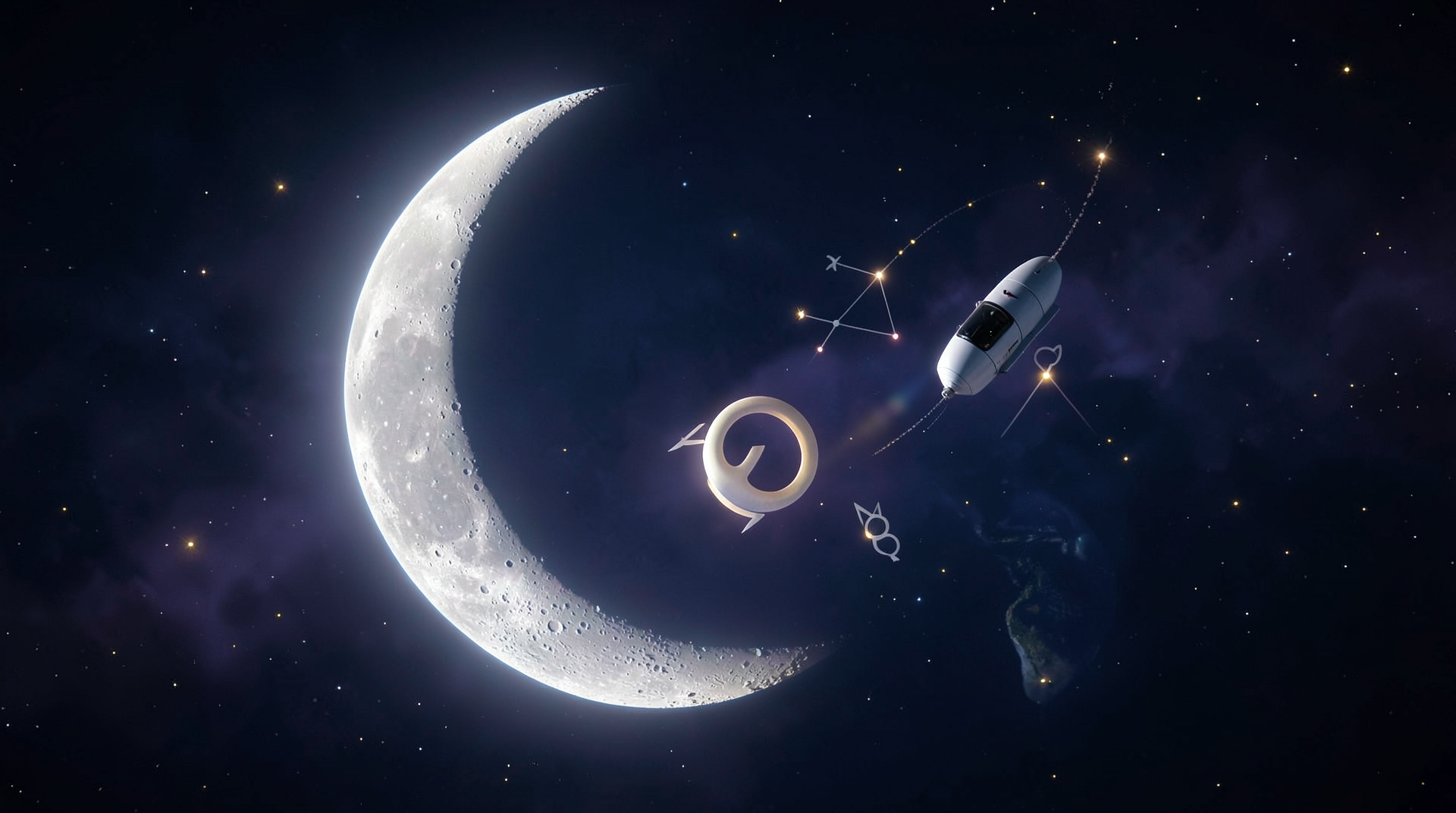
The Moon Gazes Back: Artemis 2's High-Resolution Lunar Images and the Astrology of the Ultimate Homecoming
Humanity has just received a gift from the void. NASA's Artemis 2 crew capsule, hurtling back toward Earth after its historic lunar flyby, transmitted a trove of high-resolution images of the Moon's surface — images so sharp and intimate they feel less like data and more like the Moon finally turning to look at us. For the first time since Apollo, a crew-capable spacecraft has captured the lunar surface from close range, and the photographs are nothing short of staggering.
But beneath the celebration of engineering prowess and scientific achievement, there is something stranger unfolding. The sky under which these images arrived — July 12, 2026 — is not just any sky. It is a sky humming with threshold energy, with returns and reckonings, with a Balsamic Moon and a Mercury retrograde in the sign ruled by the Moon itself. The astrology of this moment is almost too poetic to believe.
The Mission: What Artemis 2 Captured
Artemis 2 is the first crewed mission of the Artemis program — NASA's ambitious return to the Moon, named for the Greek goddess who is twin sister to Apollo. While Artemis 1 (2022) was an uncrewed test flight, Artemis 2 carried astronauts around the far side of the Moon and back, proving that the Orion capsule and its life-support systems are ready for the eventual lunar landing of Artemis 3.
As the capsule swung around the Moon's far side and began its long fall back toward Earth, its onboard imaging systems captured the lunar surface in extraordinary detail: craters razor-sharp against the black, ancient lava plains rendered in crisp monochrome, the delicate wrinkles of lunar geology laid bare at resolutions that make Apollo-era photographs look like impressionist paintings. These are not merely pictures. They are a new way of seeing our closest celestial neighbor.
The images were downlinked as the capsule crossed the halfway point of its return journey — a moment of profound symbolic resonance: the Moon, seen clearly, as the vessel carrying human eyes begins its homeward arc.
The Astrology of the Return: A Sky of Thresholds
Cancer Season: The Sign of the Moon
The Sun on July 12, 2026 sits at 20° Cancer. Cancer is the only zodiac sign ruled by the Moon. Let that sink in: during the sign of the Moon, we receive the most detailed images of the Moon ever captured by a crew-capable spacecraft. In astrological terms, this is the ruler seeing itself — the mother turning her gaze inward. Cancer is the sign of home, of origin, of the maternal, of the deep past. The Moon has always been our cosmic mother: pulling the tides, influencing the rhythms of life, watching over us in silence. Now, during her own season, she shows us her face in unprecedented detail.
But here is where it gets truly remarkable: Mercury, the planet of images, communication, and data, is retrograde at 20° Cancer — the exact same degree as the Sun. This is a Mercury cazimi that occurred just days earlier, and the messenger planet is still swimming in the heart of the Sun. Mercury retrograde in Cancer means images that return. Data that revisits. A conversation with the past that isn't quite finished. The photographs from Artemis 2 are not merely new — they are a return, a homecoming of the gaze. We looked at the Moon with Apollo. Now, under Mercury retrograde, the Moon looks back.
The Waning Crescent Moon: Endings Before Beginnings
The lunar phase at the moment these images arrived is the Waning Crescent — the Balsamic Moon — the final, thinnest sliver before the New Moon. In astrological tradition, the Balsamic phase is the time of release, of completion, of letting the old cycle die so the new one can be born. It is the darkest hour before dawn.
That these images arrive under a Balsamic Moon is deeply symbolic. The Apollo era ended. Its images, however iconic, belong to a finished cycle. Artemis 2's photographs arrive at the exact astrological moment when the old lunar cycle is breathing its last. They are not a continuation of Apollo. They are the seed-image of something else entirely — something whose shape we cannot yet fully grasp. The New Moon in Cancer arrives on July 14, and with it, a fresh cycle begins. These images are the last gift of the dying moon.
Gemini Stellium in the 9th House: Technology, Travel, and Sudden Revelation
The chart for the moment of image transmission (calculated for Cape Canaveral at noon on July 12) reveals a remarkable concentration of energy in Gemini, clustered in the 9th House of exploration, long-distance travel, and higher knowledge. The Moon herself is at 25° Gemini, flanked by Mars at 9° Gemini and Uranus at 4° Gemini — a Mars-Uranus conjunction that has been electrifying the collective for days.
Gemini rules images, data, communication, and technology. The 9th House rules voyages — physical and intellectual. Mars provides the propulsion, the drive, the machinery. Uranus provides the sudden breakthrough, the electric clarity, the high-resolution shock of the new. Together, they describe precisely what Artemis 2 has delivered: a technological lightning bolt from a great distance, images that crackle with Uranian brilliance.
The Midheaven — the point of public visibility and achievement — sits at 29° Gemini, the anaretic degree, the final degree of the sign. This is the "critical degree" in astrology: a point of maximum intensity, a threshold where one sign's energy reaches its peak before tipping into the next. Artemis 2's achievement is not routine. It is a culmination, a peak, a moment poised on the knife-edge between what was and what will be.
Saturn in Aries and Neptune in Aries: The Hard Work of the Dream
Sitting together in the 7th House of partnership and public engagement, Saturn at 14° Aries and Neptune retrograde at 4° Aries tell the story of a dream (Neptune) that has been made real through discipline and structure (Saturn). Aries is the sign of the pioneer, the initiator, the first to go where no one has gone. The Artemis program is exactly that: a pioneering return, a new kind of lunar exploration.
But Saturn in Aries also squares the Sun in Cancer. This is a tense aspect — a cardinal square between the drive to push forward (Aries) and the need to protect and nurture (Cancer). It speaks to the inherent tension in space exploration: the ambition to go farther versus the pull of home and safety. The images from Artemis 2 are triumphant, but they carry within them the memory of risk. Spaceflight is never safe. Saturn in Aries reminds us that every image transmitted is hard-won, that the capsule's return is never guaranteed until the parachutes deploy.
Neptune retrograde in Aries adds a layer of necessary disillusionment. The dream of space exploration is beautiful, but Neptune retrograde strips away the fantasy. What remains after Neptune's fog clears is the reality: the engineering, the funding, the political will, the human cost. Artemis 2's images are stunning, but they arrive in a moment when Neptune asks us to see clearly — to appreciate the achievement without lapsing into myth-making.
Artemis and Apollo: The Twin Archetypes
The name "Artemis" was chosen deliberately. In Greek mythology, Artemis is the goddess of the Moon, the hunt, and the wilderness — and she is the twin sister of Apollo, god of the Sun. The Apollo program landed men on the Moon; the Artemis program will land the first woman and the first person of color. The twin symbolism is rich: where Apollo was solar — masculine, radiant, declarative — Artemis is lunar — receptive, mysterious, cyclical.
In the July 12 chart, the interplay of Sun (Apollo) and Moon (Artemis) is front and center. The Sun in Cancer is ruled by the Moon. The Moon in Gemini is illuminated by the Sun. They are in mutual reception by rulership — the Sun governed by the Moon's sign, the Moon governed by Mercury, who sits cazimi with the Sun. It is a closed loop of light and reflection, a perfect astrological mandala for the moment when the Moon's images return to Earth.
Downsides, Cautions, and the Shadow Side
For all its poetry, this astrological moment is not without its challenges. Several aspects warrant caution:
Mercury Retrograde: Data, Delays, and Deception
Mercury retrograde in Cancer is notorious for stirring up emotional miscommunication, technical glitches, and the return of unfinished business. High-resolution images require flawless data transmission — and Mercury retrograde is the patron of corrupted files, dropped connections, and "we'll have to resend that." NASA's engineers are among the best in the world, but even they are not immune to the trickster energy of a retrograde Mercury sitting exactly on the Sun. Some images may arrive incomplete. Some may require reprocessing. The full dataset may take longer to assemble than anticipated.
More subtly, Mercury retrograde invites us to question what we are seeing. Images can be misinterpreted. The clarity of high resolution can create an illusion of complete understanding — as if seeing the Moon in finer detail means we truly know it. Mercury retrograde in Cancer, the sign of memory and emotion, whispers: the Moon holds more than your cameras can capture.
The Anaretic Degrees: Threshold Anxiety
With both the Ascendant (29° Virgo) and Midheaven (29° Gemini) at anaretic degrees, the chart of this moment hums with threshold anxiety. The anaretic degree is where a sign's energy reaches maximum intensity — and maximum instability. This is not a comfortable place. It suggests that Artemis 2's achievement, however magnificent, arrives at a moment of collective unease. We stand at the edge of something, and the ground beneath us is not entirely solid.
Saturn Square Sun: The Weight of the Return
The cardinal square between Saturn in Aries and the Sun in Cancer is a cautionary aspect. The capsule must still complete its return journey. Saturn demands respect for gravity, for physics, for the unforgiving nature of re-entry. The celebration of these images should be tempered with the awareness that the mission is not over until the astronauts are safely on the ground. In mundane astrology, Saturn-Sun squares often coincide with moments where harsh reality intrudes on optimism. The images are a triumph — but the work is not finished.
Pluto Retrograde in Aquarius: The Hidden Cost
Pluto sits retrograde at 4° Aquarius in the 5th House of creativity and public spectacle. Pluto in Aquarius speaks to the technological power that makes Artemis 2 possible — but retrograde, it also points to the hidden costs: the resources consumed, the environmental impact of launches, the geopolitical tensions that often lurk behind space exploration's unifying rhetoric. Pluto retrograde asks: who benefits from these images, and who pays for them?
A Responsible Word: Astrology as Lens, Not Oracle
Before we proceed further, an important note: astrology offers a symbolic lens through which to contemplate events — it is not a predictive science. The correlations described here between planetary positions and the Artemis 2 image transmission are interpretive, not causal. The images are real because engineers, scientists, and astronauts made them real through years of extraordinary work. Astrology simply helps us ask richer questions about what they mean.
Nothing in this article should be taken as a prediction of mission outcomes. Spaceflight is inherently risky, and any decisions about launch, trajectory, or mission parameters are made by qualified professionals using rigorous engineering analysis — not horoscopes. Astrology can deepen our appreciation of a moment; it cannot and should not replace technical judgment.
The Lunar Gaze: What These Images Mean for the Collective
Why do we photograph the Moon? Why, after all these centuries of gazing upward, do we still hunger for sharper images, closer views, more intimate detail?
In astrological terms, the Moon represents the collective emotional body — the unconscious, the instinctual, the deep tides of feeling that move through all of us. To photograph the Moon in high resolution is, symbolically, to bring the unconscious into sharper focus. It is an act of collective self-examination. Under a Balsamic Moon and Mercury retrograde in Cancer, these images are an invitation: look at what you have been. Look at where you come from. Before the new cycle begins, understand the old one.
The Moon has no light of its own — it only reflects. And yet, in reflecting the Sun's light, it shapes the rhythms of life on Earth. Artemis 2's images are, in their own way, reflections: of our technological prowess, our longing to explore, our need to understand our place in the cosmos. They show us the Moon, yes — but they also show us ourselves.
Looking Ahead: The New Moon and What Comes Next
The Cancer New Moon arrives on July 14, 2026 — just two days after these images return. It is a portal, a fresh start, a moment when the lunar cycle renews itself. The Balsamic Moon under which Artemis 2's photographs arrived will have passed. The seeds planted in this darkness will begin to sprout.
Astrologically, this suggests that the full significance of these images will not be immediately apparent. The Balsamic phase conceals as much as it reveals. It is only as the new lunar cycle unfolds — as the Moon waxes toward fullness — that we will begin to understand what Artemis 2 has truly shown us. Patience is required. Mercury retrograde in Cancer insists that meaning takes time to surface.
The Saturn-Neptune conjunction in Aries, still building toward its exact alignment later this year, hovers over all of this like a question mark. What is the dream (Neptune) and what is the structure (Saturn)? Are we building something that will last, or chasing a mirage? Artemis 2's images are part of this larger astrological story: the tension between vision and reality, between the pioneer's impulse and the weight of responsibility.
Conclusion: The Moon Turns Her Face
For most of human history, the Moon has been a one-way mirror. We looked at her; she did not look back. She received our myths, our calendars, our poems, our rockets — and remained silent, inscrutable, her far side forever hidden.
Artemis 2's high-resolution images change something fundamental. Under a Balsamic Moon, under Mercury retrograde, under the sign ruled by the Moon herself, the Moon has — in a sense — turned to face us. The gaze is now mutual. We have seen her more clearly than ever before, and in that seeing, we are also seen.
The astrological moment surrounding these images is dense with meaning: endings and beginnings braided together, technology and emotion intertwined, the pioneer's drive checked by Saturnian gravity. It is a threshold, not a destination. The images are breathtaking — but they are also an opening, a question, an invitation to go deeper.
The New Moon in Cancer is coming. What we do with these images — what they ask of us — is only beginning to emerge from the dark.
Disclaimer: This article explores astrological symbolism in relation to a current event. Astrology is a contemplative tradition, not a scientific discipline. The correlations discussed here are interpretive and should not be understood as predictions or as commentary on NASA's engineering, safety protocols, or mission planning. Artemis 2 is a feat of human ingenuity, skill, and courage — astrology simply offers one more way to appreciate its significance.
Related Articles
First Quarter Moon in Capricorn (Oct 18): The Week's "Commit or Release" Moment
October 14, 2026
The First Quarter Moon in Capricorn (Oct 18, 2026, 16:10 UTC) squares the Libra Sun — a cosmic checkpoint asking you to commit or release. Plus Venus retrograde cautions, Pluto's station, and a do/don't guide for the week.
Venus Retrograde in Scorpio Squares Pluto All Week: The Love-and-Power Test Peaking Around Oct 20
October 13, 2026
Retrograde Venus in Scorpio squares Pluto all week, exact around Oct 19–20 as Pluto stations direct. How to survive the love-and-power test — what to avoid, who feels it, and how to pass it.
Scorpio to Capricorn by Way of Sagittarius: Your Day-by-Day Lunar Weather for Oct 12–18
October 12, 2026
The Moon travels from Scorpio through Sagittarius into Capricorn Oct 12–18, 2026. Your day-by-day lunar weather, key aspects, and caution zones — including the First Quarter Moon on Oct 18 and Pluto's direct station.
The Fixed-Sign Fortress: Leo Mars–Jupiter, Scorpio Venus–Mercury and Why This Week Has No Quick Fixes
October 8, 2026
Why the fixed-sign fortress of Leo Mars–Jupiter and Scorpio Venus–Mercury makes October 8–11, 2026 a week with no quick fixes — and how to work with the sky instead of against it.