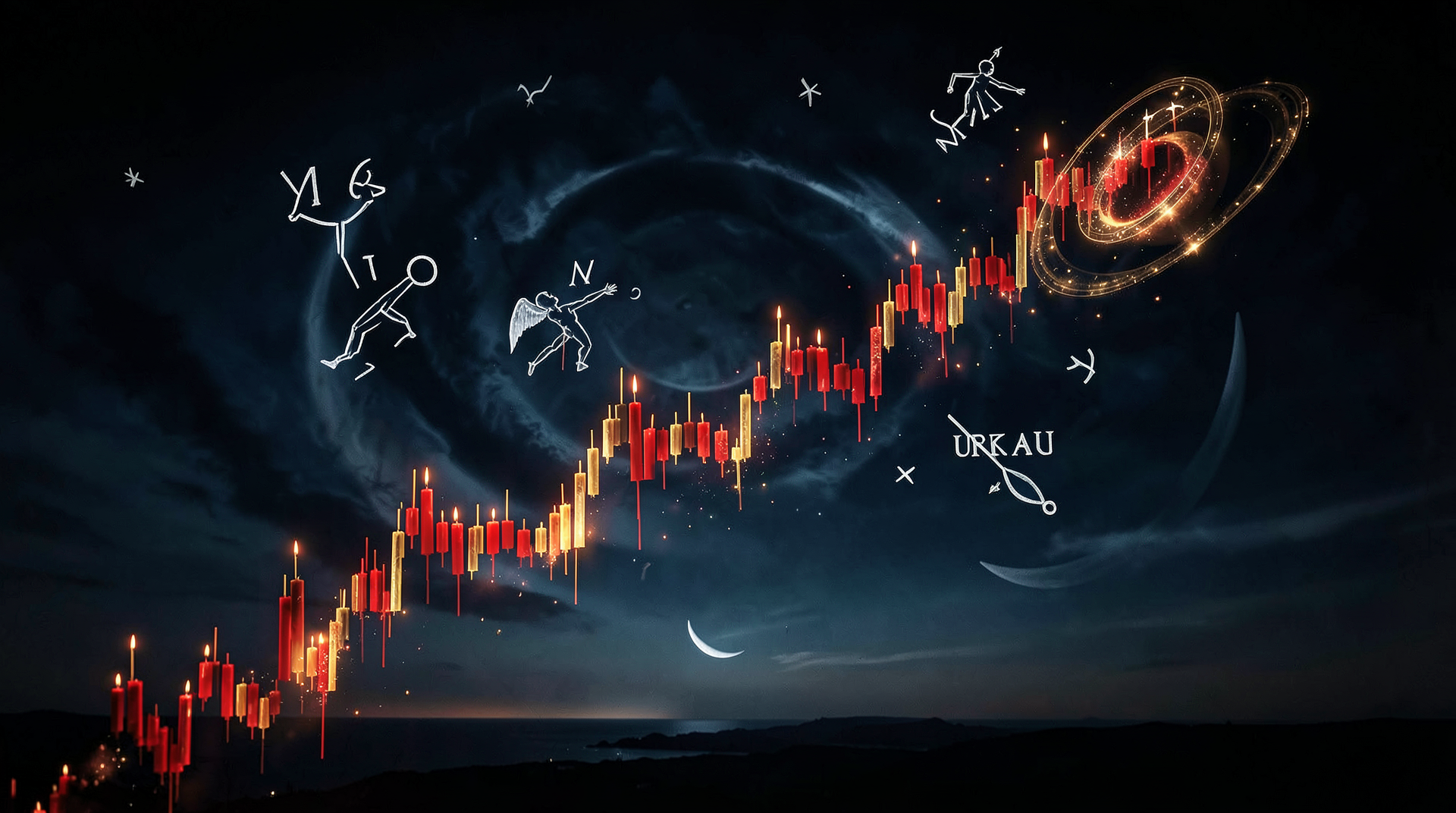
The Red Candles: U.S. Markets Sell Off as the Nasdaq Slides 2.21% — Volatility Under Mars, Uranus, and a Waning Crescent Moon
It started with the growth names. One by one the big technology stocks flickered, then tumbled, and before the closing bell the Nasdaq Composite had dropped a sharp 2.21% — leading the broader U.S. indices lower on a day that investors will remember as a sudden, anxious turn in the tape.
The S&P 500 and the Dow followed in the Nasdaq's wake, pulled down by the magnetic weight of the market's most heavily traded, highest-momentum names. What looked like a routine summer session turned into a genuine selloff, the kind that makes traders refresh their screens and reconsider what they thought they knew about the August grind.
For those who follow the skies as well as the ticker, the timing is telling. This kind of sharp, sentiment-driven, headline-fueled downdraft doesn't happen in an astrological vacuum. The August 2026 sky is carrying some of the year's most volatile fingerprints — and they were written all over the close.
What Happened on the Day
- Nasdaq Composite: ▼ 2.21% — the day's clear loser, leading all major indices.
- S&P 500: closed lower as the technology heavyweights dragged the broad market.
- Dow Jones Industrial Average: followed suit, though with comparatively lighter losses.
The selling was concentrated in the growth and technology complex — the high-multiple, high-beta names that are most sensitive to shifts in sentiment, liquidity, and the cost of money. When the "story stocks" of the moment stumble, the whole market feels the vibration.
The Sky at the Closing Bell (New York, Aug 8, 2026)
Astrologers reading the moment of the session's close find a chart pulsing with fast, restless, and unstable energy:
| Planet | Sign | Degree | House | Retrograde? |
|---|---|---|---|---|
| ☉ Sun | Leo | 16° | 8th | — |
| ☽ Moon | Gemini | 23° | 7th | — |
| ☿ Mercury | Cancer | 29° | 8th | — |
| ♀ Venus | Libra | 2° | 9th | — |
| ♂ Mars | Gemini | 28° | 7th | — |
| ♃ Jupiter | Leo | 9° | 8th | — |
| ♄ Saturn | Aries | 15° | 4th | ✔ retrograde |
| ♅ Uranus | Gemini | 5° | 6th | — |
| ♆ Neptune | Aries | 4° | 4th | ✔ retrograde |
| ♇ Pluto | Aquarius | 4° | 2nd | ✔ retrograde |
Three interlocking stories stand out.
1. Mars and Uranus in Gemini: The News-Driven Switchback
This is the loudest signature in the chart. Mars sits at a scorching 28° Gemini — the final, most urgent degrees of the sign — while Uranus, the planet of sudden change and surprise, holds court nearby in the same volatile air sign. When Mars and Uranus move through Gemini together, the prevailing mood is jumpy, restless, electric, and easily rattled by headlines.
Gemini is fundamentally a sign of information — news, chatter, narratives, communication. In market terms, this is a sky that prices in rumor and reaction faster than reason. A sharp, headline-driven Nasdaq pullback is almost a textbook Mars–Uranus-in-Gemini event: quick-witted, twitchy, and prone to overcorrection in both directions. Traders act first and rationalize later.
The placement deepens the story. Mars at the anaretic (29th-degree) zone of Gemini carries an energy of pressure, urgency, and the sense that something must give. When a chart visitor sits at the edge of a sign, the feeling is one of a countdown — and markets are rarely calm during countdowns.
2. The Waning Crescent Moon: Contraction and Trimming
The Moon at market close was a waning crescent in Gemini, having recently slipped past the Last Quarter and heading toward the next New Moon in Leo. The waning phase is the lunar economy of letting go — trimming, shedding, and pulling back.
In financial astrology, a waning Moon is a traditional color for consolidation and contraction rather than expansion. Traders in a waning period often find themselves liquidating positions, tightening risk, and stepping back from the aggressive buying that defined the bullish Sun–Jupiter window earlier in the month. This is the Moon whispering less, not more.
3. Pluto, Saturn, and the 2nd/4th-House Foundation
Two slow, retrograde giants were hammering on structural themes. Pluto — retrograde — sat in Aquarius in the 2nd house, the house of money, value, and material security. Pluto retrograde on the money axis tends to expose the hidden plumbing of finance: leverage, debt, margin, and the uncomfortable question of what assets are really worth when narratives crack.
Meanwhile retrograde Saturn in Aries anchored the 4th house — the house of foundations, institutions, and the "home base." Saturn retrograde is not a catastrophic trigger, but it is a stern exam. When Saturn tests the foundations, confidence wobbles; structures that were overextended in a sunny phase get re-measured and found wanting. That deep, below-the-surface anxiety is exactly the kind of undercurrent that turns a mild afternoon dip into a full-fledged risk-off day.
The Sun–Jupiter 8th-House Crosscurrent
One nuance keeps the picture from being uniformly dire: the Sun and Jupiter were both in Leo in the 8th house — the sector of other people's money, leverage, credit, and shared resources. A Sun–Jupiter conjunction is fundamentally an expansive, confident signature. It is the astrological fuel behind liquidity, credit, and animal spirits.
But expansion and contraction are not enemies so much as dance partners. When confidence (Sun–Jupiter) meets volatility (Mars–Uranus) and structural doubt (Saturn–Pluto retrograde), the result is a churn: a market that still believes in the long arc of growth but is being forced to pay for the leverage that growth rests on. That is precisely the uncomfortable tension of an 8th-house Sun–Jupiter against a 2nd-house Pluto.
What to Watch (and the Cautions)
A responsible reading of this chart is not a prediction — it is an inventory of tendencies. Here is what the sky is asking investors to stay honest about in the coming sessions:
- Volatility is likely to persist, not vanish. With Mars pressing through the final degrees of Gemini toward a meeting with Uranus, expect choppy, news-driven tape rather than calm, orderly direction. Do not mistake a sharp single day for the end of the instability.
- Headlines will move the market. In a Mars–Uranus-in-Gemini climate, a single statement, a whispered rumor, or a surprising data print can swing the indices. Information quality matters more than ever — verify before you act.
- Leverage is the weak point. Pluto retrograde on the 2nd/8th house axis is a warning about over-extension of credit and margin. The biggest single-day losses in painful selloffs tend to cluster in the most leveraged, most speculative corners of the growth complex.
- Foundations are being tested, not destroyed. Saturn retrograde rarely annihilates; it reexamines. This is a period for shoring up balance sheets, stress-testing assumptions, and favoring quality over hype — not for reflexive panic-selling.
A Caution on Retrograde Weather
Three outer planets — Saturn, Neptune, and Pluto — are currently retrograde, and the Moon is waning. This is a reconsider, revise, and reduce season for finance, not a launch new speculative bets one. The temptation during a scary day is to make sudden, reactive decisions; astrologically, this is precisely the moment to slow down, sit with uncertainty, and avoid dramatic portfolio surgery made in a panic.
And a responsible disclaimer: astrology is a symbolic lens for understanding collective moods and timing — it is not a technical forecasting tool and should never be the sole basis for financial decisions. Markets are moved by real economic data, earnings, policy, and geopolitical events. Use the stars as context and emotional weather, but always pair them with sound financial advice, diversification, and your own risk tolerance. When the sky is volatile, even seasoned traders counsel patience.
Conclusion: Red Candles, Clear-Headed Eyes
The Nasdaq's sharp 2.21% slide was a reminder that even in a bullish expansion, risk never fully sleeps. The astrology of the session — a twitchy Mars and Uranus in Gemini, a contracting waning Moon, and two heavy retrogrades testing the money and foundation houses — paints a picture of a market that is jittery, headline-sensitive, and in need of re-grounding.
The red candles are not, in themselves, an omen of collapse. They are a signal to slow down: to respect volatility while it is high, to question leverage while Pluto audits the balance sheet, and to remember that the waning Moon always yields to a new one. The sky is asking investors to be disciplined, patient, and honest about what they actually own.
In volatile weather, the strongest position is often a clear head.
Related Articles

When the Forest Gets a Day in Court: The Amazon Declared a Legal Person Under a Sky of Scales
September 22, 2026
Brazil's Supreme Court grants the Amazon legal personhood on the Libra equinox. An astrological reading of the ruling chart, the Virgo–Libra threshold, and the long work of making nature's standing real.

Harvest Moon at the Ram's Gate: The Sept 26 Full Moon in Aries Meets Neptune
September 22, 2026
The Harvest Moon rises at the Ram's Gate on Sept 26, 2026: a Full Moon in Aries conjunct Neptune for the first time in ~165 years. What to expect, who feels it most, and where to stay cautious.
Mars' Last Week in Cancer: Close the Books on the Emotional & Money Ledger Before Leo (Ingress ~Oct 1)
September 21, 2026
Mars spends its final days in Cancer before entering Leo around Sept 27–Oct 1, 2026. Here's how to close your emotional and financial ledger cleanly — and what the Lion's gate brings next.
The Star That Broke Ranks: France's Sanctions Standoff and the Astrology of a Fractured Europe
September 21, 2026
France is blocking the EU's renewal of Russia sanctions over the de-listing of one oligarch. We explore the astrology of the standoff — Saturn on the EU's Sun, Uranus on France's horizon, a hidden Venus in Scorpio — and what the Aries Full Moon may bring.