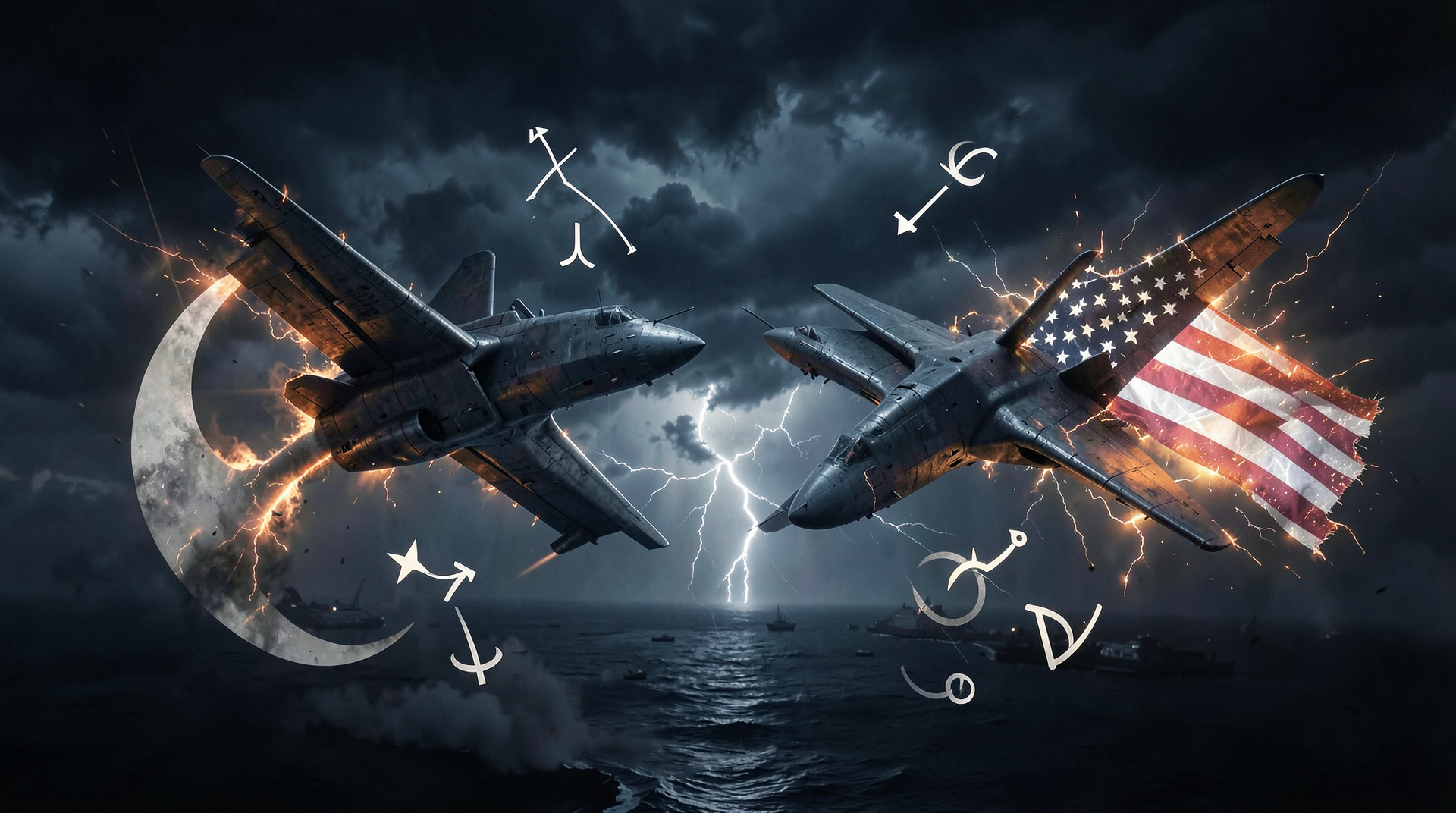
The Escalation Spiral: U.S. Strikes on Iran, Regional Retaliation, and the Astrology of a Conflict That Keeps Growing
The headlines on August 5, 2026 read like a checklist of a war nobody wanted to stop. American forces launched strikes against targets inside Iran. Within hours, Iranian retaliation answered — not on U.S. soil, but against two of Washington's most strategic regional hosts: American bases in Bahrain and Kuwait. And with each bulletin, the casualty figures climbed, revised upward across a series of official and unofficial updates.
For the steady reader of the skies, the pattern is painfully familiar. This is the same friction-lit corridor that has been simmering since the Strait of Hormuz confrontations of July: the autonomous-drone strikes on the Iranian Navy, the gas-price chokehold, the slow gravitational slide toward open exchange. But the strikes of early August mark a threshold — the moment a localized standoff became a region-scorching exchange with consequences for a dozen countries at once.
Let's read the chart for the moment, with honestly about both what it reveals and what it cannot tell us.
What Happened: A Timeline of the Escalation
- U.S. strikes on Iran. American aircraft and missile assets hit targets across Iranian territory in what officials described as a response to weeks of attacks on shipping and allied forces in the Gulf.
- Rapid Iranian retaliation. Within hours, projectiles were directed at U.S. military installations in Bahrain (home to the U.S. Navy's Fifth Fleet in Manama) and Kuwait (a key logistics and air hub in the Persian Gulf).
- Rising casualty reports. Multiple updates raised, then re-raised, the number of dead and wounded on both sides — a grim reminder that in the fog of war, the first tally is rarely the last.
- Regional fallout. Neighboring states, energy markets, and global air traffic all braced as the exchanges threatened to pull in additional players.
The word that kept appearing across the bulletins was retaliation — a word that belongs, astrologically speaking, to the very planets currently standing in the most aggressive houses of the region's chart.
The Chart for August 5, 2026: Mars and Uranus Lurk in the Eighth House
When we cast the sky over Tehran at noon on August 5, 2026, the picture is unambiguous about tension — and about the kind of tension this is.
Mars in Gemini still occupies the eighth house. Mars is the planet of action, force, and weaponry; the eighth house rules death, other people's resources, hidden wealth, and crisis. Gemini's signature is rapid, spreading motion — messages, drones, missiles crossing borders. Put them together and you get exactly what the news reports: fast-moving, distributed, covert and semi-covert strikes aimed at both lives and economic infrastructure.
Uranus in Gemini joins Mars in the eighth house. Uranus is the disruptor, the lightning that shatters the status quo. Its presence here is the astrological fingerprint of the surprise, the shock, and the unpredictable counter-escalation that follows any move in this conflict. Uranus rarely escalates neatly — it escalates chaotically, which is precisely why casualty tallies keep rising in erratic jumps rather than settling.
The Moon, at last quarter phase in Taurus, sits in the sixth house of daily labor, military service, and health. A Last Quarter Moon is a crisis-and-corrective moment: something must be released, a decision forced. Here, it squares against a backdrop of routine warfare becoming increasingly unordinary. The bullish, earthy Taurus Moon also ties the violence to resources — food, fuel, supply lines — the very things ordinary people feel first.
Saturn's "Frozen Gavel" Presses on Iran's Sun
The signature theme running through all of August's mundane-astrology coverage has been Saturn retrograde in Aries — the famous "frozen gavel" that refuses to swing decisively, locking countries into grinding stalemates rather than clean resolutions.
Cast that retrograde Saturn against the birth chart of the Islamic Republic (established April 1, 1979), and the pressure becomes specific: transiting Saturn is applying to a conjunction with Iran's natal Sun in Aries. This is a heavy transit — the archetype of a nation's leadership and founding identity coming under crushing weight, scrutiny, and consequence. It is not a transit that promises victory; it is a transit that promises accountability, often slow, harsh, and unwanted.
Meanwhile, transiting Uranus conjoins Iran's natal Moon in Gemini — a sudden, unsettling disturbance to the emotional life of the people and the national mood. It is the signature of a society rattled, surprised, and emotionally polarized. Combined with the Moon's own fixed-Taurus insistence on security, you get a nation both frightened and stubborn.
And Pluto, retrograde in Aquarius, falls in Iran's seventh house — the house of enemies, contracts, and the "other." Pluto here signals a profound, irreversible transformation in the relationship between Iran and its adversaries. Whatever the outcome of these strikes, the entanglement itself is being permanently rewired.
What This Means — and What It Doesn't
Let us be clear about the limits of astrology here. The stars do not predict body counts, timetables, or the next missile's target. Mundane astrology is a symbolic reading of tendencies, pressures, and collective mood — a map of when tensions peak and what themes dominate, not a replacement for sober journalism, diplomacy, or intelligence.
That said, the current sky gives us a useful lexicon for the present moment:
- Escalation is structurally encouraged, not dampened. Mars and Uranus in the eighth house reward bold, surprising military action far more than restraint. Peacemaking is not the easy path under this sky.
- Stalemate is likely in the background. Saturn retrograde rarely delivers quick, clean endings. Expect a long, grinding phase rather than a sudden resolution — and expect "victory" narratives on all sides to outlast the reality they describe.
- Economic pain is part of the story. The Taurus Moon and the eighth-house concentration both point to resources: energy prices, supply chains, and the cost at the pump. Markets may behave more erratically than rationally.
Caution: Why This Sky Favors Restraint — Not Recklessness
If there is a responsible note to strike, it is this: a Mars-Uranus eighth-house sky is a wonderful excuse for adrenaline and retaliation, and a terrible advisor for long-term strategy. These are not the transits under which anyone "wins"; they are the transits under which everyone pays.
For the collective — and for all of us watching from our living rooms — the wise response is caution, not certainty:
- Don't anchor your expectations to a single update. Casualty reports will keep rising and changing. Treat every number as provisional.
- Be wary of escalation logic. In an eighth-house Mars-Uranus window, every "proportionate response" invites a larger one. This is when conflicts become self-perpetuating.
- Grieve, don't gloat. Whatever one's politics, these strikes and retaliation cost human lives on multiple sides. The eighth house is also the house of shared loss.
On a strictly horoscopic level, if this were a personal chart we would advise: do not make major irreversible decisions this week; expect the unexpected; protect your resources; and do not escalate a disagreement. The same wisdom scales up.
The Road Ahead: A Last Quarter Moon Before a Leo New Moon
Astrologically, August 5 falls in the contracting, corrective tail of the lunar cycle. On August 6, a Last Quarter Moon in Taurus formalizes the release-and-let-go energy; by mid-August, a Leo New Moon will begin a fresh, fiery cycle over the region. Historically, these turning points rarely mean "peace." They mean a shift in phase — a change in the terms of the conflict, the lead actors, or the arena in which it plays out.
With Mercury in Cancer (emotional, home-and-nation-talk) and Venus in Virgo approaching an anaretic degree (fear of a final, unresolved boundary), diplomacy is present but brittle. A great deal depends on whether the loudest voices — in Tehran, Washington, Manama, and Kuwait City — choose the frozen stalemate of Saturn or the lightning of an eighth-house Uranus.
A Final Word of Caution
Astrology can illuminate the mood of a moment, but it cannot tell us the future with certainty, and it must never be used to rationalize violence, dehumanize an enemy, or dismiss the suffering of real people. On every side of this conflict there are casualties, families, and futures. Approach these charts with humility — and with the hope that whatever this turbulent sky brings, it moves, however slowly, toward at least the possibility of a livable calm.
The stars did not order these strikes, and they will not resolve them. People will. May the people who hold that responsibility read this season's sky with wisdom rather than adrenaline.
This article is for educational and reflective purposes. It is not a replacement for verified news reporting, official guidance, or professional advice. Astrology is interpretive guidance, not prediction — and never a justification for harm.
Related Articles
The Ballot and the Battlefield: The Astrology of the Vote Putin Calls a Test of the Ukraine War
September 19, 2026
As Russians vote in an election Putin calls a test of the Ukraine war, we read the sky over Moscow: Virgo's final degrees, Mercury in Libra on the leader's Sun, and Saturn & Neptune retrograde in Aries.
The Scales and the Summit: Trump–Xi, Tariffs, and the $30 Billion Question Under a Libra Sky
September 19, 2026
Expectations rise for a Trump–Xi summit on tariffs and a possible $30B deal. We read the September 2026 sky — Libra equinox, Aries Full Moon, six retrogrades — for the astrology of the trade truce and AI cooperation.
Six Planets in Reverse: A Beginner's Map to the Retrograde Sky of 2026-W38
September 18, 2026
A beginner-friendly map of the September 2026 retrograde sky: Satun, Uranus, Neptune, Pluto, Chiron and the North Node in reverse during 2026-W38 — what each one means, when they turn direct, and how to work with the week.

Monday's Moon–Venus Conjunction in Scorpio: The Emotional Tone-Setter for the Whole Week
September 17, 2026
On Monday Sept 14, 2026, the Moon met Venus at 2° Scorpio — and quietly set the week's emotional weather. Here's the day-by-day map of that intensity, plus the cautions.