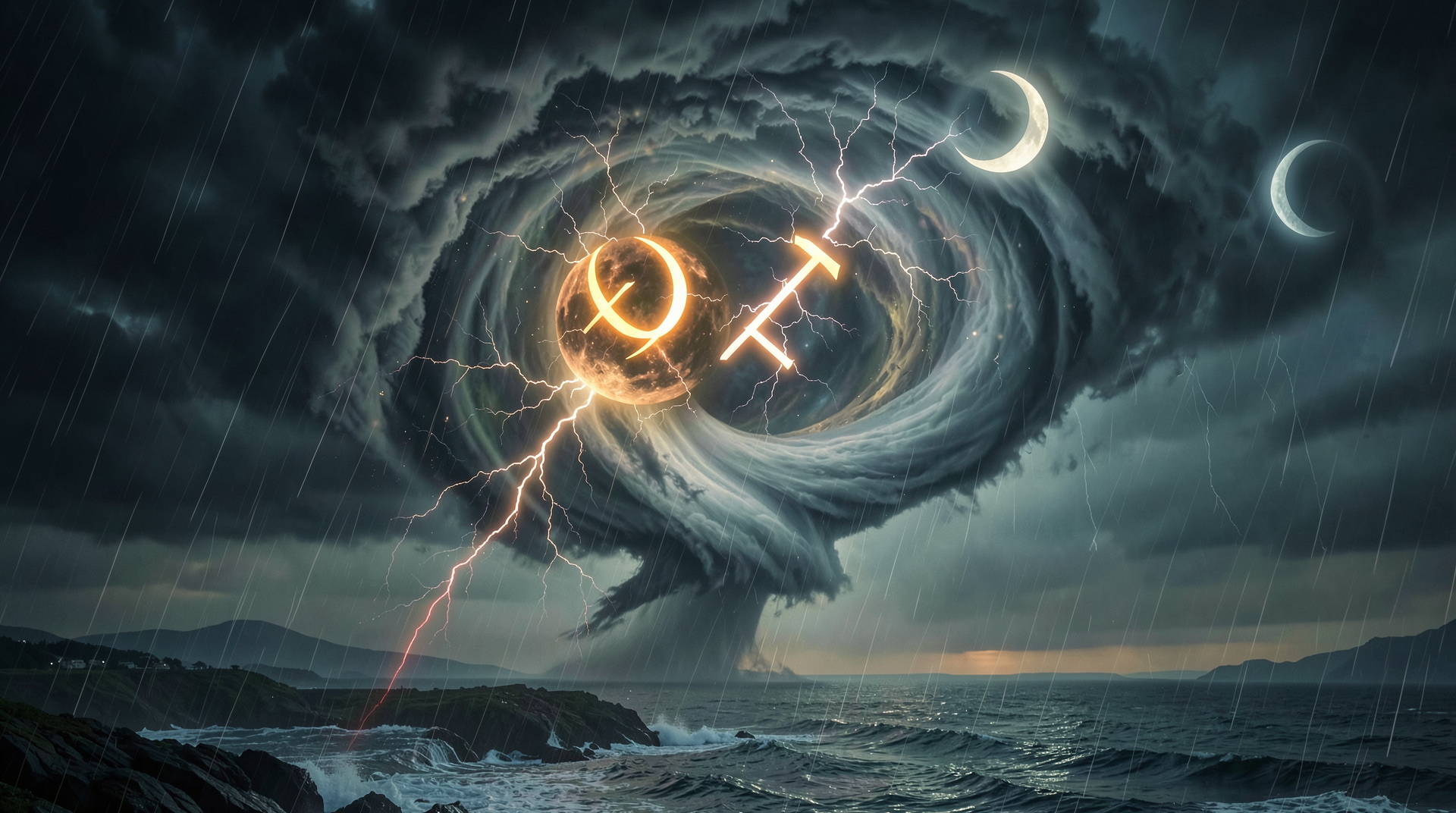
When the Storm Comes Twice
Just days after a deadly tornado tore through Wuhan under a volatile Mars–Uranus sky, the weather over China and East Asia has turned again — this time from the sea. Typhoon Maysak, moving up the coast and colliding with a battering band of torrential rain, has claimed two lives and left roughly 55,000 people affected across the region. For many, the storm was not a single dramatic moment of wind but a long, grinding siege of water: overflowing rivers, submerged villages, cancelled transport, and roads that vanished under brown floodwater.
Maysak is the second act of an atmospheric drama that has had astrologers paying very close attention. Because while tornadoes are a sudden, violent exclamation point, a landfalling typhoon followed by unrelenting rain is something else entirely — a sustained expression of the same celestial signature that lit up the skies over China's heartland just over a week ago.
The Sky's Signature: Mars Conjunct Uranus in Gemini
The single most telling placement in this week's chart is the Mars–Uranus conjunction in Gemini, sitting squarely in the 8th house of the transit sky over the region. If you want a description of "severe and erratic weather," this pairing is astrologically unmatched.
- Mars is the planet of heat, force, and sudden action.
- Uranus is the planet of rupture, electricity, and the unpredictable — the trickster that turns static systems into chaos.
When the two meet in Gemini, the sign of air, communication, travel, and — critically — the restless wind, the atmosphere itself becomes the battlefield. Gemini is an air sign, and its manic, darting energy maps naturally onto quick-forming storms, gust fronts, and systems that change track at the last minute. A tornado and a typhoon in the same week is exactly the kind of "unexpected volatility" that Mars–Uranus is famous for announcing.
That this conjunction lands in the 8th house — the realm of loss, fears, crisis, and the shared resources of communities — deepens the message: these are not merely disruptive weather events. They carry a shadow of mortality and collective strain, the kind of weather that redistributes what people thought they owned.
The Moon at 0° Taurus: Water Meeting Earth
On August 5, the Moon sits at the very 0th degree of Taurus, the sensitive "new beginning" point of an earth sign, in the 6th house of daily routines, service, and labor. Taurus is fixed earth — stubborn, grounded, and deeply connected to land and agriculture.
The meaning here is almost literal. When the Moon (the water bearer of our moods and the physical tides) squares off against volatile air planets, torrential rain meets immovable ground. Floods happen where water has nowhere to go. Rivers swell, farmland drowns, and the daily machinery of life — commute, work, food supply — grinds to a halt. The 6th house placement points to disruption of the everyday: tens of thousands of ordinary people, their routines, homes, and harvests disrupted at once.
The Moon at 0° also signals the beginning of a new lunar cycle of feeling — a reset that arrives through the medium of water and weather.
Neptune's Fog: Why Forecasts Wobble
Saturn, Uranus, and Neptune have been in the news all season, and this event is no exception. Neptune retrograde in Aries, hovering low in the chart, adds a diffuse, deceptive texture to the entire scene.
Neptune governs fog, confusion, and the dissolving of clear boundaries. Astrologically, it is the planet behind storm tracks that wobble, forecasts that are revised at the last hour, and a general sense that "we can't quite see where this is going." The message for authorities and residents alike is to expect the unexpected — the storm's path and intensity may shift even as warnings are issued.
For an audience reading horoscopes, Neptune's presence is a gentle reminder: don't take any single prediction as certain, whether it's about the weather or your love life. Certainty is exactly what Neptune undermines.
Saturn's Frozen Gavel: The Slow Work of Rebuilding
The other dominant presence is Saturn retrograde in Aries — the "frozen gavel" that has appeared throughout Astraia's coverage of this turbulent summer. In the transit chart, Saturn sits in the 6th house, opposite the nation's natal Saturn, and near the true North Node.
Saturn is the planet of limits, structure, and consequence. Retrograde and slow (essentially stationary for much of the week), it speaks of:
- Delayed or bureaucratic disaster response — coordination that lags behind the water's pace;
- The long, unglamorous aftermath — draining fields, repairing dykes, re-homing the displaced — that makes few headlines but shapes people's lives for months;
- A collective reckoning with infrastructure: the fixed structures we trust (levees, reservoirs, drainage, supply chains) and where they quietly failed.
There is a somber, necessary truth in Saturn: the dramatic storm passes, but the consequences are structural, and they must be repaired with patience and discipline, not adrenaline.
What the Chart Warns About
Astrologers looking beyond the headlines see several cautionary threads woven through this week:
- The Mars–Uranus conjunction is applying through the next several days. This means the peak of volatile air may not yet have fully passed. Further sudden squalls, wind events, and disrupted travel are a real possibility while the two planets remain in tight orb.
- Venus sits at 29° Virgo — the anaretic "degree of fate." Anaretic placements often mark thresholds and endings. Combined with Venus's association with comfort, home, and community, this cautions against assuming "the worst is over" and against rushing back into unsafe zones too early.
- The Last Quarter Moon energy (the Moon is past the Full, moving toward the Last Quarter) favors release and letting go — but in weather terms, it is a time to surrender control to safety protocols rather than to stubbornly insist on normalcy.
Astrology as Guidance, Not Prediction
It's important to be clear about what this kind of reading can and cannot do. Astrology does not predict the weather, and it offers no substitute for official storm warnings, evacuation orders, or meteorological science. Mars–Uranus conjunctions are a recurring symbol of volatility — but symbols illuminate how we experience events, not the timing or location of a specific typhoon.
Treat the sky as a mirror for mood and atmosphere, not as a crystal ball. If you're in an affected region, trust your local authorities and emergency services above any horoscope. And if you're reading from far away, this is an invitation to extend practical compassion: check on loved ones, support relief efforts, and hold space for those whose ordinary lives have been upended by water.
Conclusion: Riding Out the Clouds
Typhoon Maysak's trail of torrential rain across China and East Asia is a reminder of how the same cosmic signature can wear many faces. The tornado in Wuhan was Mars–Uranus at its loudest and most sudden. Maysak is that same volatile pairing drawn out — slower, wider, and soaked through with Neptune's fog and Saturn's grim patience. Two deaths and 55,000 affected lives are not "fate written in the stars"; they are a real, measured human toll.
But if astrology has anything useful to offer in such moments, it is a language for the mood: an acknowledgment that the sky is restless, that structures will be tested, that the work of repair is long, and that the most dependable response to chaos is grounded patience, clear communication, and care for one another. The rain will stop. The rivers will fall. And the rebuilding — like Saturn itself — will take exactly as long as it needs.
This article is offered for educational and reflective purposes. Astrological analysis is interpretive and not a substitute for professional meteorological, medical, or emergency advice. Always follow official guidance from local authorities during severe weather.
Related Articles
The Ballot and the Battlefield: The Astrology of the Vote Putin Calls a Test of the Ukraine War
September 19, 2026
As Russians vote in an election Putin calls a test of the Ukraine war, we read the sky over Moscow: Virgo's final degrees, Mercury in Libra on the leader's Sun, and Saturn & Neptune retrograde in Aries.
The Scales and the Summit: Trump–Xi, Tariffs, and the $30 Billion Question Under a Libra Sky
September 19, 2026
Expectations rise for a Trump–Xi summit on tariffs and a possible $30B deal. We read the September 2026 sky — Libra equinox, Aries Full Moon, six retrogrades — for the astrology of the trade truce and AI cooperation.
Six Planets in Reverse: A Beginner's Map to the Retrograde Sky of 2026-W38
September 18, 2026
A beginner-friendly map of the September 2026 retrograde sky: Satun, Uranus, Neptune, Pluto, Chiron and the North Node in reverse during 2026-W38 — what each one means, when they turn direct, and how to work with the week.
Monday's Moon–Venus Conjunction in Scorpio: The Emotional Tone-Setter for the Whole Week
September 17, 2026
On Monday Sept 14, 2026, the Moon met Venus at 2° Scorpio — and quietly set the week's emotional weather. Here's the day-by-day map of that intensity, plus the cautions.