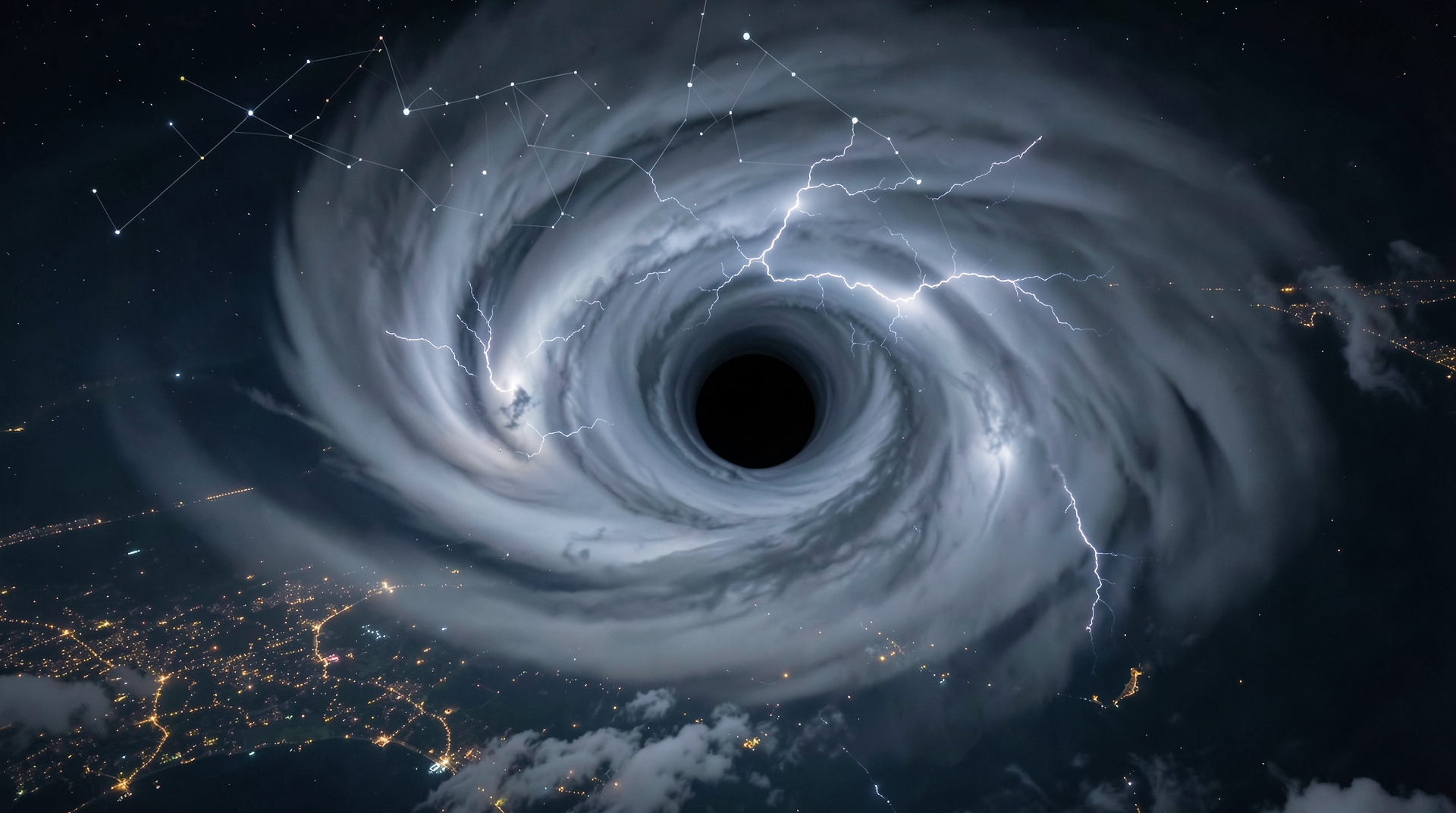
China Evacuates 1.7 Million for Typhoon Bavi: The Astrology of a Megastorm That Shook the East China Sea
The largest mass evacuation of 2020 unfolded under a First Quarter Moon — and the chart reveals why this storm, and the forces behind it, were always going to be exceptional.
In late August 2020, as Typhoon Bavi churned northward through the East China Sea, packing sustained winds of 155 kilometers per hour (96 mph), the Chinese government executed one of the largest emergency evacuations in its recent history: 1.7 million people relocated from coastal provinces. Before making its final landfall in North Korea, Bavi had already carved a path of destruction through Japan's Ryukyu Islands and battered Taiwan with torrential rain and fierce winds, leaving injuries, power outages, and flooded streets in its wake.
But for those who read the sky, the warning signs had been written in the planetary positions for weeks. The astrology of Typhoon Bavi's formation, intensification, and devastating march across the Western Pacific presents a textbook case of how specific planetary configurations manifest as extreme meteorological events — and it offers a sobering lens through which to understand humanity's relationship with nature's most powerful forces.
The Storm's Timeline: A Chronology of Destruction
Typhoon Bavi — known in the Philippines as Typhoon Igme — formed as a tropical depression on August 21, 2020, east of the Philippines. It intensified rapidly, becoming a severe tropical storm by August 22 and a typhoon by August 23 as it approached Taiwan and Japan's southern islands.
- August 23: Bavi's outer bands struck Taiwan, bringing heavy rainfall and strong winds. At least one injury was reported. The storm passed through Japan's Ryukyu Islands, including Okinawa, where it caused power outages and disrupted air and sea travel.
- August 25–26: The typhoon continued strengthening over the warm waters of the East China Sea, reaching peak intensity with winds of 155 km/h. China's National Meteorological Center issued a red alert — the highest warning level.
- August 26–27: China evacuated approximately 1.7 million people from coastal areas in Zhejiang, Fujian, Jiangsu, and Shanghai. Flights were grounded, ferry services suspended, and tens of thousands of ships recalled to port. Emergency shelters were activated across the region.
- August 27: Bavi made landfall in North Korea's North Pyongan Province, causing significant flooding and structural damage, though casualty figures remained limited thanks to the massive evacuations.
The Astrological Signature: Reading the Sky at Landfall
The transit chart cast for August 27, 2020, 8:00 AM in Shanghai — as Bavi bore down on the Chinese coast — reveals an extraordinary concentration of planetary tension that aligns with the scale of this event.
The First Quarter Moon: Crisis in Motion
Typhoon Bavi made its final approach under a First Quarter Moon (🌓) — the lunar phase of crisis, decisive action, and building pressure. The Sun at 4° Virgo formed a tight square to the Moon at 20° Sagittarius, creating the kind of friction that demands movement. In meteorological astrology, First Quarter Moons frequently coincide with storms that reach peak intensity rapidly and force authorities into urgent decision-making.
The Moon in Sagittarius — the sign of international waters, long-distance travel, and the open sea — sat in the 3rd house of communication and local movement. This placement perfectly mirrors the disruption to transport and the frantic relay of emergency information across multiple countries.
Moon Square Neptune at 0.16°: The Fog of Water
This is the chart's standout aspect. The Moon at 20° Sagittarius formed a near-exact square to Neptune at 19° Pisces — an orb of just 0.16 degrees. In astrological terms, this is as tight as a square gets, and it speaks directly to the phenomenon at hand.
Neptune rules the oceans, fog, flooding, and all boundaries dissolved by water. When the Moon — ruler of tides, public mood, and physical safety — squares Neptune this tightly, the result is a literal blurring of the line between sea and land. Storm surges, coastal inundation, and the overwhelming of human defenses by water become not just likely but archetypally inevitable.
Caution: The Moon-Neptune square also represents confusion, disorientation, and the potential for miscommunication during emergencies. For those in the storm's path, this aspect warns against underestimating water's reach or assuming conditions will hold steady. Neptune in Pisces dissolves certainty — and in a typhoon, certainty is survival.
Mars at 26° Aries: The Warrior at the Anaretic Degree
Mars at 26° Aries — the final, crisis-laden degree of its home sign — sat in the 7th house of open confrontation. Aries is Mars' own domain, and at the anaretic (final) degree, the planet of raw energy, aggression, and force operates with desperate, unmodulated intensity.
This was not a gentle Mars. It was Mars unleashed. Positioned in the 7th house — the house of declared enemies — the archetype is unmistakable: nature itself as the adversary, and humanity forced to square up to it.
Mars Square Saturn and Pluto: The Destructive Crucible
Mars at 26° Aries simultaneously squared Saturn at 26° Capricorn (0.57° orb) and Pluto at 22° Capricorn. This Mars-Saturn-Pluto configuration forms one of the most volatile and destructive combinations in astrology:
Mars square Saturn (0.57°): The unstoppable force meets the immovable object. Mars wants to break through; Saturn erects barriers. In a typhoon context, this is wind against infrastructure, raw energy against human construction — and the result is structural damage, shattered windows, collapsed buildings. Saturn retrograde in Capricorn also speaks to the failure of protective systems and the exposure of vulnerabilities in physical infrastructure.
Mars square Pluto: This is the aspect of overwhelming force. Pluto governs the underworld, mass casualties, and events that change the landscape forever. When Mars squares Pluto, the potential for destruction scales dramatically — it's no longer a personal confrontation but a collective one.
Saturn conjunct Pluto (3.37° orb): The defining planetary alignment of 2020 — the Great Conjunction that would perfect later that year — was already tightening. This conjunction in Capricorn, the sign of governments, structures, and institutional response, amplified the stakes. It demanded that authorities act decisively (which China did, with the 1.7 million evacuation) while simultaneously exposing the limits of what even the most prepared systems can withstand.
Jupiter-Saturn-Pluto in the 4th House: Foundations Shaken
Remarkably, the Jupiter-Saturn-Pluto stellium all fell in the 4th house of the Shanghai chart — the house of home, roots, land, and physical foundations. Jupiter retrograde at 17° Capricorn, Saturn retrograde at 26° Capricorn, and Pluto retrograde at 22° Capricorn all crowded the IC (Imum Coeli), the very bottom of the chart, the axis of the land itself.
This concentration at the foundation point of the chart is a stark astrological image: the ground beneath people's feet was literally in jeopardy. Homes were abandoned. Coastal foundations were battered. The 4th house stellium in Capricorn — the sign of walls, structures, and things built to last — reflects the existential threat to everything people had constructed.
Venus Opposite the Capricorn Stellium: The Human Cost
Venus at 19° Cancer sat exactly opposite Jupiter at 17° Capricorn and widely opposite the entire Capricorn cluster. Venus in Cancer rules home, family, and the instinct to protect loved ones — and its opposition to the destructive forces in Capricorn tells the story of 1.7 million people leaving their homes, the emotional cost of displacement, and the primal drive to keep family safe at all costs.
Taiwan and Japan: The Earlier Warnings
The chart for August 23, 2020, 12:00 PM in Taipei — when Bavi's outer bands struck Taiwan — shows the storm's approach in a slightly different but equally potent formation.
Here, the Moon at 26° Libra opposed Mars at 25° Aries with an orb of just 0.24 degrees — a near-exact opposition. The Moon in Libra craves balance and harmony; Mars in Aries obliterates both. This Moon-Mars opposition formed a T-square with Saturn at 26° Capricorn (Moon square Saturn at an astonishing 0.20° orb), creating a locked configuration of emotional distress (Moon), aggressive force (Mars), and institutional limitation (Saturn).
The Scorpio Ascendant at 26° added another layer: Scorpio is the sign of crisis, survival, and transformation through intensity. With the chart ruler (Pluto, traditional ruler Mars) both tightly aspecting the Capricorn cluster, this was a moment when survival instincts were activated at the deepest level.
In Japan's Ryukyu Islands, including Okinawa, the storm's impact — power outages, cancelled flights, disrupted ferry services — reflected the Mercury-in-Virgo disruption of daily routines and the Neptune-Pisces dissolution of normal infrastructure.
The Astrology of Typhoons: Recurring Patterns
Typhoon Bavi's chart is not an isolated anomaly. Meteorological astrology has long noted that major storms, hurricanes, and typhoons tend to cluster around specific configurations:
Hard Moon-Neptune aspects (conjunction, square, opposition) are present in virtually every major water-related disaster. Neptune governs the oceans, and when the Moon — ruler of tides — interacts with Neptune under tension, the boundary between sea and shore dissolves.
Mars-Saturn hard aspects correlate with destructive winds and structural damage. Saturn is the builder; Mars is the destroyer. When they clash, what humans have constructed meets a force that can demolish it.
Stelliums in the 4th house or on the IC indicate threats to the land, home, and foundations. Bavi's 4th house concentration of Jupiter-Saturn-Pluto is a particularly dramatic example.
Anaretic (29th/0°) degree placements — particularly Mars, the Moon, or the chart ruler at the final degree of a sign — amplify the energy to a crisis point. Bavi's Mars at 26° Aries (approaching the anaretic zone) and the First Quarter Moon both speak to this "last straw" quality.
First Quarter Moon phases accompany storms that build rapidly, demand immediate response, and create a sense of confrontation with nature that cannot be postponed.
2020's Larger Context: Why That Year Saw So Many Powerful Storms
The 2020 typhoon season was exceptionally active, and Bavi was just one of several powerful storms that year. Astrologically, 2020 was dominated by the Jupiter-Saturn-Pluto convergence in Capricorn — a once-in-a-generation alignment that concentrated immense planetary weight in the sign of structures, governments, and the physical world.
This triple conjunction:
- Exposed structural vulnerabilities (Saturn-Pluto) in infrastructure and emergency response
- Amplified the scale of events beyond normal proportions (Jupiter)
- Tested institutional capacity (Capricorn) to its breaking point
The fact that all three planets were retrograde during Bavi added a quality of review and reckoning — as if the cosmos was demanding that humanity confront the limits of its control over nature.
Downsides and Limitations: What Astrology Cannot Tell Us
While the astrological signatures of Typhoon Bavi are striking, it is essential to approach them with intellectual honesty and appropriate humility:
- Correlation is not causation. The planets do not cause typhoons. Rather, astrological analysis identifies meaningful patterns of correspondence between celestial configurations and terrestrial events — a symbolic resonance, not a mechanistic trigger.
- Not every difficult aspect produces a disaster. Millions of people experience Mars-Saturn squares and Moon-Neptune tensions without facing a typhoon. The chart describes potential; context determines manifestation.
- Hindsight bias is real. It is easier to identify the astrological "warning signs" after an event than to predict it beforehand. Retrospective analysis always risks over-fitting the data to the outcome.
- Astrology is not a replacement for meteorology. Satellite imagery, atmospheric pressure readings, ocean temperature data, and emergency management systems saved lives during Bavi — not horoscopes. Astrology can add a layer of meaning and reflection, but it is no substitute for science-based disaster preparedness.
The Evacuation: Saturn in Capricorn at Its Best
For all the destructive indicators in Bavi's chart, there is one profoundly positive astrological reading to be drawn: the mass evacuation of 1.7 million people represents Saturn in Capricorn operating at its highest expression.
Saturn in Capricorn is the archetype of responsible authority, protective structures, and the systems that preserve life through discipline and planning. The Chinese government's decision to move 1.7 million citizens — a logistical undertaking of staggering complexity — required exactly the kind of organizational capacity that a well-dignified Saturn represents.
The fact that casualties from Bavi were remarkably low given the storm's intensity is a testament to what Saturnine prudence, preparation, and respect for natural forces can achieve. It is a reminder that when humanity chooses to respond to nature's power with humility rather than hubris, outcomes improve dramatically.
A Cautionary Note
Astrology offers symbolic insight, not deterministic prediction. The patterns described in this article reflect correlations observed over centuries of astrological study, but they should never be used as a basis for making life-or-death decisions during natural disasters. Always follow the guidance of meteorological agencies, emergency services, and government authorities. Astrology can help us understand events — but science, preparation, and community solidarity are what keep us safe.
Conclusion: The Sky Speaks, But We Must Listen
Typhoon Bavi was a storm of immense power — and the astrology of its peak intensity tells a coherent, almost literary story: a First Quarter Moon demanding crisis response, a near-exact Moon-Neptune square blurring the boundary between ocean and land, a Mars-Saturn-Pluto crucible unleashing destructive force, and a 4th house stellium shaking the very foundations of home.
But the chart also tells the story of 1.7 million people moved to safety — of Saturn in Capricorn's disciplined protection, of Venus in Cancer's fierce love for family, of collective action in the face of overwhelming natural force.
The sky does not cause the storm. But it mirrors it — and in that mirror, we can see not only the forces arrayed against us, but also the resources we possess to endure, adapt, and survive. Bavi's astrological signature is, ultimately, a study in both vulnerability and resilience: a reminder that nature's power exceeds our own, but that careful reading of the signs — whether in the sky or on the satellite feed — can mean the difference between catastrophe and collective survival.
Related Articles

First Quarter Moon in Capricorn (Oct 18): The Week's "Commit or Release" Moment
October 14, 2026
The First Quarter Moon in Capricorn (Oct 18, 2026, 16:10 UTC) squares the Libra Sun — a cosmic checkpoint asking you to commit or release. Plus Venus retrograde cautions, Pluto's station, and a do/don't guide for the week.
Venus Retrograde in Scorpio Squares Pluto All Week: The Love-and-Power Test Peaking Around Oct 20
October 13, 2026
Retrograde Venus in Scorpio squares Pluto all week, exact around Oct 19–20 as Pluto stations direct. How to survive the love-and-power test — what to avoid, who feels it, and how to pass it.
Scorpio to Capricorn by Way of Sagittarius: Your Day-by-Day Lunar Weather for Oct 12–18
October 12, 2026
The Moon travels from Scorpio through Sagittarius into Capricorn Oct 12–18, 2026. Your day-by-day lunar weather, key aspects, and caution zones — including the First Quarter Moon on Oct 18 and Pluto's direct station.
The Fixed-Sign Fortress: Leo Mars–Jupiter, Scorpio Venus–Mercury and Why This Week Has No Quick Fixes
October 8, 2026
Why the fixed-sign fortress of Leo Mars–Jupiter and Scorpio Venus–Mercury makes October 8–11, 2026 a week with no quick fixes — and how to work with the sky instead of against it.