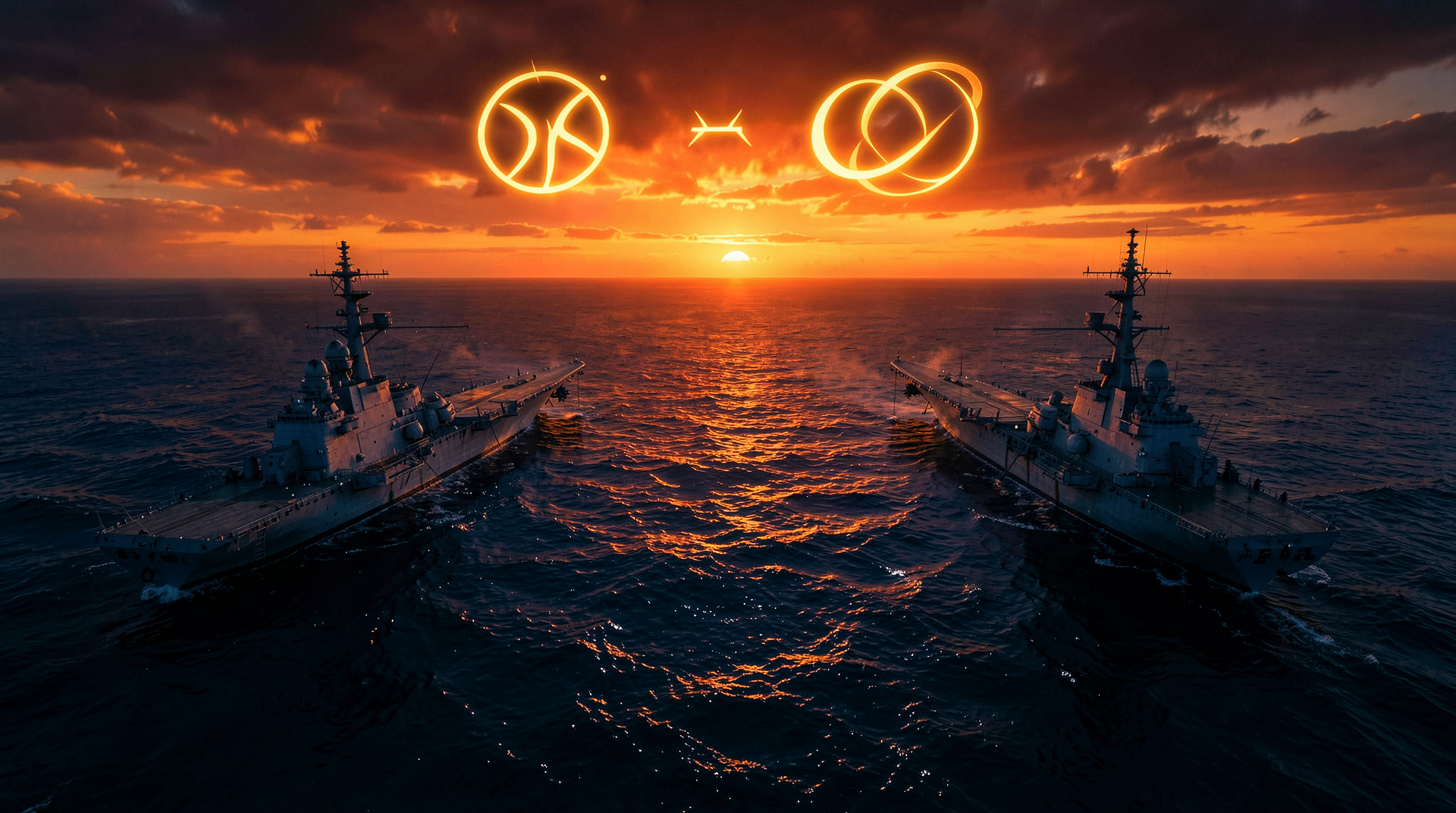
The Strait Where the World Holds Its Breath
The narrowest point of the Strait of Hormuz is just 21 nautical miles wide. Through this sliver of water between the Persian Gulf and the Gulf of Oman passes roughly one-fifth of the world's petroleum — some 17 to 21 million barrels every single day. On July 21, 2026, that chokepoint is not merely a geographic fact. It is the most dangerous place on Earth.
The escalation between the United States and Iran over control of the strait has reached a fever pitch. After weeks of tit-for-tat military posturing, the seizure of commercial vessels, and the Trump administration's on-again, off-again tariff threats and military strikes, the two nations now stand at a precipice. Diplomatic channels have collapsed. Military assets crowd the waters. And neither side has articulated — or appears willing to accept — a face-saving mechanism for de-escalation.
Against this backdrop, the astrology of July 21, 2026 is nothing short of chilling. A stationary Saturn. Mars in the 8th house of death and destruction. Mercury still retrograde in Cancer. And a First Quarter Moon — the lunar phase of crisis and decisive action. This is not a sky that whispers. It is a sky that demands we look squarely at what happens when two powers, each convinced of its own righteousness, refuse to blink.
Saturn Stationary in Aries: The Physics of an Immovable Object
At 14°43′ Aries, Saturn is practically frozen in the sky. Its apparent speed on July 21 is just 0.009 degrees per day — a near-standstill that will last through the end of the month before the planet begins its four-and-a-half-month retrograde journey on July 27. In astronomical terms, Saturn has reached its first station. In astrological terms, the planet of limits, blockades, and karmic consequence has become a cosmic roadblock.
Saturn in Aries is already a study in contradiction: the planet of slow, methodical discipline occupying the sign of impulsive, headstrong action. When Saturn stations in Aries, the impulse to do something collides with the impossibility of forward motion. It is the astrological equivalent of a military standoff — weapons aimed, fingers on triggers, and absolutely nothing moving.
⚠️ Astrological Warning: Saturn stationing before retrograde represents a pressure cooker. The tension builds without release. Historically, Saturn stations in Aries have coincided with military stalemates that either resolve through catastrophic eruption or through the painful, grinding work of diplomacy. The risk here is that the former path feels easier than the latter.
For the Strait of Hormuz crisis specifically, stationary Saturn in Aries is a near-perfect symbolic match. A maritime chokepoint — a place where movement is restricted by geography — mirrors the astrological chokepoint in the sky. Nothing passes easily. Everything is bottlenecked.
Mars in Gemini, 8th House: The Dual-Front Nightmare
If Saturn represents the standstill, Mars tells us where the explosion might come from. On July 21, transit Mars sits at 15°48′ Gemini, positioned in the 8th house of the transit chart cast for the strait. The 8th house is the domain of death, transformation, shared resources, and other people's money. It is, in mundane astrology, the house most directly associated with war, debt, and the violent redistribution of power.
Mars in Gemini is a tricky placement. Gemini is the sign of duality, communication, and tactical speed. Mars here doesn't fight one war — it fights two, or three, or a dozen at once. It is the planet of combat expressed through information warfare, naval skirmishes, drone strikes, and the kind of multi-vector conflict that defies easy categorization. Think less of a single pitched battle and more of a distributed, chaotic, rapid-fire exchange of hostilities across multiple domains simultaneously.
Mars in the 8th house adds another layer: this is not a skirmish over territory alone. It is fundamentally about control of resources — the oil and gas that transit the strait, the economic lifeblood of global markets. The 8th house Mars says: this is about who owns what, and who is willing to destroy it to prevent the other from having it.
Adding to the volatility: transit Mars is applying to a conjunction with transit Uranus at 4°37′ Gemini (exact later in the month). Mars-Uranus conjunctions are among the most explosive aspects in astrology — sudden attacks, technological warfare, accidents that spiral into larger conflicts. The fact that this conjunction builds in the 8th house of a chart cast for one of the world's most contested waterways should give any observer serious pause.
Mercury Retrograde in Cancer: When Diplomacy Goes Dark
As if the Saturn-Mars pressure cooker weren't enough, Mercury remains retrograde at 16°37′ Cancer on July 21. Mercury will not station direct until July 23–24, and even then it will take weeks to clear its post-retrograde shadow.
In mundane astrology, Mercury retrograde governs failed communications, diplomatic breakdowns, treaties that don't hold, and the dangerous fog of misread signals. In Cancer — the sign of nationalism, homeland, and emotional security — the retrograde takes on a particularly tribal character. Each side hears what it wants to hear. Each side interprets the other's actions through the lens of its own wounded pride and historical grievance. The rational middle ground, always precarious in geopolitics, becomes nearly invisible.
The existing diplomatic architecture for US-Iran communication — already skeletal after years of erosion — is essentially non-functional under this influence. Back-channel messages get garbled. Red lines get misinterpreted. A military maneuver intended as a warning gets read as an act of war.
Caution: Mercury retrograde in Cancer does not cause diplomatic failure — but it describes the conditions under which diplomatic failure becomes far more likely. During this period, the margin for error in communication is razor-thin, and the consequences of a single misunderstood signal are vastly amplified.
The First Quarter Moon: A Crisis That Demands Action
The Moon enters Libra at 27°23′ on July 21, forming a First Quarter Moon — the square between the Sun at 28°37′ Cancer and the Moon. In the lunar cycle, the First Quarter represents the moment of crisis in action. The seed planted at the New Moon (in this case, the Cancer New Moon of July 8) now encounters its first major test. Things that were set in motion two weeks ago now reach a point where they must be confronted.
A First Quarter Moon in Libra — the sign of balance, justice, and partnership — squaring a Sun in Cancer suggests a crisis that pits the desire for peace and equilibrium (Libra) against deeply rooted national and emotional security needs (Cancer). Both the United States and Iran frame their positions in these terms: the US speaks of freedom of navigation and international order; Iran speaks of sovereignty and resistance to foreign coercion. The Libra Moon asks: can there be a just resolution? The square to the Cancer Sun answers: not without one side feeling its core security has been compromised.
The First Quarter Moon is not, inherently, a destructive phase. It is a phase of necessary action. But when the action available is military rather than diplomatic — as it is when Mercury is retrograde and Saturn is stationary — the risk that action becomes destruction rises dramatically.
Iran's Natal Chart Under Siege: Saturn Conjunct the Islamic Republic's Sun
Perhaps the most sobering astrological signature of this moment is revealed when we overlay the July 21 transits onto the birth chart of the Islamic Republic of Iran (April 1, 1979, 3:00 PM, Tehran).
Iran's natal Sun sits at 11°08′ Aries — the very sign where transit Saturn now stations at 14°43′. Saturn is within 3.5° of an exact conjunction to Iran's national Sun, and the aspect is separating — meaning it was even tighter in recent days. This is a Saturn return of sorts for the Islamic Republic: the planet of pressure, isolation, and existential reckoning bearing down on the very core of the nation's identity.
In mundane astrology, a Saturn conjunction to the natal Sun represents a period of maximum external pressure on a nation's leadership, legitimacy, and sense of purpose. For Iran, already grappling with internal dissent and economic strain from sanctions, this transit threatens to expose every structural weakness. The danger is that a regime under this degree of Saturnian pressure may conclude that a confrontation — even a catastrophic one — is preferable to appearing weak.
Additional critical aspects to Iran's chart:
- Transit Mars (15°48′ Gemini) falls in Iran's natal 10th house of government and international standing, and applies to a conjunction with Iran's natal Moon (7°19′ Gemini) in the same house. This is war — or the threat of war — landing directly in the house of public perception and national leadership. The Moon represents the populace; Mars on the Moon suggests a people under fire.
- Transit Pluto (4°25′ Aquarius) occupies Iran's natal 6th house of military, civil service, and daily operations. Pluto here speaks of structural transformation through destruction — the potential collapse or radical reorganization of military command and state infrastructure.
- Transit Jupiter (4°36′ Leo) occupies Iran's natal 12th house of hidden enemies and self-undoing. Jupiter expands whatever it touches. In the 12th house, it can magnify paranoia, secret adversaries, and the kind of ideological overreach that leads nations into traps of their own making.
- Natal Pluto (18°02′ Libra) opposes transit Saturn (14°43′ Aries) — an applying aspect that represents a collision between the forces of transformation-through-power (Pluto) and the forces of immovable limitation (Saturn). This is regime-survival mode at its most raw.
The US Chart: A Missing Piece and What We Can Infer
While the US Sibly chart (July 4, 1776) falls outside the date range available for precise astrological computation in this analysis, we can infer key dynamics from the transit chart alone. Transit Saturn in Aries squares the United States' natal Cancer Sun (July 4, 1776) — a hard aspect that has historically coincided with periods of national trial, from the Civil War to the post-9/11 era. Saturn squaring the US Sun is a test of national character, and the stationary quality of Saturn makes the test especially grueling.
Mars in Gemini, meanwhile, energizes the United States' natal Mars in Gemini (at 21° in the Sibly chart). The US was, in a literal astrological sense, born with Mars in Gemini — a nation whose military doctrine has always emphasized speed, mobility, and the capacity to fight on multiple fronts. Transit Mars activating this natal placement suggests a moment when the United States' martial instincts are both heightened and, under Mercury retrograde, poorly coordinated.
The Strait Itself: A Geopolitical Chokepoint Under Cosmic Pressure
The Strait of Hormuz is not merely a backdrop to this crisis — it is the stage upon which every astrological signature of July 21, 2026 is projected. Its geography — narrow, contested, indispensable — is a mirror of the sky:
| Astrological Signature | Geopolitical Parallel |
|---|---|
| Saturn stationary in Aries | The strait as immovable chokepoint; no one can pass without consequence |
| Mars in Gemini, 8th House | Multi-domain warfare over shared resources (oil) |
| Mercury retrograde in Cancer | Failed diplomacy; nationalist rhetoric replacing negotiation |
| First Quarter Moon in Libra | The crisis point: act now or lose face |
| Saturn conjunct Iran's natal Sun | Existential pressure on the regime |
| Mars-Uranus conjunction (building) | Risk of sudden, technologically-driven escalation |
The question the astrology poses is not whether this configuration is dangerous — it manifestly is — but whether the players involved can recognize the danger in time to step back from it.
Historical Rhythms: When Saturn Stood Still Before
Stationary Saturn in Aries is not an everyday occurrence. Saturn enters Aries roughly every 29.5 years and stations retrograde in the sign at predictable intervals. Looking back at previous Saturn stations in Aries offers a sobering perspective:
- 1944 (Saturn retrograde in late Aries/Gemini): The height of World War II. Saturn's station coincided with the period between D-Day preparations and the Normandy landings — a moment of maximum tension before decisive action.
- 1975 (Saturn stationary in Cancer/Leo): A different sign, but the Saturn station before the fall of Saigon illustrates the pattern of regimes crumbling under stationary Saturn's weight.
- 1996 (Saturn stationary in Aries): The Taiwan Strait Crisis, when China conducted missile tests near Taiwan and the US dispatched carrier groups — a chokepoint crisis with eerie parallels to today.
The pattern is consistent: Saturn stationary in Aries coincides with geopolitical standoffs where the cost of backing down and the cost of fighting both appear unbearable. The resolution, historically, has depended on whether cooler heads could find a diplomatic off-ramp before the pressure became unsustainable.
The Path Forward: Astrological Timelines and What to Watch
The astrology offers not just a diagnosis but a timeline — and a set of dates when the risk of escalation is highest:
July 23–24: Mercury stations direct at 15° Cancer. The fog of miscommunication begins — slowly — to lift. But the shadow period extends into mid-August. Diplomatic breakthroughs, if they come, will likely be tentative and reversible. Do not assume that Mercury going direct means the crisis is over. The damage done during the retrograde will take weeks to assess.
July 25–26: Mars squares Venus (19° Gemini-Virgo). This aspect brings relationship tension to a head — and in mundane astrology, "relationships" includes international ones. Expect a flashpoint around these dates. The square aspect demands resolution, and under the broader Saturn-Mars architecture, resolution may come in the form of confrontation rather than conciliation.
July 27: Saturn stations retrograde at 14°43′ Aries. The pressure begins to shift direction. Saturn retrograde turns the energy inward — for nations, this can mean domestic political consequences of the crisis begin to outweigh the external confrontation. Regimes under Saturn retrograde on their Sun often face internal challenges that limit their capacity for external action.
Early August: Mars approaches Uranus in Gemini (exact in early August). This is the period of maximum danger. Mars-Uranus conjunctions are correlated with sudden, unexpected military escalation — drone strikes, cyber attacks, naval incidents that spiral out of control. If the crisis is to go hot, this is the window to watch.
Late August: Saturn retrogrades back over 11° Aries (Iran's Sun). The pressure on the Iranian regime peaks for a second time. This could represent either a breaking point or a moment when the regime, having survived the first pass, consolidates its position.
A Responsible Disclaimer
Important: Astrology is a symbolic language, not a predictive science. The correlations drawn here between planetary configurations and geopolitical events represent patterns observed over centuries of mundane astrological study, but they do not constitute certain prediction. Geopolitics is shaped by human decisions, institutional dynamics, and countless variables that no astrological chart can fully capture. This analysis is offered as a framework for understanding the archetypal quality of the moment — the psychological, emotional, and structural pressures at play — not as a forecast of inevitable outcomes. In matters of war and peace, astrology should inform reflection, not replace judgment.
Conclusion: The Weight of a Stationary Sky
On July 21, 2026, the sky over the Strait of Hormuz is heavy with unfinished business. Saturn, the great taskmaster of the zodiac, has planted itself in Aries like a boulder in a narrow river, and the waters are rising on both sides. Mars in Gemini sharpens the instruments of war while Mercury retrograde ensures that those who would talk their way out of conflict cannot find the words. The First Quarter Moon demands action, but the action available may not be the action anyone wants.
The astrology suggests that the window for a diplomatic resolution is narrow and closing — but not yet shut. The Mercury station direct on July 23–24, combined with Saturn's retrograde beginning on July 27, could, in the best-case scenario, provide just enough shift in the cosmic weather to allow cooler heads to prevail. But the Mars-Uranus conjunction building in early August is a ticking clock, and it is ticking loudly.
What happens in the Strait of Hormuz in the coming weeks will not be determined by the planets. It will be determined by human beings — their fears, their pride, their calculations, and, one hopes, their wisdom. But the planets tell us this: those human beings are operating under extraordinary pressure, in conditions of maximum uncertainty, with consequences that reach far beyond the 21 nautical miles of water they are contesting.
The world is watching. And Saturn is watching, too — taking notes, as it always does, for the karmic ledger that will one day come due.
Related Articles
Mars Closes to 11° of Jupiter in Leo: The Week 2026's Biggest Conjunction Starts Feeling Real
October 17, 2026
Mars hits 11° Leo this week, closing to within 11° of Jupiter — the moment 2026's biggest conjunction starts feeling real. What to expect, the shadow side, and how to work the build.
Mercury Is Tapping the Brakes in Scorpio: Finish Your Detective Work Before Its Late-October Retrograde
October 16, 2026
Mercury is slowing in late Scorpio before its October 22–24 retrograde station. A practical guide to finishing your detective work, sealing your contracts, and surviving the November rewind.
The October 15–18 Stand-Still: Pluto, the North Node, and the First Quarter Moon Line Up Their Stations
October 15, 2026
From October 15–18, 2026, Pluto's direct station at 3° Aquarius, the North Node's brake at the 29° Aquarius threshold, and the First Quarter Moon in Capricorn line up into a rare celestial standstill. Here's what the pause means — and how to work it.
First Quarter Moon in Capricorn (Oct 18): The Week's "Commit or Release" Moment
October 14, 2026
The First Quarter Moon in Capricorn (Oct 18, 2026, 16:10 UTC) squares the Libra Sun — a cosmic checkpoint asking you to commit or release. Plus Venus retrograde cautions, Pluto's station, and a do/don't guide for the week.