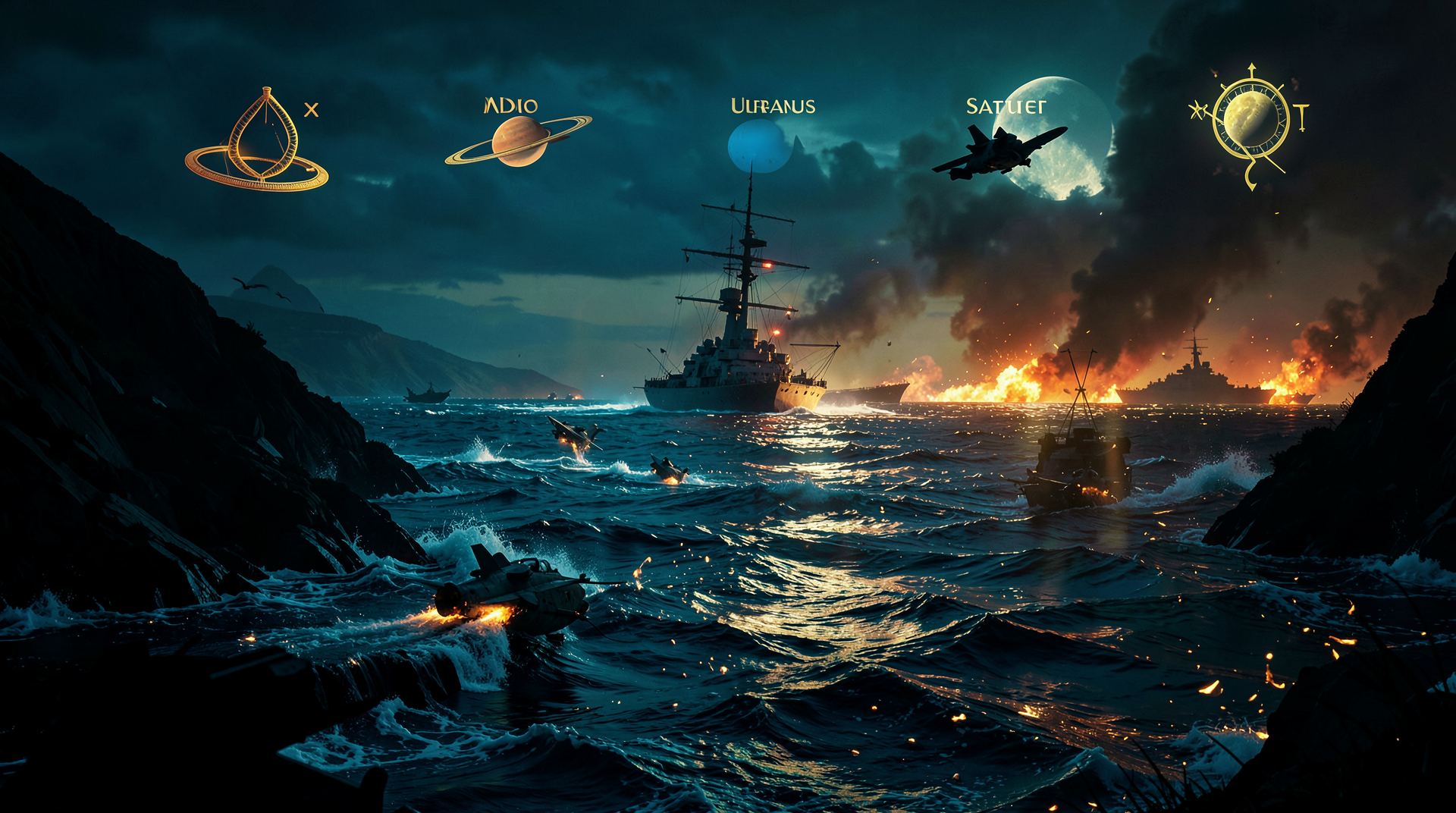
Strait of Hormuz Naval Skirmish: The Astrology Behind the Closure of the World's Most Critical Oil Chokepoint
Editor's note: This article examines the astrological backdrop of the reported Strait of Hormuz naval skirmish of August 2026 through the lens of mundane astrology. It is offered as perspective and reflection — not as a prediction of events, and never as a substitute for reliable news reporting or expert geopolitical analysis.
Introduction
On the morning of August 22, 2026, the Strait of Hormuz — the narrow waterway through which roughly one-fifth of global oil supplies transit — became the flashpoint of a direct naval engagement between Iranian fast-attack craft and a US-led coalition flotilla. Within hours, reports emerged of the strait's formal closure, and energy markets swung violently as traders priced in the unthinkable: the world's most critical oil chokepoint, shut.
For geologists and energy analysts, the story is one of pipelines, tanker routes, and naval force posture. For astrologers, it is a story written in the sky — a Mars-Neptune conjunction sharpened by Uranus, unfolding against a grave Saturn retrograde and a tense lunar eclipse season. This article explores the celestial signatures surrounding the skirmish, the volatile astrological weather ahead, and the cautions that any responsible reading of such transits demands.
The Event Chart: August 22, 2026, Bandar Abbas
To understand the astrological fingerprint of this event, we cast the chart for the moment and place of the engagement — Bandar Abbas, the Iranian port city that overlooks the strait, and the early-morning hours of August 22, 2026.
The chart is dominated by a potent Mars-Neptune conjunction — an aspect often associated with covert operations, maritime confusion, fogs of war, and conflicts fueled by emotion rather than clarity. Mars is the god of war; Neptune rules the sea, oil, illusion, and sacrifice. Their union in this engagement's chart is an almost archetypal signature: a naval confrontation in which perceptions diverge sharply, each side seeing a different story of who fired first and why.
Compounding the Mars-Neptune blend is a square from Uranus — the planet of sudden rupture, rebellion, and shocking volatility. Uranus squares to the conjunction throws a destabilizing bolt into the mix: events that escalate faster than anyone planned, unpredictable chain reactions, and a total disregard for the expected script. For oil markets, Uranus is the planet that loves a gut-wrenching spike.
Meanwhile, a heavily emphasized Scorpio ascendant rising over the strait recalls the zodiac's sign of the scorpion — the emblem of the Iranian naval forces themselves — and speaks to themes of deep water, hidden depths, transformation through crisis, and the willingness to strike with a stinger when cornered.
The Bigger Sky: Eclipse Season and a Grave Saturn
The skirmish did not occur in an astrological vacuum. It landed squarely within eclipse season, the turbulent window surrounding the lunar and solar eclipses of late August and early September 2026. Eclipses are traditionally regarded in mundane astrology as accelerants of destiny — moments when tensions that have been building beneath the surface erupt into visible form, and when "events" crowd the timeline.
Adding weight to the moment is a retrograde Saturn in the sky. Saturn retrograde tends to pull the brakes on structures, treaties, and institutions — making established frameworks feel brittle and slow to respond exactly when agility is most needed. In a geopolitical context, a retrograde Saturn can signal the weakening of international agreements, the strain of old alliances, and a mood of austerity, obstinacy, and hard lessons. Nations may dig into entrenched positions precisely when flexibility could avert catastrophe.
The combination is combustible: eclipse season supplies the dramatic narrative turn, Mars-Neptune supplies the fog and the fury, Uranus supplies the shock, and Saturn retrograde ensures that any resolution is hard-won, delayed, and painful.
Volatile Energy Markets: A Uranus Story
For those watching the price of crude, the astrological reading offers a sobering frame. Uranus — the planet of electricity, sudden change, and market panic — is square to the Mars-Neptune conjunction, a configuration that screams "volatile spikes and violent reversals." In mundane astrology, when Uranus is activated in a chart tied to a commodity chokepoint, we can expect:
- Sharp, news-driven price surges as traders react to headlines faster than fundamentals can be assessed.
- Extreme intraday whipsaw, where gains are erased as quickly as they are made.
- Disconnects between price action and physical supply, as markets trade on fear, speculation, and rumor rather than actual barrels.
The astrological caution here is blunt: markets under a tense Uranus-Mars-Neptune dynamic are prone to overreaction in both directions. What surges on rumor may collapse on clarity — and vice versa. Anyone navigating these waters, whether in trading or in personal financial planning, is advised to expect irrational swings and to avoid leveraging decisions on a single headline.
Challenges and Cautions: What the Sky Says — and What It Doesn't
A responsible astrological reading of this event must acknowledge both its warnings and its limits.
Astrological Warnings
- Mercury's role in misinformation. Mercury, always the wildcard of communication, is active during this period — and with Neptune strong in the sky, the risk of misinformation, propaganda, and contradictory official statements is exceptionally high. Do not assume that any single account of the skirmish — from any side — tells the complete story.
- Escalation risk under Mars. Mars brings heat, but it also brings brinksmanship. The combination of Mars with Neptune and Uranus suggests that miscalculation is the single greatest danger — incidents that begin as "warning shots" have the potential to spiral beyond any party's control.
- Saturn retrograde's hard lessons. Any diplomatic resolution forged during this window is likely to be fragile, partial, and subject to revision. Tempered expectations are the order of the day.
The Limits of Astrology
It is essential to state plainly: astrology is not a predictive instrument for geopolitical events. The skies do not "cause" naval skirmishes, oil shocks, or wars. Rather, astrological symbolism offers a language of timing, mood, and archetype — a lens through which we can reflect on why a moment feels the way it does. Earthly events are driven by human decisions, national interests, military logistics, and a thousand material factors that no planetary chart can capture.
Nor should any reader make consequential decisions — financial, political, or personal — on the basis of a horoscope. If you are affected by the energy crisis or the regional conflict, rely on verified news sources, government advisories, and qualified professional advice, not on celestial interpretation.
The Road Ahead: Patterns to Watch
Looking beyond the immediate skirmish, mundane astrologers will be watching how the eclipse season of September 2026 unfolds, and how the lingering Mars-Neptune-Uranus configuration dissipates or re-fires. Historical parallels — the tanker wars of the 1980s, the various Hormuz closure threats of the past two decades — remind us that such crises rarely resolve in a straight line. They flicker, pause, resume, and transform.
The wise counsel of the stars here is not prediction but preparedness and patience: expect ambiguity, plan for volatility, verify before believing, and resist the pull of panic. Neptune's fog lifts eventually; Uranus's shock waves settle. The question is what structures — and what trust — remain standing when they do.
Conclusion
The August 2026 Strait of Hormuz skirmish is a textbook study in how astrological archetypes can illuminate a moment without dictating it. A Mars-Neptune conjunction blurred by a square from Uranus, set against eclipse season and a retrograde Saturn, paints a portrait of maritime confusion, sudden escalation, and hard lessons in a fragile world. For those who read the sky, it is a reminder of how thin the membrane between routine commerce and global crisis truly is.
But the stars do not doom us — they describe a weather, not a verdict. The outcome of any human crisis rests with human beings: their decisions, their diplomacy, and their restraint. Astrology can help us name the storm. It cannot sail the ship.
Disclaimer: This article is for informational and entertainment purposes only. It is not financial, political, or military advice, and it does not constitute a prediction of future events. Always consult verified news sources and qualified professionals for decisions that affect your safety, your finances, or your livelihood.
Related Articles
Mercury Is Tapping the Brakes in Scorpio: Finish Your Detective Work Before Its Late-October Retrograde
October 16, 2026
Mercury is slowing in late Scorpio before its October 22–24 retrograde station. A practical guide to finishing your detective work, sealing your contracts, and surviving the November rewind.
The October 15–18 Stand-Still: Pluto, the North Node, and the First Quarter Moon Line Up Their Stations
October 15, 2026
From October 15–18, 2026, Pluto's direct station at 3° Aquarius, the North Node's brake at the 29° Aquarius threshold, and the First Quarter Moon in Capricorn line up into a rare celestial standstill. Here's what the pause means — and how to work it.
First Quarter Moon in Capricorn (Oct 18): The Week's "Commit or Release" Moment
October 14, 2026
The First Quarter Moon in Capricorn (Oct 18, 2026, 16:10 UTC) squares the Libra Sun — a cosmic checkpoint asking you to commit or release. Plus Venus retrograde cautions, Pluto's station, and a do/don't guide for the week.
Venus Retrograde in Scorpio Squares Pluto All Week: The Love-and-Power Test Peaking Around Oct 20
October 13, 2026
Retrograde Venus in Scorpio squares Pluto all week, exact around Oct 19–20 as Pluto stations direct. How to survive the love-and-power test — what to avoid, who feels it, and how to pass it.