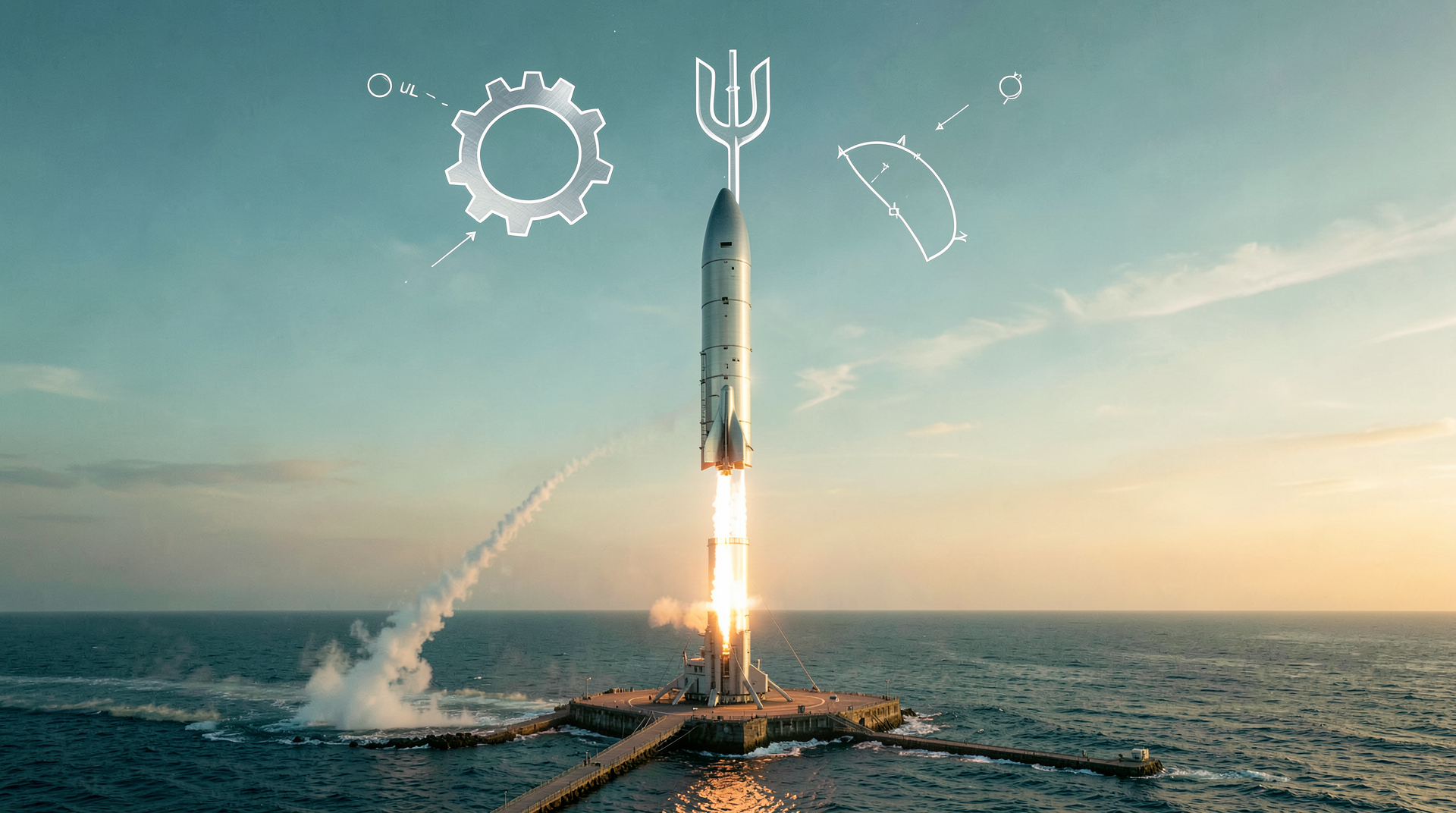
On a humid Texas dawn at Starbase, Boca Chica, a stainless-steel leviathan rose off the pad, climbed high into the edge of space, and then — instead of punching onward to orbit — arced gracefully back down toward a landing some distance away on the same planet. It was a sub-orbital hop, a point-to-point rehearsal: the first dedicated "Earth Prototype" of SpaceX's Starship, built not to reach Mars but to cross the globe in under an hour.
For an industry that has spent six decades measuring achievement in escape velocity, this was a different kind of milestone. It wasn't about leaving Earth. It was about compressing Earth — folding a fourteen-hour flight into forty minutes, turning the map itself into the obstacle course.
And like every threshold crossed in the sky, it happened under a sky that had something to say about it.
What Actually Happened
The Earth Prototype is a variant of the Starship second stage, stripped of the deep-space life-support intended for interplanetary crews and optimized instead for rapid, reusable sub-orbital sorties. The test profile was deliberately modest: a vertical ascent to the upper atmosphere, a brief ballistic coast, and a powered, propulsive descent to a landing pad across the range.
The milestone matters for reasons beyond the hardware:
- Commercial realism. This wasn't a marketing animation. A two-point sub-orbital trajectory — the exact physics profile a commercial "rocket airline" would use — was flown and landed.
- Reusability at scale. Starship's design goal of "fly, refuel, fly again" was exercised in its most operationally relevant form: same day, same planet, rapid turnaround.
- The bridge to orbital flight. Every control authority, thermal margin, and guidance algorithm proven on a sub-orbital trajectory is a step toward the heavier, fully orbital Starship that will one day carry crews to Mars — or, closer to home, a Starship that may one day carry you from New York to Shanghai in three quarters of an hour.
The skeptics will rightly note the chasm between one successful hop and a certified commercial service. Certification, air-traffic integration, sonic-boom management, passenger survival under high G-loads — the distance between "it flew" and "it carries fare-paying humans" is vast. Yet the flight removed the single most important question mark: whether the physics and the hardware can hold together on a point-to-point trajectory at all.
The Sky at Liftoff: Reading the Event Chart
We cast the moment of the Boca Chica climb (August 13, 2026, local dawn) to see what the heavens were doing as that first Earth-prototype descended toward the landing site.
A New Moon is rising. The Moon and Sun were conjoined in a fresh-cycle phase — the classic signature of a beginning, a seeding, a first step onto a new road. There could hardly be a better lunar weather for a maiden voyage. New Moons don't promise completion; they promise potential. This launch was never meant to be an ending — it was the ignition of a cycle.
Sun in Leo, deep in the 12th house. The bold, theatrical, fixed-fire Leo Sun — the sign of spectacle, pride, and creative will — burned low in the chart's most hidden house, the 12th, the realm of the unseen and the behind-the-scenes. SpaceX's story is Leo to the core: audacious, public, unapologetically dramatic. But a 12th-house Sun is a reminder that the real work — the engineering, the patience, the years of quiet iteration — happens far from the cameras, in the shadow where the light hasn't reached yet.
Mars in Cancer on the Midheaven. Mars, the planet of thrust and action, stood at the top of the chart (the Midheaven, MC) in watery, nurturing, defensive Cancer. Mars here isn't the brash frontal assault; it's the protective instinct made powerful — a builder who fights for the home team, who pushes forward while guarding what it loves. On a rocket event chart, Mars on the MC is the engine given public purpose: action with a caretaker's heart, the will to get home safely. It also flags emotional volatility in the operation — Mars in Cancer can be reactive, sensitive to pressure — so the "cool hands" of the control room matter as much as the thrust.
Uranus in Gemini, in the 9th house of travel. Here is the true star of the show. Uranus — the great awakener, the planet of sudden breakthroughs, invention, and disruption — moved through fast-thinking, quick-moving Gemini, landing in the 9th house, the ancient domain of long-distance travel, foreign lands, and the expansion of horizons. This is the astrology of the map being rewritten: connection, communication, and movement made startlingly swift. Uranus in Gemini is point-to-point travel as a concept — collapsing distance through cleverness and electricity-rapid motion. Its presence in the 9th house on the day of this flight is as on-the-nose as astrology gets.
Mercury and Jupiter conjoined in Leo (11th house). The communicator and the expander stood together in fire — a grand, optimistic, and generous signature. This is the public announcement, the grand vision, the crowd's awe. It speaks to a launch not just engineered but told — a story destined to travel itself, faster than the rocket.
Venus in Libra rising. The planet of beauty and balance rose on the Ascendant in its own sign of harmony. For a machine of unimaginable violence — controlled explosions, G-forces, a body of fire — this is a lovely counterpoint: grace, equilibrium, and the exquisite balance required to light a rocket and bring it home intact.
The Shadows: Where This Could Still Go Wrong
Astrology that only cheers is astrology that has stopped looking. This chart carries its cautions, and an honest reading dwells on them.
Saturn retrograde in Aries, in the 8th house. Saturn — the taskmaster of limits, delays, and hard consequence — sat retrograde in the sign of initiation, parked in the 8th house of transformation, shared resources, and existential risk. Retrogrades ask us to revisit: to re-check, re-test, re-examine what we thought we'd solved. In an 8th-house placement, the stakes are life-and-death and the lesson is humility before forces we do not fully control. For a program that has famously blown up prototypes on the way to success, this is the astrological voice reminding everyone that the next milestone is earned, not owed — that speed must never outrun safety, and that corners cut today become crises tomorrow.
Neptune in Aries, in the 7th house, also retrograde. Neptune is the planet of dreams, fog, and the ideal that outruns the actual. Retrograde in the 7th house of partnerships, it murmurs warnings about overpromising: about promotional timelines that outpace physical reality, about the seductive blur between what we wish were certified and what is certified. It also cautions the passenger's imagination — for a commercial point-to-point future, hype is the greatest risk of all, because disappointment (a schedule slip, a scrubbed flight, a ticket that doesn't materialize) can curdle public trust faster than any hardware failure.
A 12th-house New Moon. Beginnings born behind the veil are powerful but secret. The 12th house is the house of the subconscious, of what is hidden until it is not. This reminds us that the timeline — what works, what fails, when real commercial service arrives — is not yet fully visible to the public eye. Treat any promise of a "rocket airline by next year" as a 12th-house mystery to be proven, not a guarantee.
What It Means for the Bigger Picture
Read together, the chart tells a coherent story: a spectacular, optimistic beginning (Leo Sun, Mercury–Jupiter) that will capture the world's imagination; a breakthrough in the mechanics of distance (Uranus in Gemini in the 9th); and a public, protective engine driving it forward (Mars on the MC). But it also insists on discipline and re-testing in the face of existential risk (Saturn retrograde in the 8th) and guarding against the fog of over-hype (Neptune retrograde in the 7th).
For those who study the sky, this is a textbook "beautiful dawn, demanding climb" chart: the omen is for the beginning, not for automatic arrival. The New Moon asks us to plant the seed; Leo asks us to perform the future boldly; Saturn and Neptune ask us to keep both feet — and both hands — firmly on the controls.
A Responsible Footnote
Astrology is a lens for reflection, not a predictive engine, and it is never a substitute for engineering, regulation, or safety review. Charts describe weather, not wiring: they can illuminate the temperament of a moment, but they cannot and must not be read as a guarantee of what a rocket will or won't do. Whether you're booking a future "sub-orbital hop" or simply watching from the ground, the practical lessons are the same ones any grounded astrologer would give — proceed with wonder, verify before you rely, and never let the romance of speed override the discipline of safety. The sky is beautiful to read; it is also indifferent to everything we haven't yet tested.
Standing on the Threshold
A single successful hop does not remake the world. But every world-remaking technology began as a small, strange thing that worked once, in a place few people were watching. The Starship Earth Prototype's sub-orbital arc was, astrologically, a classic New Moon moment: small, unglamorous at its core, and freighted with possibility out of all proportion to its altitude.
Under a Leo Sun shining from the hidden house, with Mars guarding the Midheaven and Uranus — the sky's great disruptor — riding the house of travel, this flight was more than an engineering demo. It was the first rehearsal of a future in which the distance between two points on Earth becomes a short, strange dream, and in which the question is no longer whether humans can ride a rocket across the planet, but how carefully.
The map, as they say, is about to change. Under this sky, the compass has already started spinning.
Published by Astraia — astrology as a companion to wonder, never a substitute for judgment.
Related Articles
Mars Races Toward Jupiter in Leo All Week: The 8th-House Power Surge Paving 2026's Biggest Conjunction
September 30, 2026
Mars enters Leo this week and begins its sprint toward Jupiter — the 8th-house power surge that paves the way for 2026's biggest conjunction on Nov 14–15. Plus Venus retrograde cautions and what to do now.

Mercury Enters Scorpio on September 30: The Diplomat Becomes a Detective
September 29, 2026
Mercury enters Scorpio on September 30, 2026, trading the diplomat's scales for the detective's magnifying glass. What the intense ingress, the Mars–Pluto face-off, and the coming Scorpio Mercury retrograde mean for communication, research, and relationships.
Venus Turns Retrograde in Scorpio on October 3: The 2026 Love & Money Re-Run Begins
September 28, 2026
Venus stations retrograde at 8°29' Scorpio on October 3, 2026 — kicking off a ~40-day love & money re-run. Full guide: dates, timelines, cautions, and how to work with it.

Ice and Scales: The Astrology of the Iceland Peace Summit — Can Trump's 'Close' Actually Hold?
September 28, 2026
Trump meets Russia–Ukraine representatives in Reykjavik claiming a ceasefire is close. We cast the Iceland summit sky: Libra diplomacy under Neptune's fog and the Aries Full Moon.