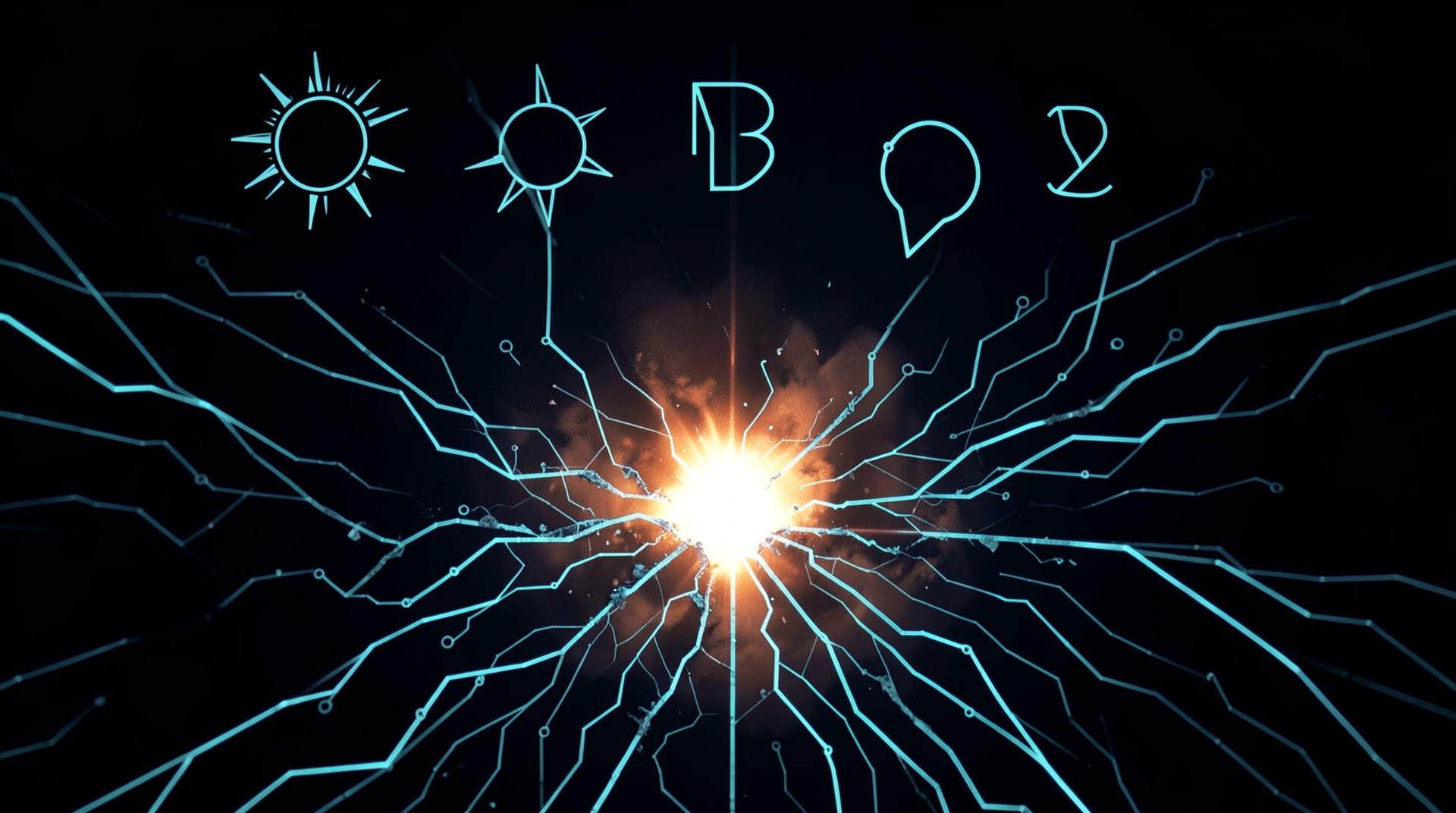
It began as a flicker at dawn. Across Tehran, Isfahan, Tabriz and the oil-rich southwest, the lights stuttered, surged — and then went dark. Within hours, Iran's Ministry of Energy confirmed the unthinkable: the national power grid had not failed under the weight of summer demand or a natural disaster. It had been disassembled, line by line, by software.
Cybersecurity firms are now attributing the outage to a sophisticated strain of industrial control system (ICS) malware dubbed "Solar Flare" — a payload engineered to masquerade as a harmless geomagnetic surge while methodically disabling the circuit breakers, substation relays and SCADA systems that keep the country electrified. The code's complexity, its multi-stage kill chain, and its surgical precision point, forensics teams say, to a collaborative, multi-state intelligence effort — the shadow of a war waged in code, claimed by no one and felt by millions.
As the waning crescent Moon darkens over the region, we turn to the sky for context. Because long before the first line of malicious code was written, the planets were sketching the outline of this story — and they still have something to say about what comes next.
What We Know: A Grid Taken Down From the Inside
The attack reportedly unfolded over three waves. In the first, a trojanized firmware update slipped through a third-party maintenance contractor that services Iranian substations — a classic supply-chain vector, and nearly identical in shape to the 2010 Stuxnet worm that once dismantled centrifuges at Natanz. The second wave was propagation: "Solar Flare" moved laterally across the SCADA network, quietly mapping transformers, breakers and backup diesel generators. The third wave was the strike itself — a synchronized trip of protective relays designed to imitate the electrical signature of a solar-induced geomagnetic storm.
That final detail is the cleverest and most unsettling: experts believe the malware's name was chosen as a misdirection, letting Iranian engineers blame the Sun (and a flurry of actual solar activity in late August) long enough for the attack to complete its work.
Blackouts have now touched at least fourteen provinces. Hospitals have fallen back on generators, the Tehran Metro has suspended service, and water-pumping stations are running on reduced pressure — a reminder that when a grid dies, so does the oxygen of modern life. Iran's leadership has called the strike "an act of war," while declining to name an adversary. International analysts suspect a joint U.S.–Israeli–Gulf operation, but attribution remains, as ever, a hall of mirrors.
The Ghost of Stuxnet
Astrologically and historically, this is the moment the Stuxnet era promised us. In September 2010 — sixteen years ago almost to the week — the discovery of Stuxnet quietly announced that nation-states had crossed a line: physical destruction could now be delivered through digital receptors. "Solar Flare" is that lineage's coming-of-age: an offensive that targets civilian infrastructure, engineered by a consortium of states, designed to be deniable.
Deniability is the keyword. In this murk, nobody takes credit, nobody verifies, and the truth is the first casualty.
The Sky Over Tehran, September 7, 2026
To read this story properly, we overlay the transiting planets on the birth chart of the Islamic Republic of Iran — proclaimed on April 1, 1979, in Tehran, a state born under an Aries Sun and Midheaven (the signature of a revolutionary, combative national identity) with a retrograde Mercury in Pisces (a nation whose official voice has always been tangled up in secrets and shadow-play).
What happened on the ground is startlingly legible in the sky.
Saturn Bear Down on Iran's Sun — and It's Still Applying
The most significant placement is transiting Saturn in Aries, retrograde, grinding toward a conjunction with Iran's natal Sun (11° Aries) and Midheaven (9° Aries). As of September 7, Saturn sits at 13° Aries — past the cusp of the Moon's nodes and closing in. This is the pressure planet moving against the exact degree occupied by the state's identity at birth. In mundane astrology, a Saturn transit to a nation's Sun and MC reads as a test of legitimacy, sovereignty and structural integrity — a force that strips away false confidence and demands that institutions prove their strength.
Here, the chorus is brutal: an assault on the state's most fundamental infrastructure during a Saturnian test of its resilience. And because the aspect is still applying (Saturn will tighten its grip through the autumn), this may be the first blow, not the last. Expect further probes, further hardening — and, astrologically, further karmic consequences for whoever chose to strike, since Saturn's ruler is neither patient nor partisan.
Neptune's Fog: The Hand That Doesn't Show
Just behind Saturn on the same axis sits transiting Neptune in Aries (3° 30' Rx) — the planet of fog, illusion and covert waters, thrown against Iran's Sun and MC from the first house of the transit chart. If Saturn is the hammer, Neptune is the smoke. In days to come, expect wildly contradictory claims: "act of God" vs. "act of war," rival attributions, forged evidence, and competing narratives engineered by whichever states benefited. Neptune retrograde disciplines us to sit with uncertainty rather than pretending we have certainty.
This is the astrological signature of the multi-state collaboration: Neptune showing that modern warfare's most powerful weapon is not the malware itself but the ambiguity wrapped around it.
Mars in Cancer: The Hidden Hand in the 12th House
Now the strike itself. On September 7, Mars in Cancer (17°) falls squarely in Iran's 12th house of covert operations — the house of the invisible enemy — while in the transit sky Mars sits in the 8th house, the domain of energy, shared resources and the national grid itself. An attacker Mars in the energy house, projected onto the victim's house of hidden warfare: the story is written in two coordinates at once.
Sharper still is the tightest aspect of the day: transiting Mars forms an applying square (0.65° orb!) to Iran's natal Pluto in Libra — the aspect astrologers would draw if asked to symbolize a hybrid strike: a blow to the state's power conducted through Pluto's own dialect of shadow, coercion and deniable dominance. Pluto, in mundane terms, is the god of the underworld — and the malware moved through the underworld of the grid.
The "Solar" in Solar Flare
Iran's natal chart carries a Saturn in Virgo at 8° — the state's "infrastructure Achilles' heel," if you like. This week, the transiting Sun in Virgo (14° 45', with Mercury alongside at 24°) blazes directly across that degree — the literal sun "flaring" against the country's weak point. That the attackers chose the name "Solar Flare" — the very fable of a solar storm — is the kind of dark poetry astrologers are trained to notice.
Meanwhile, Mercury, freshly turned direct but still in the post-retrograde shadow, occupies the transit 10th house and hovers near Iran's natal Saturn degree. Mercury is the planet of code, communication and information systems — and he is still shaking off the glitches of a recent retrograde. In the aftermath of every Mercury station, history suggests, digital infrastructure is at its most fragile, and its most exploit-able. Patch, verify, re-verify: the shadow has not lifted yet.
Uranus Nearly Stationary in Gemini: The Lifelines
Uranus in Gemini (5° 47') is essentially parked — almost stationary after turning direct — in Iran's 11th house of alliances, diplomacy and international networks. Uranus is the planet of disruption in the sign of the network, and it is hovering exactly where Iran's relationship with the outside world lives. It is no coincidence that the same week sees reports of Starlink terminals becoming desperate lifelines (as we covered earlier this month on Astraia) while satellite-relayed communications surge across a country in the dark. When Uranus parks in the house of alliances, connectivity itself becomes contested terrain.
And Pluto retrograde in Aquarius — the slow-burning lord of the underworld — sits in Iran's 7th house of foreign powers and adversaries, quietly confirming the cosmological subtext of this war: it was never one state against one state. It was Pluto against Pluto — power blocs colluding in the dark.
The Darkening Moon: Worse Before the Dawn
Finally, the Moon. On September 7, the waning crescent Moon in Cancer — dimming toward the Virgo New Moon due around September 10–11 — passes conjunct Iran's natal Ascendant and Jupiter. In the hours of the blackout, the Moon herself moved through the nation's first house, the emotional body of the public: fear, alertness, communal anxiety — softened only by a touch of Cancerian solidarity as neighbors checked on neighbors.
But a waning crescent is also the sky's way of saying endure. Power grids, like nations, do not spring back under a dark Moon. The balsamic window is for conserving, not for expecting rapid normalization. Hospitals, cold chains, water systems: all will be tested until the Virgo New Moon arrives with its harvest of audit, repair and rebuild.
What to Watch — and the Cautions
Astrology is a lens, not a verdict. But the sky raises specific warnings for the weeks ahead:
- Saturn is still applying to Iran's natal Sun. Expect the pressure to increase. Historical precedent suggests retaliatory cyber operations, tightened domestic control, and further infrastructure stress through the autumn. If you live in the region — or work in critical infrastructure anywhere — treat the next six weeks as a maintenance-and-harden window, not a "wait and see" one.
- Neptune's fog demands verification. Every "official" claim about attribution, casualty numbers or grid status should be treated as a controlled narrative until independently confirmed. Do not let algorithmically amplified panic — or reassurance — do your thinking for you.
- The Mars–Pluto square is volatile. Fire and shadow in close aspect can spiral into miscalculation. The risk of an overreaction — a kinetic response to a digital strike — is real. Those with any agency in the matter would do well to let the Mars–Pluto square (which peaks within days) burn out before escalating visibly.
- Mercury's shadow lingers. Avoid "big red-button" migrations of critical systems until Mercury has cleared its post-retrograde zone later in September. The glitch-maker's influence does not end the day the planet turns direct.
- In your own life, don't capitulate to fear. Candle-lit sky-watching, community mutual aid, and a basic emergency kit are Virgo-season wholesome. Doom-scrolling to 3 a.m. is not. Saturn rewards preparation, never panic.
A note on method: Astrology offers symbolic context, not mechanical prediction. Cyberattacks are investigated with forensic tools, not telescopes. No planetary placement can tell us who wrote "Solar Flare" — that is work for analysts and courts of evidence. What the stars can do is remind us that hidden wars have always been part of our story, and that every nation's chart, like every person's, carries both its strengths and its fault lines.
Conclusion: The Grid Is an Astrological Organ
In the end, a power grid is an extraordinary thing to contemplate through an astrological lens. It is a system of channels, junctions and pulses — a circulatory system for the energies of modern civilization. When Malware named after the Sun severs it, we are watching a war conducted through the body's own arteries.
The planets will not resolve this crisis; engineers, diplomats and citizens will. But the sky of September 2026 offers a sobering frame: a state born under an Aries Sun is being tested by Saturn's exacting hand, struck by a Mars moving invisibly through its 12th house, and cloaked in Neptune's deniability. The Virgo New Moon on the horizon, however, is the harvest Moon of repair — of auditing, hardening, and building back more carefully than before.
Geopolitics aside, the deeper lesson of "Solar Flare" is simple and universal: the lights we take for granted are a miracle of coordination — and, like all miracles, they must be protected. Whether the sky overhead or the code inside the walls, everything that holds civilization together deserves both our vigilance and our wisdom.
Related Articles
Mars Closes to 11° of Jupiter in Leo: The Week 2026's Biggest Conjunction Starts Feeling Real
October 17, 2026
Mars hits 11° Leo this week, closing to within 11° of Jupiter — the moment 2026's biggest conjunction starts feeling real. What to expect, the shadow side, and how to work the build.
Mercury Is Tapping the Brakes in Scorpio: Finish Your Detective Work Before Its Late-October Retrograde
October 16, 2026
Mercury is slowing in late Scorpio before its October 22–24 retrograde station. A practical guide to finishing your detective work, sealing your contracts, and surviving the November rewind.
The October 15–18 Stand-Still: Pluto, the North Node, and the First Quarter Moon Line Up Their Stations
October 15, 2026
From October 15–18, 2026, Pluto's direct station at 3° Aquarius, the North Node's brake at the 29° Aquarius threshold, and the First Quarter Moon in Capricorn line up into a rare celestial standstill. Here's what the pause means — and how to work it.
First Quarter Moon in Capricorn (Oct 18): The Week's "Commit or Release" Moment
October 14, 2026
The First Quarter Moon in Capricorn (Oct 18, 2026, 16:10 UTC) squares the Libra Sun — a cosmic checkpoint asking you to commit or release. Plus Venus retrograde cautions, Pluto's station, and a do/don't guide for the week.