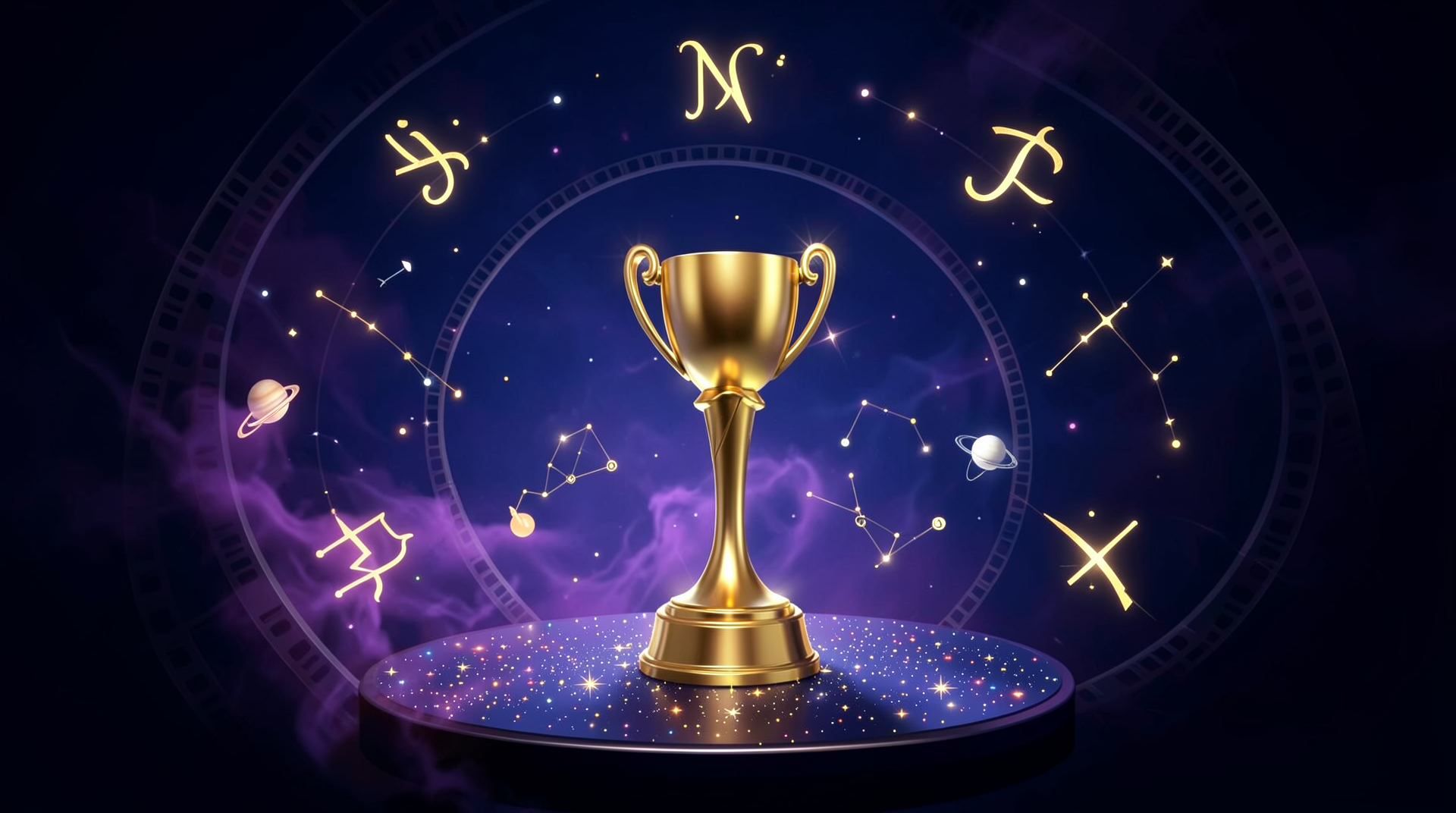
On the night of March 15, 2026, the Academy did something it has never done in ninety-eight ceremonies: it handed Best Picture to a film whose cast includes performers nobody ever auditioned. The Silicon Soul — a small, fiercely independent sci-fi meditation on consciousness, memory, and what it means to be made rather than born — became the first movie featuring AI-generated background actors to win the top Oscar.
The moment was called many things in the hours that followed: a breakthrough, a betrayal, a beautiful mistake, a mirror. The truth, as usual, is that it was all of these at once. And if you look at the sky that was wheeling over the Dolby Theatre while the envelope was opened, the stars were remarkably on message. This was not a night of clean victory. It was a balsamic night — an ending that is really a seed.
The Sky Over the Dolby Theatre
Cast the chart for the ceremony moment — Sunday, March 15, 2026, early evening in Hollywood — and you find a sky thick with symbolism:
| Planet | Position | House | Mood |
|---|---|---|---|
| Sun | 25° Pisces | 7th | The dream made public, in dialogue with its audience |
| Moon | 17° Aquarius | 6th | Balsamic crescent — the collective's labor, holding its breath |
| Mercury | 9° Pisces (retrograde) | 7th | Every word re-examined, every speech a rewrite |
| Venus | 12° Aries | 8th | Passionate, contested creative credit |
| Mars | 10° Pisces | 7th | Emotionally charged argument at the podium |
| Saturn | 3° Aries | 8th | Hard contracts and hard questions |
| Neptune | 2° Aries | 8th | Illusion, soul, and the dissolving line |
| Uranus | 28° Taurus | 10th | The gold standard itself, cracking open |
| Pluto | 5° Aquarius (retrograde) | 6th | A long reckoning with the industry's workforce |
Two stories dominate this chart. One is Pisces — the Sun, a retrograde Mercury, and Mars all swim in the sign of dreams, imagination, and the dissolving self. The other is the 8th house, where Saturn, Neptune, Venus, and Chiron crowd together in early Aries. That is the astrology of a night that celebrates art while refusing to stop asking who owns it.
Pisces Season: The Dream That Dreams Itself
The Academy Awards have always lived in Pisces season — the ceremony is a rite of the water sign, the great melting pot where individual visions dissolve into a shared imagination. This year, the Sun sat at 25° Pisces in the 7th house, the house of relationship, encounter, and being seen by the other. That placement framed the evening as a dialogue: not the Academy crowning a film, but cinema holding a mirror up to the culture that made it.
The Silicon Soul is precisely that kind of mirror. A story about synthetic beings who long for memories they were never given, it asks whether a soul can be assembled from data, from imitation, from the labor of thousands of unseen hands. That the Academy chose it — while the industry that produced it is itself learning to work with synthetic performers — is the kind of coincidence astrologers take notes on. Pisces is the sign where the boundary between "real" and "imagined" stops meaning very much. For one night, the Academy agreed.
Mercury Retrograde in Pisces: Every Speech Is a Rewrite
Here is the caution flag that flies over the whole celebration: Mercury was retrograde in Pisces during the ceremony, sitting in the 7th house and near the North Node. Shortly after the winner was announced, the speech went off-script, the credits scroll flashed an uncorrected name, and social media spent the next six hours arguing about what the film's director had — or hadn't — said about the human actors who walked the picket line months earlier.
This is Mercury retrograde behaving exactly as Mercury retrograde behaves. Contracts get re-read; statements get misquoted; old disputes resurface as if they were new. The astrology here is not a judgment on the film — it's a warning about processing the event too quickly. Any deal signed around AI casting, residuals, or credit during this window deserves a second and third look. If you are a creator navigating the new synthetic landscape, treat the weeks of Mercury's retrograde as a review period, not a signature period. The win is real; the terms are not yet settled.
Saturn, Neptune & the 8th House: Who Owns the Ghost?
The most significant configuration of the night was the 8th-house stellium in Aries: Saturn at 3°, Neptune at 2°, Venus at 12°, and Chiron nearby. The 8th house is the arena of ownership, contracts, inheritance, and the transformation that comes from facing what we owe. Saturn in Aries demands clear rules and accountability — for the first time in the ceremony's history, the words "background actor" and "synthetic likeness" appeared in the same acceptance speech. Neptune in Aries, still in its tight dance with Saturn, dissolves whatever those rules pretend to settle: after all, if a face is generated from ten thousand scanned faces, whose face is it?
Neptune in the 8th house asks the uncomfortable question beneath the champagne: what is being honored here, and what is being quietly absorbed? The Saturn–Neptune conjunction in Aries that dominated late 2025 and early 2026 has always been about the untidy marriage of structure and dissolution — and there is no better symbol for it than an award handed to a film's human creators for work that included the labor of no one in particular. Venus in Aries in the same house adds fuel: passionate claims of authorship are heating up, and they will not cool down because of one statue.
The honest astrological read: this Oscar did not resolve the ethics of AI performance. It dramatized them. Anyone who tells you the debate is over is selling something — and Neptune is the planet that knows exactly who's selling.
A Balsamic Moon in Aquarius: An Ending, Not an Answer
By the time the ceremony aired, the Moon had withered to a waning crescent in Aquarius — the balsamic dark-of-the-moon phase, just a few nights before the Pisces New Moon. Balsamic Moons are for release, completion, and the quiet planting of what comes next. In Aquarius, the sign of the collective, the message was unmistakable: a chapter is closing, and the next one belongs to everyone — or to no one.
Pluto, retrograde at 5° Aquarius, sat in the ceremony's 6th house, the house of labor and the daily machinery of an industry. Pluto in Aquarius is the long, slow transformation of how collective technological life is governed. It moves at a glacial pace, and it is still retrograde — still digging, still auditing. The 6th-house placement says the real story of this era is not the red carpet. It is the crew members, the background actors, the technicians, and the unknown thousands whose likenesses will now be negotiated by unions, studios, and algorithms. The Academy gave the film its gold; Pluto is still reading the fine print.
Uranus at the Midheaven: The Gold Standard Breaks
At the exact moment of the announcement, Uranus stood at 28° Taurus conjunct the Midheaven of the Hollywood sky. The Midheaven is the public face, the throne of reputation — and Taurus is the sign of gold, value, and tradition. Uranus is the breaker of vases. There could hardly be a more literal chart for "the gold standard of cinema just got shattered by an iconoclast."
But Uranus is also the planet of hype — of revolutionary promises that sometimes outrun their follow-through. The caveat is worth stating plainly: one trophy does not make a new industry. A night of disruption is not the same as a transformed one. The award celebrated a provocation. The years of practical work — contracts, consent, credit, compensation — are what Uranus in Taurus will actually be testing.
A Filmmaker's Mirror
It is impossible to write this without nodding to the filmmakers who spent a decade preparing the culture for this conversation. Alex Garland — the writer-director behind Ex Machina and Devs, the great modern chronicler of synthetic consciousness — turned 56 during the year of this ceremony, and the skies over the Dolby Theatre played a quiet duet with his birth chart. The transiting Moon met his Chiron almost to the degree, and both Saturn and Neptune were closing in on that same wounded point in Aries — the archetype of a career spent asking whether machines can dream, and what it costs the humans who build them.
We mention him not by way of prediction or endorsement, but as a reminder: long before the first AI-generated extra appeared in a credited shot, storytellers were already doing the spiritual work of the transition, giving the culture a vocabulary for what the stars were slowly, inevitably arranging. Art, like astrology, is often the place where the future rehearses.
What the Stars Don't Promise
A responsible reading of this night must end with limits. Astrology describes climate, not outcome. Retrograde Mercury did not force the win, and Saturn's placement did not write the speech — but the sky over March 15, 2026 described the emotional weather of the evening with uncanny precision: celebration shadowed by re-examination, triumph tangled with ownership disputes, a new beginning carried in a balsamic hour.
So treat this reading as guidance, not prophecy. If you are an artist, a technologist, or a negotiator working at the human–machine frontier: enjoy the milestone, but keep your contracts in draft until Mercury turns direct, keep your credits itemized, and expect the conversation to return — it always does, and Pluto in Aquarius guarantees it will return with receipts.
Conclusion: The Dawn of a New Reel
The Silicon Soul winning Best Picture is one of those rare cultural events where the symbol and the substance arrived in the same envelope. An indie film about synthetic beings — made partly with synthetic hands — took the oldest prize in cinema during a Mercury retrograde in Pisces, under a balsamic Moon, while Saturn and Neptune worked out the terms of the 8th house in real time.
There is a temptation to call it the end of an era. The astrology says otherwise. It is the beginning of an era, one that Hollywood will spend the next several years — and the next several Pluto-and-Uranus transits — learning to live in. The night belonged to the dreamers. The reckoning, as always, belongs to the dawn.
Astrology is a lens, not a verdict. This article offers symbolic reflection on a cultural moment and is not a substitute for legal, ethical, or professional guidance — especially where AI, labor rights, and contracts are concerned. Make big decisions with your eyes, your counsel, and your values open.
Related Articles
Mars Closes to 11° of Jupiter in Leo: The Week 2026's Biggest Conjunction Starts Feeling Real
October 17, 2026
Mars hits 11° Leo this week, closing to within 11° of Jupiter — the moment 2026's biggest conjunction starts feeling real. What to expect, the shadow side, and how to work the build.
Mercury Is Tapping the Brakes in Scorpio: Finish Your Detective Work Before Its Late-October Retrograde
October 16, 2026
Mercury is slowing in late Scorpio before its October 22–24 retrograde station. A practical guide to finishing your detective work, sealing your contracts, and surviving the November rewind.
The October 15–18 Stand-Still: Pluto, the North Node, and the First Quarter Moon Line Up Their Stations
October 15, 2026
From October 15–18, 2026, Pluto's direct station at 3° Aquarius, the North Node's brake at the 29° Aquarius threshold, and the First Quarter Moon in Capricorn line up into a rare celestial standstill. Here's what the pause means — and how to work it.
First Quarter Moon in Capricorn (Oct 18): The Week's "Commit or Release" Moment
October 14, 2026
The First Quarter Moon in Capricorn (Oct 18, 2026, 16:10 UTC) squares the Libra Sun — a cosmic checkpoint asking you to commit or release. Plus Venus retrograde cautions, Pluto's station, and a do/don't guide for the week.