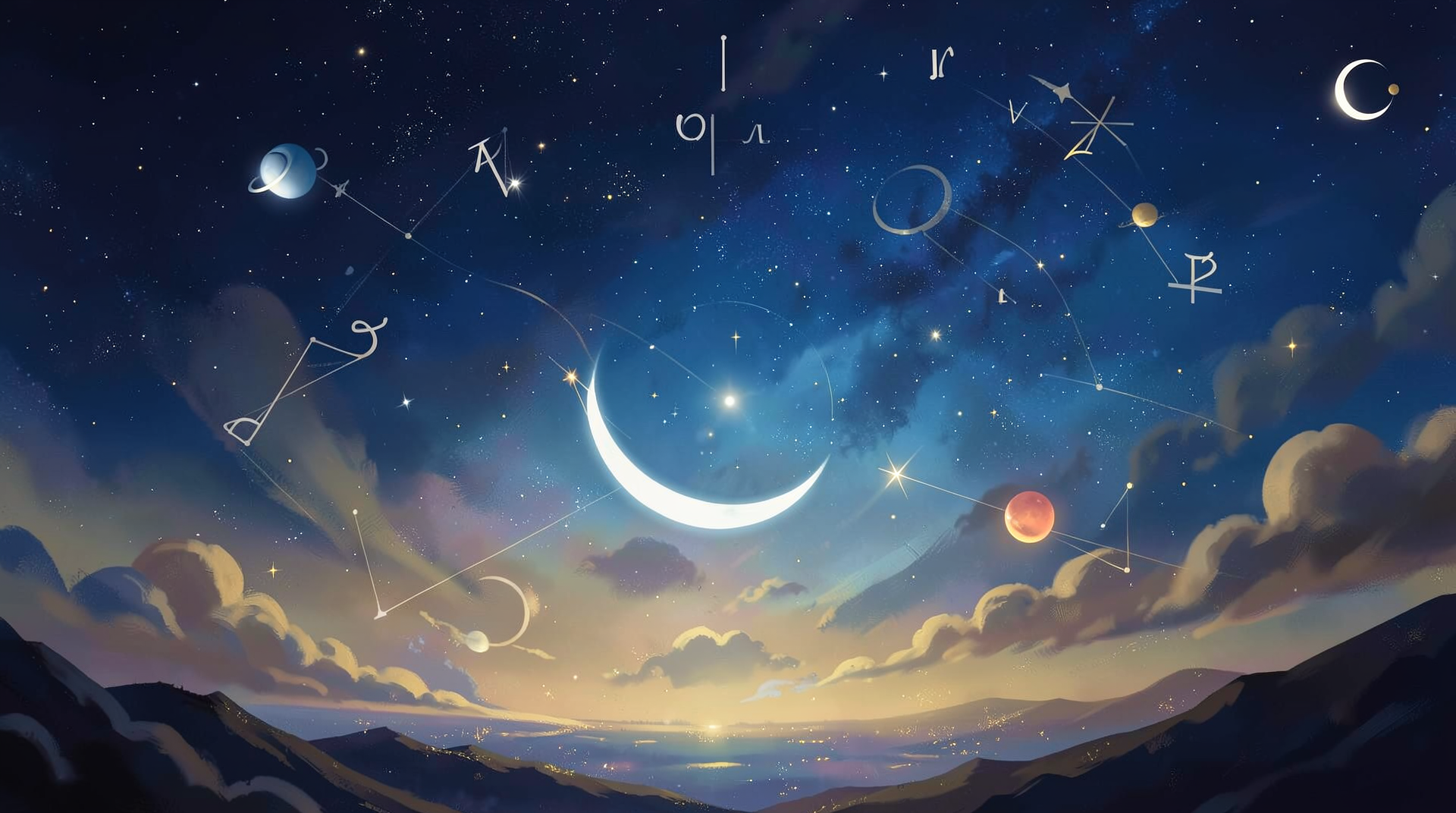

For a few breathtaking nights, the horizon did something the news cycle almost never allows for: it made everyone stop scrolling.
Mars, Jupiter, and Saturn — the wanderer, the expander, and the taskmaster — appeared in a rare near-perfect line, strung like beads along the ecliptic with a slim, glowing crescent Moon hanging beneath them like the notch on a cosmic key. The result wasn't just a pretty picture. It was the biggest surge in astrotourism and stargazing interest anyone in the dark-sky industry can remember.
Car parks at national parks were full by 6 p.m. Telescope retailers sold out of entry-level scopes. City dwellers who hadn't looked up since the last eclipse found themselves driving three hours to find true darkness. Booking platforms reported searches for "dark sky resort" and "astrotourism" up by triple digits year-on-year.
And astrologically speaking? The sky was handing us a thesis statement about collective desire, visibility, and the difference between looking up and actually seeing.
What Actually Happened in the Sky
Let's be precise about the mechanics, because the beauty doesn't diminish the geometry.
In the days around the event, Mars (in emotional Cancer early degrees), Jupiter (in regal, magnifying Leo near the anaretic—wait, no—near the heart of the Lion), and Saturn (in cardinal Aries, retrograde, standing his ground) swept into a rare near-linear configuration as seen from Earth. The crescent Moon, waxing slender and bright with earthshine, swept past to complete the postcard.
A few crucial truths before the poetry:
- It was a line of sight, not a cosmic coincidence. The three planets weren't physically stacked in space — they never are. What aligned was our perspective along the flat plane of the ecliptic, the Sun's apparent path through the sky. To the naked eye, it looked like a cosmic ruler had been laid across the twilight. That's what made it rare and stirring.
- It was visible to the unaided eye. No telescope, no filter, no app required. Mars glowed warm and amber-low, Saturn steady and patient, Jupiter blazing with its familiar, unblinking whiteness. The crescent Moon, delicate as a fingernail clipping, completed the scene.
- It is already ending. This is the part every "did you see it?!" post leaves out: the Moon moved on within two nights, and the planetary spread will slowly relax its geometry over the coming weeks. If you're only reading this now because a friend's photo went viral — you missed the headline act, but the show's closing notes are still spilling over the horizon.
The Astrology of the Lineup: Fire Meets Water Meets the Cardinal Edge
For an astrology audience, this wasn't just a pretty alignment of worlds — it was a recipe card for the season's deeper conversations.
Jupiter in Leo (at roughly 10° Leo during the height of the event) is the sun of the matter. Jupiter expands, blesses, and exaggerates whatever it touches. In fixed-fire Leo, it's the planet of more: more drama, more heart, more creative courage, more playing to the room. It rules the ninth house of the cosmos, travel, belief systems, and the search for meaning — which is why it felt like everyone, all at once, felt an almost patriotic pull to go see it for real.
Saturn in Aries, retrograde (around 14° Aries on the date) is the disciplinarian with his foot on the accelerator. Retrograde since late July, Saturn is asking us to review our structures, our boundaries, our adult responsibilities. In the alignment, he represents the legacy of the thing — the reason we build observatories and dark-sky reserves and protected wilderness corridors at all. He says: the stars were here before you, and they'll be here after — the least you can do is look up with respect.
Mars in watery Cancer (early degrees) adds the emotional undercurrent. Mars is the action planet, but in Cancer he's cautious, territorial, emotional, nourishing. This is not the hot rush of Aries or the raw power of Capricorn; this is the desire to protect what we love, go home, and stare at the infinite with the people who feel safe. Mars in Cancer deeply explains why astrotourism — the feeling of smallness and connection, the desire for the sublime and communal — surged.
And the crescent Moon? She's the master switch. A waxing crescent illuminates only a sliver, yet it appeared beside the mightiest outer planets like a tiny, perfect signature. In astrology, the Moon rules our instinct, our bodies, our habitual responses — and in a waxing phase, it's the energy of intention. The message written in the sky: small beginnings, guided by heart, can hold their own against the vastness.
The Astrotourism Boom: When the Sky Became the VIP
The astrotourism angle is where this stops being a sky report and becomes a cultural moment. It's no accident this happened in 2026, a year when:
- Dark-sky sanctuaries have multiplied from novelty to industry standard, with "star parks" in the Atacama, the high Alps, and outback Australia all reporting sellout camping seasons.
- "Slow travel" has converged with "awe tourism." Travelers are trading busy itineraries for the luxury of standing still in true darkness.
- Astrology-driven travel has grown up. People aren't just checking "see aurora borealis" off a list (though that's still huge); they're booking stargazing retreats to mark a Saturn return, a Jupiter return, a once-in-a-decade house move.
- Cities are the new desert. The light-pollution crisis has made real darkness a luxury commodity. To see the Milky Way clearly from your own yard is now the ultimate flex; to travel to see how your ancestors saw it is aspirational travel at its purest.
Astrotourism is booming because it offers something increasingly rare: genuine, un-poseable awe. You can't filter a meteor shower. You can't retouch the sky. You stand under it, and for a minute, the algorithm loses its grip on your nervous system.
The Shadow Side: What the Brochures Leave Out
It would be irresponsible to write a love letter to cosmic wonder without a caution flag, because the universe deals harshly with the uncurious. Here's the other side of the astrotourism coin.
The forecast is part of the show — and often ruins it. For every crystal-clear night above a Yosemite meadow, there will be a string of disappointing, clouded-out weekends where the biggest thing in the sky is weather fatigue. If you planned a once-in-a-lifetime trip specifically to see an event like this one, build in buffer time and a rain date; otherwise, you're gambling with forces no app can overrule.
The hype outruns the reality. When something breaks the mainstream, the marketing sharks circle. You'll see "rare once-in-10,000-year alignment" headlines for a standard conjunction that happens every few years. Apply healthy skepticism. A "rare planetary alignment" can mean anything from "genuinely not repeated in the lifetimes of anyone reading" to "two planets were sort of near each other in a bright sky." Do your own math before you book a non-refundable package based on an influencer's screen grab.
Light pollution is the elephant in the observatory. Ironically, the very act of hundreds of "astrotourists" descending on a prime viewing spot can destroy the very darkness they came to experience, with headlights, camera flashes, and drone lights. Travel responsibly: park your car with lights off, use red filters, and follow park rules to preserve the dark.
Displacement is a real concern. Some of the best stargazing spots are on Indigenous lands and in communities that have lived under these same skies for millennia — and they are now being priced out or overrun by visitors. The best astrotourism is regenerative: it gives back, employs locals, and protects the dark.
Telescopes don't fix a tired soul. And here's the honest truth: a $2,000 setup won't buy you wonder. Plenty of people traveled hundreds of miles, faced unexpected clouds, and went home aggrieved — because they confused the photo opportunity with the experience. The best astrologers know the planets just are; they're a mirror. If you can't be moved by a brilliant, unaided-eye sky, no equipment in the world will save you.
A Word on the Astrology (And the Caution)
Before we go further, a quick, loving reality check for the starry-eyed.
Astrology is a language of correspondence, meaning, and pattern — not a weather forecast for fate. No planetary alignment, however "once-in-a-decade" or "triple-mutant-rare," makes you do anything. If you feel a tug toward the cosmos in the coming weeks, let it be an invitation to explore your own relationship with the sky — not a standing order to quit your job and move to the desert on a whim (unless a lot of grounded, rational, Saturnine planning supports that move, in which case — bring back pictures).
A few cautions, offered with love:
- Avoid major, binding decisions simply because "the stars say so." If you feel a powerful urge to launch a business, end a relationship, or buy property under a Now Moon, sit with it for at least one full lunar cycle. Real insight compounds; impulsive decisions compound too, in the wrong direction.
- Watch out for the "New Wavelength" trap. With so much hype around an alignment, the temptation to dismiss the astronomy ("it's just light," some astrologers sniff, conveniently missing the point) can be as strong as the tendency to over-credit the event with magical powers. The truth, as ever, is in the middle: the sky reflects patterns; it doesn't dictate outcomes.
- Beware of overload. An unusually dense cluster of "cosmic guidance" in your feed is a sign to log off — not to max out your credit card on crystals and retreat deposits. Discernment is the highest wisdom of all, no matter how hard the algorithms push.
And remember the most grounding astrological fact of all: the sky is not happening to you; you are participating in it. Right now, as of this writing in late August 2026, we're still carrying the tremors of a major Neptune in Aries and a Saturn in Aries energy — a decade-long, generational gauntlet of redefining identity, boundaries, and selfhood. In that context, a collective, overwhelming urge to go outside, stand in the grass, and feel utterly dwarfed by a silent, starry sky makes perfect sense. The personality is an Aries battlefield; the soul just wants to reattach to something bigger than the ego.
How to Work With This Energy (Responsibly)
So the lineup has passed — but its energy hasn't gone anywhere. Here's how to honor the message of those few luminous nights all season long.
1. Take a "beginner's mind" night walk. You don't need a telescope, binoculars, or even to know your Andromeda from your elbow. Watch the Moon for a few nights in a row and notice how fast it moves against the fixed stars. That astronomical humility is the gateway to every good thing.
2. Protect the dark. If you saw the photos and felt a pang, turn it into a vote. Support local dark-sky initiatives. Advocate for outdoor light shields and warm-toned bulbs at home. Darkness is a habitat, and it's in ecological recovery right now. The sky is a shared commons; take care of it.
3. Plan for the next real event (August 2027: a solar eclipse across the continental U.S.!). No, seriously—put it in your calendar now, figure out the logistics, and give yourself a goal that involves looking up and being amazed. The anticipation is half the medicine.
4. Travel with intention. If you can afford to travel for the sky, great — do it in a way that doesn't erase the wonder for others. Support local guides, respect the land, save your stargazing dollars for places and people who treat the night as sacred, not just scenic. The universe rewards the patient.
5. Let it change you a little. The point of a once-in-a-while cosmic spectacle isn't to fill your camera roll — it's to recalibrate your perspective. The universe spent 13.8 billion years getting you to this very spot, under this one, singular, unrepeatable sky. That's not astrology. That's just true.
The Bottom Line
This latest alignment was a gift — a rare, camera-broken-in-half, "did you SEE that?" kind of gift. It gave astrotourism a much-needed financial shot in the arm, reminded a scrolling species that the greatest show on Earth isn't on a screen, and handed astrologers a satisfying hook for conversations about expansion, structure, and care.
But like the Moon that hung beside the giants of the solar system, it was also a reminder more than a destination. Something fleeting, bright, and destined to move on.
The stars don't need us to understand them to keep shining. They don't need our telescopes or our hashtags. They simply are — silent, ancient, and, on a good night, generous enough to line themselves up and give us all something worth looking at once in a while.
Catch your breath. Look up. The show's not over yet.
Astrology is a tool for reflection, not a substitute for professional, medical, financial, or legal advice. All planetary transits describe potential energy for exploration — no star chart should ever override your own judgment, common sense, or professional guidance. Travel safely, look after each other, and never look directly at the Sun (even during an alignment — especially during an alignment). The stars are wonderful, but they are not a licensed therapist.
Related Articles
Mars Closes to 11° of Jupiter in Leo: The Week 2026's Biggest Conjunction Starts Feeling Real
October 17, 2026
Mars hits 11° Leo this week, closing to within 11° of Jupiter — the moment 2026's biggest conjunction starts feeling real. What to expect, the shadow side, and how to work the build.
Mercury Is Tapping the Brakes in Scorpio: Finish Your Detective Work Before Its Late-October Retrograde
October 16, 2026
Mercury is slowing in late Scorpio before its October 22–24 retrograde station. A practical guide to finishing your detective work, sealing your contracts, and surviving the November rewind.
The October 15–18 Stand-Still: Pluto, the North Node, and the First Quarter Moon Line Up Their Stations
October 15, 2026
From October 15–18, 2026, Pluto's direct station at 3° Aquarius, the North Node's brake at the 29° Aquarius threshold, and the First Quarter Moon in Capricorn line up into a rare celestial standstill. Here's what the pause means — and how to work it.
First Quarter Moon in Capricorn (Oct 18): The Week's "Commit or Release" Moment
October 14, 2026
The First Quarter Moon in Capricorn (Oct 18, 2026, 16:10 UTC) squares the Libra Sun — a cosmic checkpoint asking you to commit or release. Plus Venus retrograde cautions, Pluto's station, and a do/don't guide for the week.