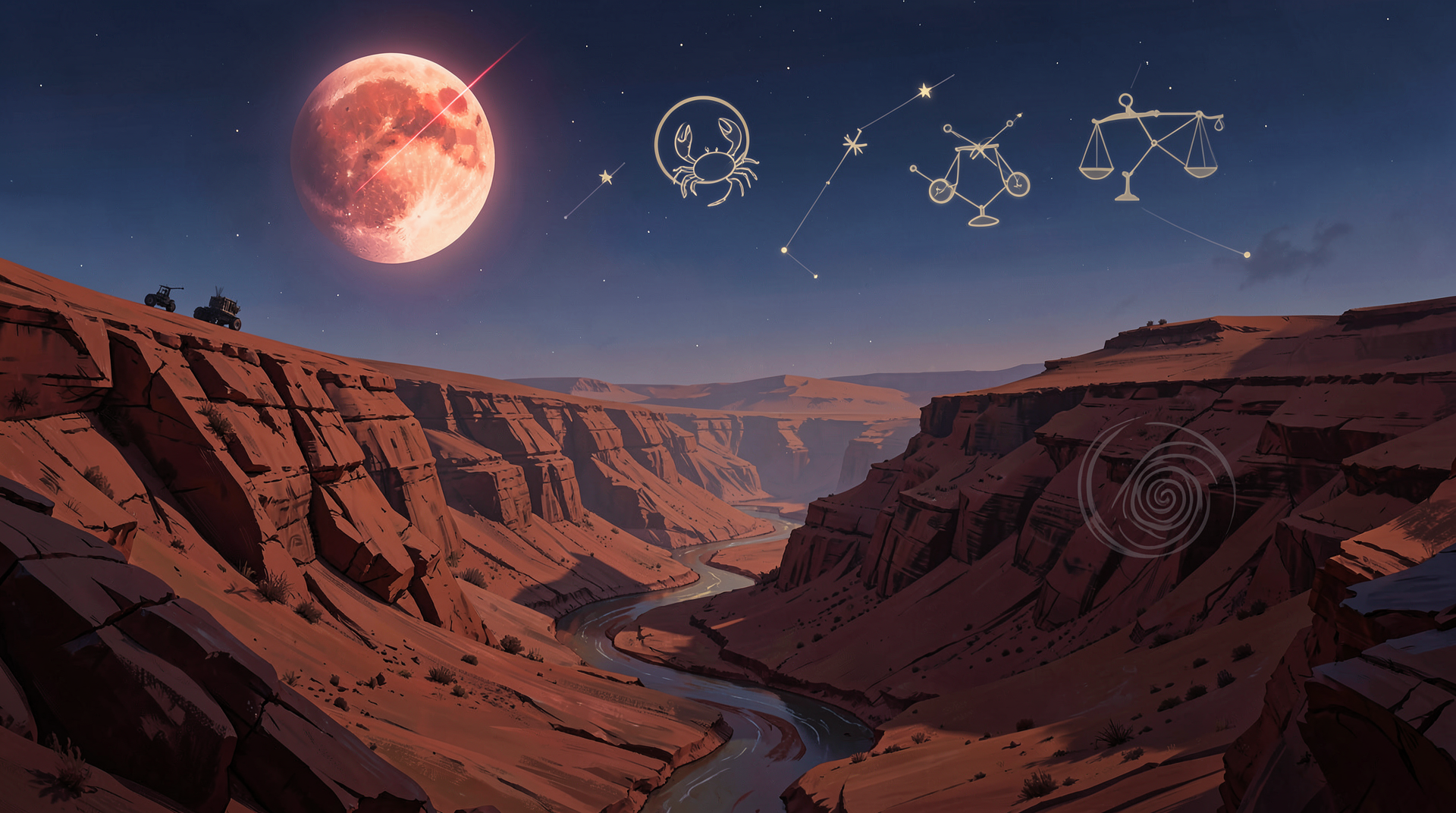
For hundreds of millions of miles, a question has traveled with us: are we alone? This week, NASA's Perseverance rover delivered the closest thing to an answer we have ever held in our hands — conclusive evidence of ancient microbial fossilization in the rocks of Jezero Crater. Life, it turns out, once left its imprint on Mars.
It is the kind of moment astrology lives for — not because the planets caused the discovery, but because the sky keeps an elegant, symbolic record of how such moments arrive. When we cast the charts of the rover's landing and the sky over the announcement, the symbols line up with a resonance that borders on poetry: a water-seeking machine born under a desert of a sky, the red planet transiting the sign of water, and a deep-reveal signature in the planets of truth and communication. Let's read it all.
What Perseverance Found
The announcement, made from NASA's Jet Propulsion Laboratory in Pasadena and corroborated by mission scientists worldwide, is epochal in scale: layered, stromatolite-like structures — mats of fossilized microbes — embedded in the delta sediments of Jezero Crater, the site of an ancient Martian lake. The structures show the telltale banding, mineral replacement, and chemical signatures of biological origin, and multiple independent instruments on the rover agree.
We must be careful with the word conclusive. What the rover has proven is that the evidence is consistent with ancient life — the physical samples remain on Mars, awaiting a future Mars Sample Return mission to be read under terrestrial microscopes. As we'll see, the sky over this announcement is just as careful, demanding that we hold wonder and verification in the same hand.
A Rover Born Under Wild Skies
Every mission has a "birth," and for Perseverance that moment was February 18, 2021, 20:55 UTC, when it touched down in Jezero Crater. Its natal chart is a fortune-teller's dream.
- Moon in Taurus, conjunct Mars in the 5th house. The Moon — ruler of tides, cycles, and the fertility of life — sits barely two degrees from the planet Mars itself, the red world, in the house of creation and discovery. If ever a machine was symbolically "born" carrying life-on-Mars in its chart, it is this one.
- Neptune in Pisces, in the 3rd house. The planet of mystery and the veiled unknown rides through the sign of waters in the house of investigation — the archetype of a probe sent to read secrets written in stone and sediment.
- A sky parched of water. Only 12% of the rover's birth chart falls in water signs, against a dominant 41% air. A machine built to search for water was born under a desert of a sky — an irony so sharp it reads like fate, and a reminder that what we lack on the surface, we sometimes find buried beneath it.
- Mercury retrograde at birth. The messenger planet was moving backward in Aquarius when Perseverance was born — a fitting omen for data that arrives slowly, out of order, and must be re-read many times before it means anything. It took more than five years for the rover's whispers to harden into proof.
- Midheaven in Libra, at 0°24'. The rover's "public stage" degree falls at the very threshold of the Scales — the sign of judgment, weighing, and fair assessment. Which is exactly what the science itself has demanded all along.
The Sky at the Announcement
Now cast the sky over the moment of revelation — the final week of September 2026. The planets are enlisted as witnesses:
- The Sun in Libra sits almost exactly on the rover's natal Midheaven. On the day of the announcement the Sun stood at 4°51' Libra, a hair's breadth from the 0°24' Libra Midheaven of Perseverance's birth chart. In astrological terms, that is the signature of a public achievement stepping into the full light — the moment a long, quiet labor becomes a headline. The Sun, the giver of life, shining on the place where the rover was "destined" to be recognized.
- Mars is in its final days in Cancer — the water sign. The red planet transits Cancer (until its ingress into Leo around October 1), moving through the sign of waters, feelings, and the primal feminine principle of life's origin. It is almost too on-the-nose: Mars itself, in the sign of water, presiding over the discovery of water-born life on Mars. In the transit chart, that watery Mars presses against the rover's natal Saturn — more on that in a moment.
- Mercury in late Libra, newly direct, rising as the evening star. The messenger planet of communication moves forward again at 26° Libra, carrying the news outward from the 8th-house threshold of revelation. Mercury, the planet that was retrograde at the rover's birth, has now straightened its course — as if to say the long-echoed message has finally found its voice.
- The Moon, waning gibbous in Aries, only days past the intense Harvest Full Moon of September 26, keeps a sober foot on the accelerator: the emotional fireworks of "we found life!" settle into the long, practical work of confirmation.
The Revelation Signature: Mercury Square Pluto
Look closely at the aspect between the rover's chart and the announcement sky, and you find the true engine of the story: transiting Mercury in Libra squares the rover's natal Pluto in Capricorn at 89° — a razor-tight, almost exact square.
Pluto is the great excavator: the force that digs beneath surfaces, unearths what is buried, and refuses to let secrets stay hidden. Mercury is the communicator, the one who carries the message to the world. When they square, the result is a truth that demands to be spoken — sometimes cleanly, sometimes prematurely. The same sky shows transiting Pluto conjunct the rover's natal Mercury (and its natal Saturn), the slow god of transformation laying hands on the machine's own "voice." The discovery was always going to be announced; whether it was announced well was always going to depend on scholarly restraint.
That is the caution baked into this chart: Pluto-Mercury squares are notorious for overclaiming. The temptation to shout "life!" at the first suggestive pattern — the temptation to let hope outpace evidence — is precisely what this aspect warns against. The scientists held their fire for years. We should do the same.
Mars in Cancer, and the Water That Remembers
Astrologers have long associated Mars with war, drive, and the spark of animating energy — but Mars in Cancer is Mars humbled, moving through the sign of memory, nurture, and the emotional deep. There is a folk-astrological tradition that Mars in water signs softens the warrior into the guardian of the hearth. Jacob Bronowski once said that we die so that things may continue; Mars in Cancer reminds us that life is carried forward in the touch of water and the storage of memory.
What Jezero Crater contains is precisely that: memory, stored in water. A river delta is a library written in sediment, and Perseverance has found its marginalia — the ghostly handwriting of microbes that lived, loved, and multiplied in a warm, wet Mars billions of years ago, when the Sun this week teaches us to look up, the planet named for the god of war is quietly teaching us to look back.
The Gauntlet: Saturn Opposite Mars and the Aries Retrogrades
Not everything in this sky is triumph. For the astrology of this event to be honest, we have to read the friction too.
- Transiting Mars in Cancer sits in applying opposition to the rover's natal Saturn in Aquarius. Mars says prove it to the world now; Saturn says proof is a process, and it is not finished. This is the astrological shape of the Mars Sample Return debate: the discovery inflames public demand to bring those rocks home, even as Saturn reminds Congress and the agencies of the cost. Expect budget battles, schedule slips, and geopolitical jostling over who gets to touch Martian rock first.
- The Aries Gauntlet is still on. Saturn, Neptune, and Chiron are all retrograde in early Aries — the "Aries Gauntlet" we've been tracking all September. Saturn retrograde demands rigorous verification; Neptune retrograde stirs projection — it invites us to see what we want to see in ambiguous images. A rusty smear on a landscape photo can become a "bone"; a rounded rock can become a "trilobite." Be wary of the feed, and trust the peer review.
- The Moon in Aries, waning toward the dark. Expect a crash of sentiment after the peak: the euphoria of "we are not alone" will be followed by the sober logistics of "what do we do with that?" That cycle is healthy. Let it complete.
What This Means for Us
For the collective human chart, this discovery is an event of the 9th house and beyond: the house of the cosmos, of origins, of the big questions. It gently rearranges our relationship to loneliness. If life took hold on a second world in our own solar system, the universe is not a desert — it is an orchard, and we were not the first seeds.
Astrologically, Mars in Cancer in the week of the Aries Full Moon offers a strange and beautiful gift: the warrior planet teaching the water-sign lesson of gentleness — that the strength of life is not in conquest but in kinship, in the shared chemistry of carbon and water that binds us to a microbe that died on a riverbank four billion years ago. When you look at the red star in the sky this week, don't see a battlefield. See a cradle.
A Word of Caution
Astrology is a language of meaning and reflection, not a predictor of scientific findings — and this is a story written by telescopes, spectrometers, and decades of painstaking labor, not by horoscopes. Let the chart be a mirror for how we feel and respond to the news, never a substitute for the evidence itself. Likewise, whatever you read in the transits, do not let any headline — astrological or scientific — rush you into grand conclusions. Excitement is welcome; verification is essential. If you feel the pull to make big life decisions in the glow of this news, give yourself the waning Moon's gift: time.
The Long Light
What makes this moment so profound is not that the sky "predicted" it, but that the sky and the discovery tell the same story — of water remembered, of messages delayed and finally decoded, of a desert world that was once a garden. Perseverance, a machine named for a human virtue, found fossils on a planet named for the god of war. Under a Cancer Mars and a Libra Sun, under the waning light of an Aries Moon, the cosmos handed us a mirror: we are made of the same ancient water and stardust as the life that once bloomed in Jezero Crater.
That is the echo in the crimson dust — and it sounds a lot like home.
This article is for reflection and inspiration, not a substitute for scientific reporting or personal, professional, or financial decision-making. Always consult primary sources — and your own discernment — before drawing conclusions or taking action.
Related Articles
The Stockpile in the Stars: The Astrology of America's Strategic Bitcoin Reserve
September 26, 2026
When Washington put bitcoin in a national vault, the planets were already writing the story. An astrological deep dive into the Strategic Bitcoin Reserve's birth chart, Trump's Uranus-on-the-Midheaven moment, and the Aries Full Moon questions of September 2026.
Through the Looking Glass: Apple's AR Glasses and the Astrology of the iPhone's Goodbye
September 26, 2026
Apple unveiled lightweight AR glasses — "Glass" — designed to eventually replace the iPhone. We read the sky at the reveal: a Libra Sun, a Scorpio Venus rising, and a Saturn–Pluto goodbye to the flagship era.
The Vacant Throne: The Astrology of Iran's Interim Leadership Council After Khamenei
September 26, 2026
After Supreme Leader Khamenei's death, Iran's Interim Leadership Council steers a state in crisis. We read the astrology: Saturn on the Republic's founding Sun, Uranus on its natal Moon, and the Neptune-touched Full Moon in Aries on Sept 26.
State of the Union 2026: The Astrology of the Great American Recovery
September 25, 2026
Chart cast for the 2026 State of the Union: Aquarius Sun conjunct Pluto, an anaretic Taurus Moon, late-Capricorn Mercury and Jupiter retrograde in Cancer — the astrology of 'The Great American Recovery.'