Peak Demand, Balsamic Moon: OPEC+ Confirms the Plateau — Four Years Early, Under a Sky of Endings
Vienna, July 9, 2026 — In a report that landed with the quiet gravity of a Saturn transit, OPEC+ issued its annual World Oil Outlook this morning, confirming what analysts have whispered for months: global oil demand has officially plateaued. The cartel's own models now show a flat line where a steady upward slope was once projected — four years ahead of the 2030 peak the organization had insisted upon as recently as 2024. The era of endlessly rising demand for the commodity that built the twentieth century is, by OPEC's own admission, over.
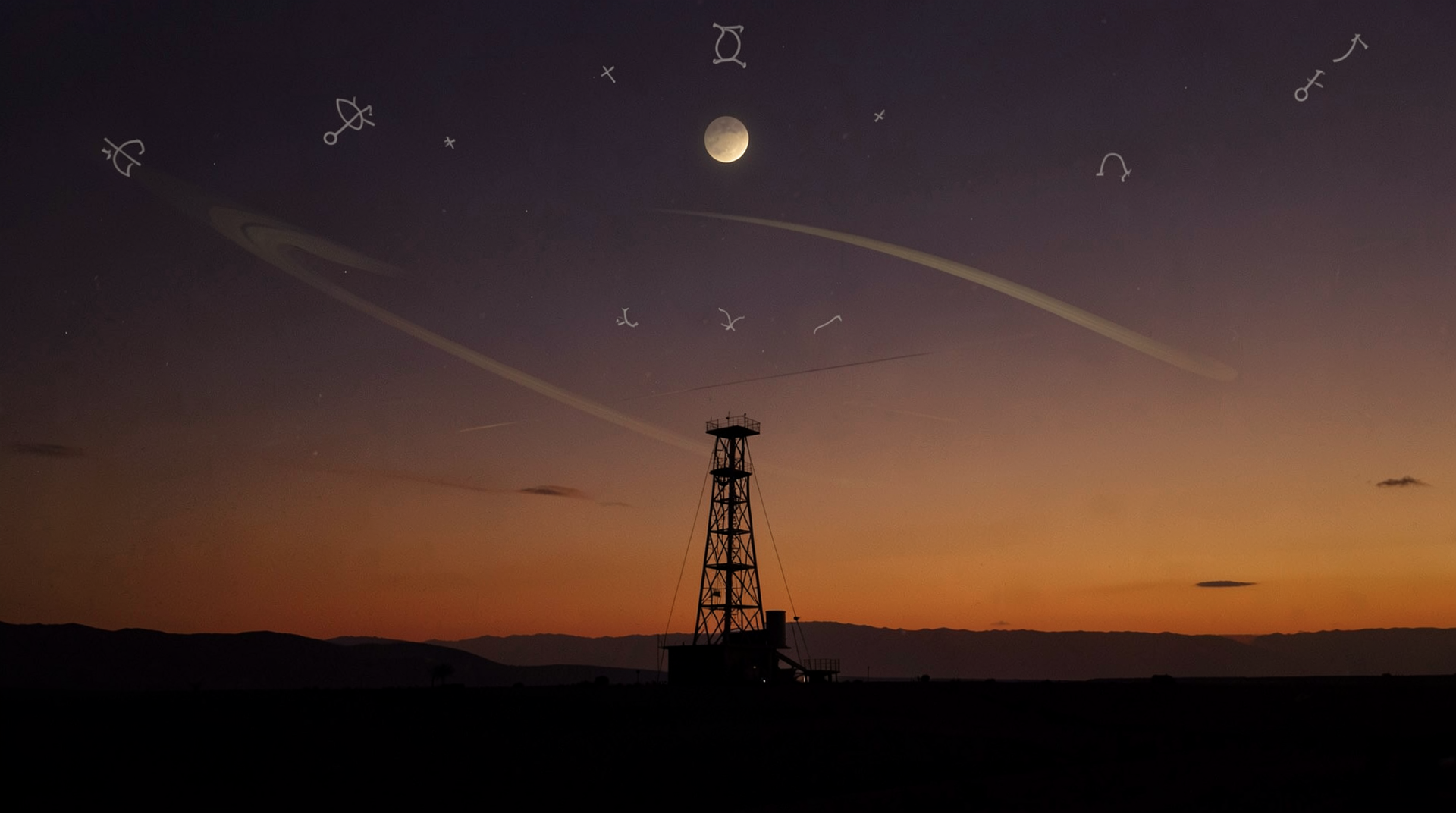
The report landed under a Balsamic Moon in Taurus — the darkest phase of the lunar cycle, when the Moon shrinks toward invisibility before the New Moon. In mundane astrology, the Balsamic Moon governs endings, release, and the quiet closure of cycles that no longer serve the living. That it falls in Taurus — the sign of material resources, value, and the Earth itself — is a cosmic punctuation mark that would be almost too on-the-nose, were astrology not so persistently, disconcertingly legible.
The Report Nobody Wanted to Write
For decades, OPEC's World Oil Outlook served as the industry's bullish bible. Each year, demand curves bent inexorably upward, driven by emerging-market growth, aviation expansion, and the petrochemical sector's insatiable appetite. Even as electric vehicles gained market share, even as renewables scaled, the cartel's message remained consistent: oil's best days are still ahead.
That message changed this morning.
The 2026 edition projects global oil demand stabilizing at approximately 103.5 million barrels per day — a figure essentially unchanged from 2024 levels — with a "gradual structural decline" beginning no later than 2032. The language is calibrated, diplomatic, bureaucratic. But the subtext is seismic: the growth model is dead. The plateau has arrived.
"This is not a cyclical trough," one senior OPEC economist told reporters on background. "This is the inflection point we had hoped to defer by another decade."
The Astrology of a Quiet Earthquake
The chart cast for the report's release — July 9, 2026, 10:00 AM in Vienna, where OPEC maintains its secretariat — is a study in endings.
Mars Conjunct Uranus in Gemini: The Sudden Word
At the Midheaven — the point of public visibility — sits Mars at 7° Gemini, within three degrees of Uranus at 4° Gemini. In mundane astrology, Mars-Uranus conjunctions deliver explosive revelations. In Gemini, the sign of data, communication, and reports, this conjunction electrifies the information itself. The report is not merely news; it is the kind of news that changes the structure of what people believe to be true.
Mars-Uranus in Gemini at the MC also squares OPEC's natal Sun-Virgo MC from 1960 — the founding identity of the cartel as the rational manager of global oil. That square is a direct challenge: the data contradicts the self-image.
Mercury Retrograde in Cancer: The Revised Story
Mercury at 23° Cancer is retrograde, retracing degrees it first crossed in late June. Mercury retrograde periods are notorious for miscommunication, delays, and re-evaluation — but they also bring revision. Reports issued under Mercury retrograde often contain data that has been revisited, corrected, or reluctantly conceded. The report's acknowledgment that earlier projections were wrong is classic Mercury-retrograde-in-Cancer territory: a painful emotional truth about security (Cancer) that must be spoken, however reluctantly.
Venus at 29° Leo: The Anaretic Farewell
Perhaps the most symbolically potent placement in the chart is Venus at 29°33' Leo — the final degree, the anaretic degree, of the sign of extravagance, royalty, and conspicuous consumption. Venus at 29° Leo in the 12th House of endings and hidden things is the astrological signature of a dying era of excess. The oil-fueled lifestyle of the twentieth century — the muscle car, the suburban sprawl, the cheap flight to a distant beach — reaches its symbolic terminus at this degree.
Anaretic Venus always carries a warning: the thing you love is at its final threshold. Hold too tightly and you will be dragged across.
Saturn at 14° Aries: The Fire, Constrained
Saturn at 14° Aries forms the backbone of the chart's structural meaning. Aries is fire — initiative, aggression, the raw combustion that oil literalizes. Saturn is limits, contraction, the cold reality of finitude. Saturn in Aries (where it will remain through 2028, joined by Neptune in a historic conjunction) says: the fire cannot burn forever. The plateau is not a political choice; it is a Saturnian fact, as indifferent as gravity.
Saturn in Aries also squares OPEC's natal Moon at 7° Cancer — the cartel's emotional body, its sense of security and nurturance. This square is painful. It describes an organization forced to accept that its core purpose — managing abundance — is being replaced by the task of managing scarcity.
Pluto Retrograde at 4° Aquarius: The Long Transformation
Pluto at 4° Aquarius, retrograde, opposes OPEC's natal Uranus at 23° Leo. Pluto in Aquarius governs the transformation of collective systems — the electrification of everything, the decentralization of power, the technological dismantling of legacy infrastructure. Its opposition to OPEC's Uranus (the cartel's radical founding vision) suggests a long-term structural transformation that no quarterly report can capture. The plateau is not an event; it is the visible edge of a Plutonian process that began years ago and will continue for decades.
The North Node at 0° Pisces: The Karmic Threshold
The North Node sits at 0°42' Pisces — the very threshold between Virgo (analysis, data, the compulsive need to measure and control) and Pisces (dissolution, surrender, the acceptance of what cannot be measured). A North Node at zero degrees always signals a karmic reset point. The message here is unmistakable: stop analyzing the data to death. The era of Virgoan control over resources is ending. The Piscean dissolution has already begun.
Why Now? The Convergence of Forces
The astrological narrative aligns with material realities that have accelerated faster than almost anyone predicted:
- Electric vehicle adoption crossed the 50% threshold in China, the world's largest auto market, in early 2026 — triggering a non-linear shift in gasoline demand
- Solar and battery storage costs fell below $20 per megawatt-hour in key markets, making new oil-fired generation economically irrational
- Petrochemical recycling technologies matured faster than expected, reducing virgin feedstock demand
- Aviation biofuels achieved commercial scale, eating into the last growth bastion of oil demand
- Carbon pricing mechanisms expanded across 73 jurisdictions, imposing structural costs on extraction
The Saturn-Neptune conjunction building in Aries throughout 2025–2026 has its own story to tell here. Neptune dissolves what Saturn has built. In Aries, the sign of combustion, of raw energy, of the forward thrust itself — this long conjunction describes the slow dissolution of the aggressive energy paradigm. Oil is not merely a fuel; it is a metaphysical principle made liquid: the stored fire of ancient life, burned to propel forward motion. Saturn-Neptune in Aries asks: what happens when forward motion no longer requires fire?
The Limits of Astrological Reading: Cautions and Caveats
It would be irresponsible to present the astrological chart as a prediction of economic outcomes. Astrology illuminates archetypal patterns, symbolic resonances, and the qualitative texture of moments in time — it does not forecast oil futures. The OPEC+ report itself carries the usual caveats about geopolitical disruptions, supply shocks, and the unpredictability of technological change.
Furthermore, a demand plateau is not a demand collapse. The world will consume approximately 103 million barrels of oil per day for years to come. The petrochemical sector, heavy transport, aviation, and industrial heat applications remain deeply dependent on petroleum. The plateau is a structural shift, not an overnight revolution, and it will unfold unevenly across regions and sectors.
Readers should also note that Mercury retrograde (through July 19, 2026) tends to produce data that is later revised or reinterpreted. The report's headline conclusion may shift in nuance as Mercury stations direct and retraces these degrees in August. Treat this as a provisional signal, not a final word.
Chiron at 0° Taurus: The Wound in the Earth
No astrological analysis of this moment would be complete without acknowledging Chiron at 0°34' Taurus — the wounded healer at the very first degree of the Earth sign. Chiron in Taurus speaks to the wound humans have inflicted on the planet through extraction. It also speaks to the wound within the economic system built on extraction — the communities, workers, and nations whose identities and livelihoods are inseparable from oil.
The Balsamic Moon in Taurus, conjoining Chiron in the coming days, illuminates this wound without offering easy salves. The end of demand growth is not simply a climate victory; it is also the beginning of a painful transition for millions of people whose lives are organized around the oil economy. The Balsamic Moon asks us to sit with that complexity — to grieve what is ending even as we release it.
Looking Ahead: The Cancer New Moon and What Comes Next
The Balsamic Moon phase ends with the Cancer New Moon on July 14, 2026 — a new lunar cycle seeded in the sign of security, home, and foundational needs. The New Moon will oppose Pluto in Aquarius, forming a T-square with Saturn in Aries. This configuration suggests that the post-plateau conversation will pivot rapidly from what is ending to how we secure what comes next.
Jupiter at 1° Leo, having just ingressed into the sign of creative fire, will trine that New Moon — an aspect of generative possibility. The message is clear: the plateau does not mean the end of energy; it means the beginning of a different kind of fire.
In Conclusion: The Gift of the Balsamic Moon
The Balsamic Moon is not a phase of despair. In the wisdom traditions that astrology draws upon, the dark Moon is the most sacred phase — the moment of greatest potential, when the old has been released but the new has not yet been seeded. It is the pregnant darkness.
OPEC's report, for all its sobering implications, is a Balsamic Moon document. It closes a chapter that began in Baghdad in September 1960, when fourteen nations gathered under a Virgo Sun and a Sagittarius rising to assert sovereignty over their resources. For sixty-six years, that assertion has shaped the global order. The plateau does not erase that history; it completes it.
The question the stars pose on July 9, 2026, is not how do we keep the fire burning? It is: what do we build in the darkness, before the next fire ignites?
Disclaimer: Astrological analysis is offered for reflective and interpretive purposes only. It does not constitute financial, investment, or policy advice. Planetary transits describe archetypal patterns and symbolic resonances; they do not predict specific economic outcomes. All readers are encouraged to consult qualified financial and energy-sector professionals when making decisions related to commodity markets, investments, or energy policy. Astrology invites contemplation — it does not replace due diligence.
Related Articles

First Quarter Moon in Capricorn (Oct 18): The Week's "Commit or Release" Moment
October 14, 2026
The First Quarter Moon in Capricorn (Oct 18, 2026, 16:10 UTC) squares the Libra Sun — a cosmic checkpoint asking you to commit or release. Plus Venus retrograde cautions, Pluto's station, and a do/don't guide for the week.
Venus Retrograde in Scorpio Squares Pluto All Week: The Love-and-Power Test Peaking Around Oct 20
October 13, 2026
Retrograde Venus in Scorpio squares Pluto all week, exact around Oct 19–20 as Pluto stations direct. How to survive the love-and-power test — what to avoid, who feels it, and how to pass it.
Scorpio to Capricorn by Way of Sagittarius: Your Day-by-Day Lunar Weather for Oct 12–18
October 12, 2026
The Moon travels from Scorpio through Sagittarius into Capricorn Oct 12–18, 2026. Your day-by-day lunar weather, key aspects, and caution zones — including the First Quarter Moon on Oct 18 and Pluto's direct station.
The Fixed-Sign Fortress: Leo Mars–Jupiter, Scorpio Venus–Mercury and Why This Week Has No Quick Fixes
October 8, 2026
Why the fixed-sign fortress of Leo Mars–Jupiter and Scorpio Venus–Mercury makes October 8–11, 2026 a week with no quick fixes — and how to work with the sky instead of against it.