Oil Prices Surge as Middle East Hostilities Escalate: The Astrology of the Barrel and Inflation's Shadow
It began in the Gulf of Oman, as so many supply shocks do: a sudden escalation along the Strait of Hormuz, a flare-up that traders had been pricing for weeks and half-hoping would never come. By Friday, September 4, 2026, the headlines were no longer about posture or prediction. Oil was up sharply, futures curves were steepening, and economists were once again whispering the word central banks dread most: inflation. Renewed Middle East hostilities have pushed crude prices higher and re-opened the question of how much the global economy can absorb before it staggers.
For the astrologer, this is not a neat story about charts and barrels — it is a live, breathing example of mundane astrology: the ancient practice of reading world events through planetary signature. And the sky on this particular Friday is unusually loud. A Last Quarter Moon in Gemini, a freshly stationed-direct Uranus, Mars grinding through Cancer's eighth house, and Neptune retrograde in Aries are all writing on the same wall. The message is less "oil will reach X dollars" than it is a weather report for a season of volatility, rumor, and reckoning. Let's read it.
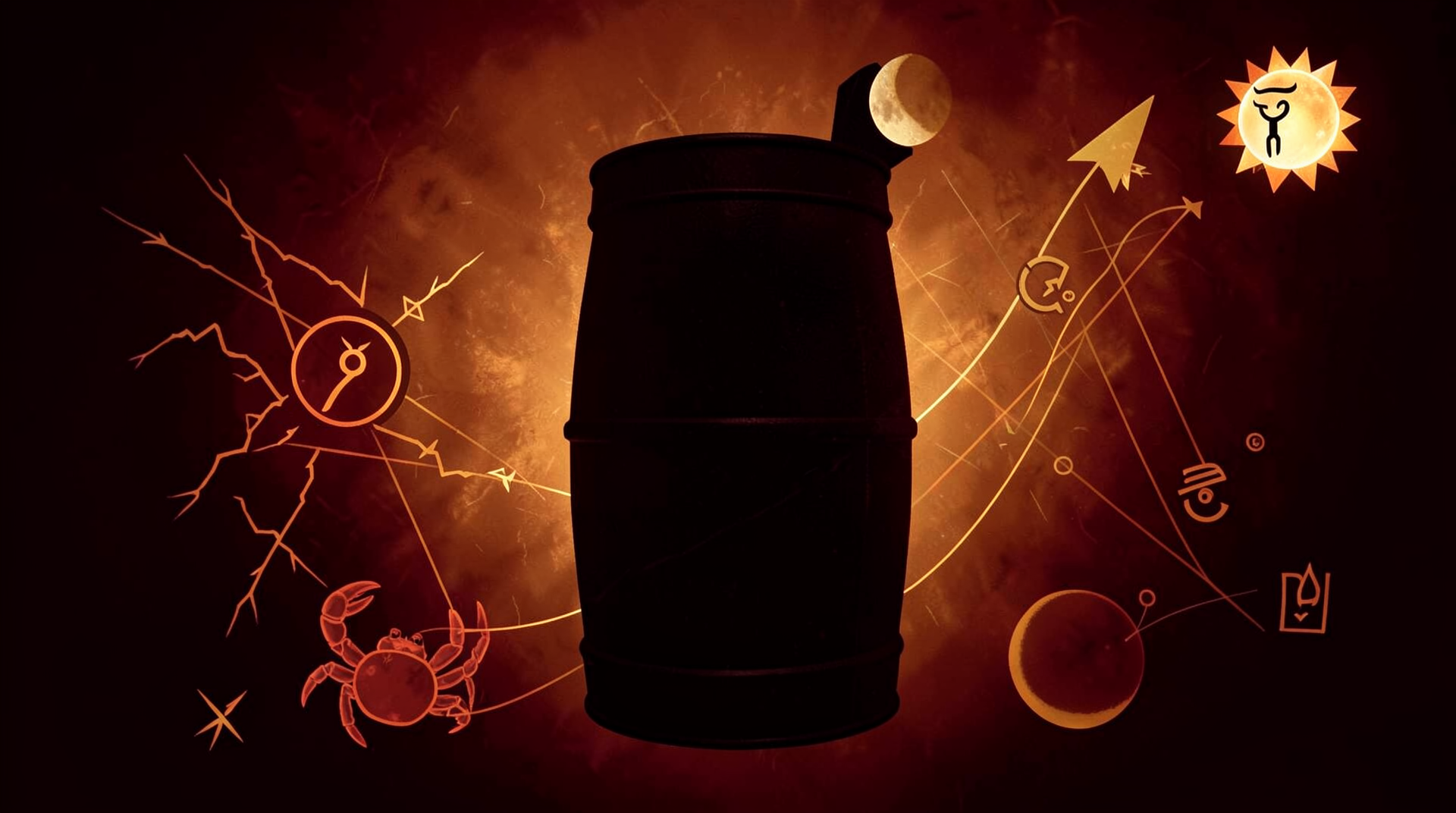
What Actually Happened
For context beyond astrology: a fresh round of hostilities in the Middle East — renewed naval skirmishes near the Strait of Hormuz and strikes on energy infrastructure deeper inside the region — sent benchmark crude prices climbing in early September. The Strait itself remains the single most consequential oil chokepoint on Earth, carrying roughly a fifth of global petroleum consumption. Any credible threat to that narrow waterway doesn't just move prices; it moves the entire economic weather system. Analysts cite three immediate consequences:
- A direct supply risk premium priced into every barrel, as shippers, insurers, and refiners hedge against disruption.
- A freight and insurance shock, as war-risk premiums on Gulf tankers multiply overnight.
- Fresh upward pressure on inflation, precisely at a moment when headline price growth had looked like it was finally cooling.
For households, the through-line is painfully simple: more expensive fuel compounds food, transport, and energy costs. For markets, it is a reminder that geopolitical risk is not an abstract metric — it is a barrel with a fuse.
The Chart at the Moment of Escalation
Casting the sky for Tehran at midday on September 4, 2026 (the morning the price surge consolidated), the chart's most striking feature is not a single planet but a constellation of stresses and reversals that looks almost choreographed. Here is what lines up.
Mars in Cancer in the Eighth House: The Deepest Wallet, the Sharpest Claw
Mars — the traditional significator of conflict, war, and aggression — sits at 15° Cancer in the eighth house, the sector that rules shared resources, debt, other people's money, and, in the oldest financial texts, the assets that float between nations. Cancer is a sign of territory, homeland, and protective walls; Mars in Cancer fights defensively, but it fights harder than almost any other placement when it perceives home ground being threatened. The Strait of Hormuz is, astrologically speaking, a textbook eighth-house Cancer Mars theater: the defense of land and livelihood through control of the collective's shared fuel supply.
This placement is also about emotional economics. Market participants are not cold calculators here; they are anxious guardians of the family budget, the retirement account, the national reserve. Expect decisions driven more by fear of loss than hope of gain — a classic eighth-house Mars profile.
Uranus Stationing Direct in Gemini: The Shock That Keeps Shocking
Uranus, the planet of rupture, surprise, and sudden reversals, has just completed its retrograde and is stationing direct at 5° Gemini in the seventh house of treaties, partnerships, and open adversaries. A station — the moment a planet appears to pause before changing direction — is one of the most volatile signatures in astrology; the planet's energy is magnified and discharged like a held breath. In Gemini (information, trade routes, contracts) and the seventh house (enemies and alliances formally arrayed against each other), this is the signature of a news-driven market that can reverse direction violently on a single headline.
The practical translation: expect whiplash. A morning of panic-buying can give way to an afternoon of profit-taking, and diplomatic statements can move prices more than military ones. Uranus stations are notorious for after-shocks that continue for days or weeks even after the station moment passes.
Sun and Mercury in Virgo in the Tenth House: The Ledger Gets Scrutinized
The Sun and a fast-moving Mercury travel together in Virgo in the tenth house — the sector of the public sphere, governments, and the visible economy. Virgo is the sign of analysis, measurement, and the humble household account book. As oil climbs, this signature turns every central bank watchtower into a forensic auditor: every jobs report, every CPI print, every OPEC communiqué will be dissected for what it really means for inflation. The tenth house placement puts governments and regulators under the microscope — and, given Mercury's proximity to the Sun (still within combustion's lingering glare), official messaging may be muddled, hedged, or delivered with less clarity than the moment demands.
The Last Quarter Moon in Gemini: The Moon of the Re-Evaluation
Today's Moon is in the Last Quarter phase — the waning square — at 12° Gemini in the chart's seventh house. The Last Quarter is astrology's crisis-of-consensus moment: whatever was believed and built mid-cycle is now questioned and must be released. In Gemini, that means narratives. The market is not just trading oil; it is trading stories about oil — who controls it, who can ship it, who is bluffing. A Last Quarter Moon in Gemini excels at exposing a narrative's weak seam. It also favors cutting positions, trimming exposure, and waiting rather than committing — themes we'll return to in the cautions below.
Pluto Retrograde in Aquarius in the Second House: The Deep Revaluation of Value
Pluto, the planet of death and transformation, is retrograde at 3° Aquarius in the second house of money, resources, and what a society collectively owns. This is the slow-burn signature behind the moment's deepest underlying question: what is a barrel of oil actually worth in a world rewiring its energy system, its currency alliances, and its supply chains? Pluto retrograde in the second house suggests that surface prices are only the visible crust of a profound re-pricing of resources themselves. The inflationary fear is not just that prices rise — it is that the scale of value is being permanently renegotiated.
The Fog of War: Neptune Retrograde and the Danger of Believing the Headline
Every war is fought twice — once with weapons, once with words — and that second battle is Neptune's territory. Neptune is retrograde at 3° Aries in this chart, and in wartime contexts, a Neptune in the foggy, dissolving sign of Aries is the classic signature of misinformation, exaggerated claims, speculative rumors, and sincerely believed falsehoods. Attack footage circulates before it is verified. Supply-disruption estimates are revised up, then down. "Sources familiar with the matter" multiply like shadows.
This is the single most important caution of the week: the price spike and the headlines are both partly a Neptune retrograde mirage zone. Some of what pushed oil up today is real; some of it is rumor compounding on itself. Discerning which is which — literally the work of Virgo's Sun and Mercury — is the whole game. Traders, journalists, and ordinary consumers alike should demand verification before reacting. If a claim seems to confirm the worst fears, Neptune retrograde says: check it twice.
What This Means for Markets, Households, and Governments
For traders and investors
The sky's message is volatility with unreliable information. The Uranus station argues for wider-than-usual swings; the Last Quarter Moon argues for de-risking rather than doubling down; Neptune retrograde argues for treating every headline as provisional. Astrologically, this is not a configuration that rewards heroic conviction — it rewards patience, stop-losses, and position sizing that can survive a false rumor. Astrology is guidance, not a trading signal; but as risk weather, this sky reads as "expect turbulence, respect it."
For households and everyday finances
Mars in the eighth house stokes anxiety about the family budget, and with the Sun and Mercury in Virgo, the practical response is literal bookkeeping: review energy costs, revisit discretionary spending, build a small cushion against pump-price shocks. Inflation fears are real, but they are also the emotional fuel of this chart — do not let fear dictate large purchases or long-term commitments made in a panic.
For governments and central banks
The tenth-house Sun–Mercury in Virgo puts official communication under intense scrutiny: markets will parse every sentence from every minister and banker for signals on interest rates, fuel subsidies, and strategic reserve releases. Delays are likely — Saturn is retrograde in Aries, and retrograde Saturn rarely delivers rapid, friction-free policy relief.
The Cautions: When Things May Not Go As Hoped
A responsible reading must resist tidy optimism. This chart is not one of quick resolution:
- The Uranus station aftershock window extends for roughly two weeks after September 4. Sudden reversals — both escalations and de-escalations — remain possible as headlines flip.
- Neptune retrograde in Aries means the true state of supply could be obscured for some time; a "solution" announced in the media may dissolve upon inspection.
- Mercury's lingering combustion near the Sun muddies official statements and can turn press conferences into exercises in ambiguity.
- The Last Quarter Moon's counsel is release, not acquisition: this is a poor window for impulsive financial decisions, poorly hedged positions, or assuming a diplomatic scramble means the crisis has passed.
- Retrograde Saturn in Aries warns that sanctions, negotiations, and ceasefire frameworks will face delays, revisions, and bureaucratic friction before anything is sealed.
Disclaimer: This article pairs current events with astrological symbolism for reflection and context — it is not financial, investment, or political advice. Commodity prices respond to real-world logistics, policy decisions, and human decisions that no chart can fully capture. Never make major financial decisions on the basis of a horoscope alone; treat the sky as one lens among many, and consult qualified professionals for matters of money, safety, and law.
The Deeper Current: Pluto, Uranus, and the Rewiring of Resources
Zoom out from this single Friday and the larger story is the 2020s' slow tectonic shift: Pluto in Aquarius, Uranus in Gemini, and the North Node in Aquarius are collectively rewriting how the world shares energy, information, and wealth. Oil shocks are not new — the seventies proved that — but the context is. A world moving (unevenly) toward renewables, digital currencies, and new trade blocs is a world where the price of old energy carries new-political meaning. Today's spike is a wave; the current beneath it is the greatest re-pricing of natural resources in a generation.
Conclusion
Oil is up. Inflation fears are back. The Strait is smoking. And the sky is doing what skies always do: holding up a mirror. Mars in Cancer in the eighth house shows us a conflict over the world's shared fuel, fought with homeland-defensive fury. Uranus stationed direct in Gemini predicts headline whiplash and sudden reversals. Neptune retrograde warns us not to believe everything we read. And the Last Quarter Moon asks us, quietly, what we are willing to release.
The practical takeaway is neither doom nor denial. It is discernment: verify the news, steady the household budget, resist impulsive bets, and remember that astrology describes weather, not destiny. The market will move again tomorrow — the question is whether we move with fear, or with awareness.
Stay grounded, stay informed, and let the stars keep you humble rather than certain.
Related Articles
Mars Closes to 11° of Jupiter in Leo: The Week 2026's Biggest Conjunction Starts Feeling Real
October 17, 2026
Mars hits 11° Leo this week, closing to within 11° of Jupiter — the moment 2026's biggest conjunction starts feeling real. What to expect, the shadow side, and how to work the build.
Mercury Is Tapping the Brakes in Scorpio: Finish Your Detective Work Before Its Late-October Retrograde
October 16, 2026
Mercury is slowing in late Scorpio before its October 22–24 retrograde station. A practical guide to finishing your detective work, sealing your contracts, and surviving the November rewind.
The October 15–18 Stand-Still: Pluto, the North Node, and the First Quarter Moon Line Up Their Stations
October 15, 2026
From October 15–18, 2026, Pluto's direct station at 3° Aquarius, the North Node's brake at the 29° Aquarius threshold, and the First Quarter Moon in Capricorn line up into a rare celestial standstill. Here's what the pause means — and how to work it.

First Quarter Moon in Capricorn (Oct 18): The Week's "Commit or Release" Moment
October 14, 2026
The First Quarter Moon in Capricorn (Oct 18, 2026, 16:10 UTC) squares the Libra Sun — a cosmic checkpoint asking you to commit or release. Plus Venus retrograde cautions, Pluto's station, and a do/don't guide for the week.