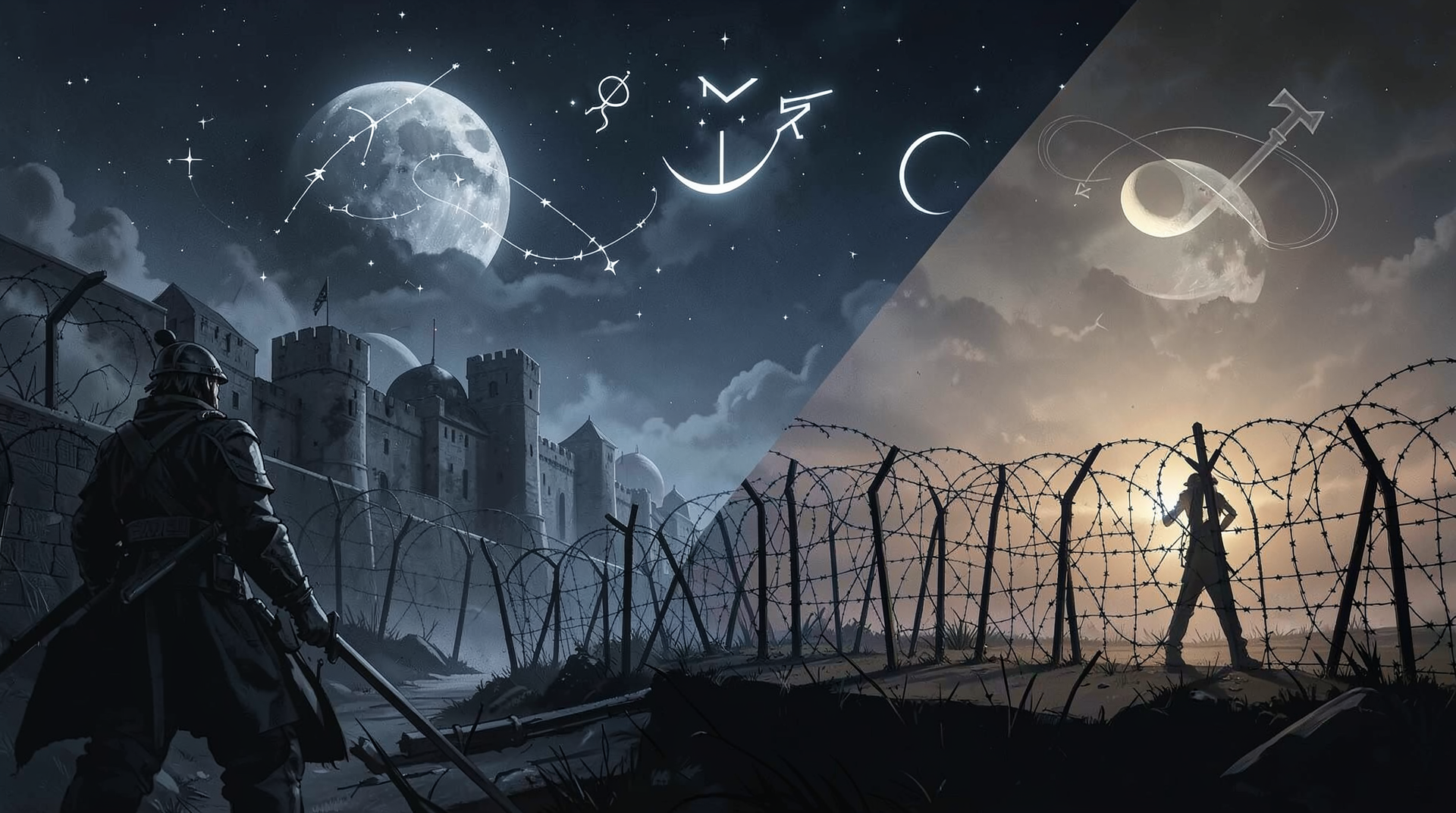
Around the fortified heart of the Korean Peninsula, a rare and delicate event has punctuated the summer quiet: South Korean authorities reported that a North Korean soldier crossed the Demilitarized Zone (DMZ) and defected. The crossing — a feat of extraordinary nerve through one of the most heavily fortified strips of land on Earth — is both a human story and a geopolitical tremor that reverberates far beyond the barbed wire.
Defection across the DMZ is uncommon, because the border is a wall of minefields, watchtowers, motion sensors, and twin armies standing within shouting distance of each other. That a single soldier could slip through it, whether on foot through the Joint Security Area or through the rugged mountainsides of the Civilian Control Zone, is a reminder that the two Koreas remain, seventy-eight years after partition, locked in a frozen state of unresolved war.
In this article, we look at the news through the lens of mundane astrology — reading the planetary sky of August 8, 2026, against the charts of the two Koreas and the tense geometry of the border itself. As always, we'll treat astrology as a language of timing, meaning, and warning rather than as a tool of prediction.
Two Nations, One Wound: The Charts in Play
The Republic of Korea (South Korea) was formally established on August 15, 1948, giving it a Leo Sun — a chart crowned by a strong 10th-house Mercury and Saturn, and an Aries Descendant. In mundane astrology the Descendant (the western horizon, the 7th-house cusp) represents "the other" — the partner, the adversary, the relationship that defines and mirrors a collective identity.
For South Korea, that Descendant in Aries has always pointed, with painful literalness, toward the North: the aggressive, martial "other" across the line. The Demilitarized Zone isn't just a geographic border; astrologically it sits on the Descendant, the threshold where self meets adversary.
The Democratic People's Republic of Korea (North Korea) was proclaimed on September 9, 1948 — a Virgo Sun with a Scorpio Ascendant and a Sagittarius Moon rising. A Scorpio-rising nation is secretive, impenetrable, and immovable from within — traits that make the act of a citizen walking out of it all the more remarkable, and all the riskier.
Reading the Sky of August 8, 2026
Casting the chart for the event at the DMZ (near Panmunjom) on the morning of August 8, 2026, several configurations stand out — powerful not as omens of inevitability, but as symbols that help us understand the character and risk of the moment.
Mars in Gemini: The Messenger Who Crossed
The most striking signature is Mars in Gemini at nearly 28° (the final, "anaretic" degree of the sign), sitting high in the event's 9th house — the house of foreign lands, long journeys, borders, and the crossing of horizons. Mars is the soldier, the blade, the act of will; Gemini is the sign of movement, the threshold, the swift crossing from one place to another.
On South Korea's natal chart, transit Mars lands in the 9th house too: the house of international affairs and boundaries being traversed. Gemini rules messengers, defectors, and people who "pass between." A Mars-in-Gemini crossing of a border — fast, decisive, information-bearing — is almost textbook symbolism for a defection that moves a body and a story from one side to the other.
But Mars at the anaretic 29th degree, especially carrying the trailing themes of the recent Mars–Uranus conjunction in Gemini (so prominent through late July and early August), brings an edge of instability, surprise, and unpredictability. This is not a static turn; it is a hinge, a teetering moment where the outcome could pivot.
Saturn on the Descendant: The Frozen Gavel on the Frontier
Perhaps the deepest signature is retrograde Saturn in Aries at 14° sitting almost exactly on South Korea's Aries Descendant — the axis of "the other." In mundane astrology, Saturn on the Descendant is the frozen gavel: a period when the relationship between self and adversary is locked, hardened, and subject to slow, grinding reckoning.
This echoes a theme running through the whole of 2026: Saturn's long retrograde station in Aries, the "frozen gavel" that has colored so many world events this year. On the Korean frontier it speaks to the rigidity of the standoff — the decades-old inertia of a conflict that neither side would dare to break, even as individual human beings risk everything to cross it.
Saturn opposite the Sun in this same window hints at tension between the North Korean state (structure, control, the wall) and the individual will to freedom. The defector's act is a personal Saturn — the assumption of enormous responsibility and consequence — set against the collective's Saturn, the frozen machinery of state.
Pluto Under the Nation's Threshold
Transit Pluto in Aquarius is converging on South Korea's Imum Coeli (the IC, the 4th-house cusp) — the foundation, the roots, the home soil. Pluto here is a deep, generational pressure working on the nation's foundations: questions of identity, history, security, and what "homeland" even means when one family is cleaved in two by a line of wire and mine.
Meanwhile, the Moon in Gemini in the event's 9th house opposing South Korea's natal Moon in Capricorn speaks to emotional news arriving across a border — the surge of empathy, uncertainty, and collective feeling that a defection (and, historically, the fate of the defector) always stirs.
What the Defection Means — and What It Doesn't
It's worth being precise about the limits of astrological reading here, and the limits of the event itself.
A single defection does not change the strategic equation on the peninsula. The DMZ has seen defections before — soldiers, diplomats, even high-ranking officials — and each one has been a human drama that left the geopolitical framework essentially intact. The "frozen gavel" of Saturn on the Descendant is a warning against over-reading any single event as a turning point: systems that are this hardened do not crack from one act of individual courage, however brave.
We should also hold space for the human cost and the unfinished story. A defector's crossing is usually the beginning, not the end, of a harrowing ordeal: interrogation, resettlement, questions of family left behind, and the often-painful process of becoming a new citizen. The North Korean state, for its part, has historically responded to defections with severe retaliation against the soldier's family and unit. The courage of the crossing is real; so is the shadow it casts.
The Vigilance of the Waning Crescent
The event falls under a waning crescent Moon — a dark, still, introspective phase near the end of the lunar cycle, before the Leo New Moon. Waning crescents are not moons of triumph; they are moons of waiting, of aftermath, of the quiet that follows a rupture. They favor caution over celebration, and patience over conclusions.
This is reinforced by the wider retrograde backdrop of August 2026: Saturn retrograde in Aries and Neptune retrograde in Aries are both operating in the same cardinal degrees the frontier occupies. Retrogrades ask us to slow down, review, and avoid rushing to judgment or irreversible commitments. For a situation as volatile as the Korean border, the counsel is almost Shakespearean: hold, watch, and verify.
To that end, a few cautions feel appropriate:
- Do not treat this as a reliable "signal" of regime collapse or imminent reunification. Astrologically and strategically, single events rarely equal turning points in systems under heavy Saturn.
- Beware the fog of Neptune. Retrograde Neptune in Aries warns that information may be incomplete, sensationalized, or manipulated in the first hours of such reports. Details of where, how, and why the soldier crossed may shift as the story develops.
- Humanitarian discretion matters. The defector's identity, safety, and family are at stake. Sensationalism — astrological or journalistic — does real harm to real people in these windows.
How This Reads for Individuals, Not Just Nations
Mundane astrology is fascinating partly because it mirrors personal experience. The symbolism of this event — Mars in Gemini crossing a line under a Saturn-backed boundary — is a poignant metaphor for anyone standing at their own frontier in early August 2026.
If you have been weighing a major change — leaving a situation, crossing into unfamiliar territory, committing to a new direction — the sky suggests you are not wrong to feel both the pull and the danger of it. Mars in Gemini rewards bold, well-informed movement; Saturn on the Descendant reminds you that every crossing comes with consequences and responsibilities you cannot negotiate away.
But the waning-crescent stillness counsels preparation over impulsiveness, and the retrograde season warns that reversals are possible. Move with courage, yes — but verify your ground, protect what you're leaving behind emotionally, and don't mistake a single brave step for the whole journey.
A Responsible Word on Astrology Itself
Let's be clear about what astrology is and is not. Astrology offers a language of timing, atmosphere, and psychological resonance — it can help us frame and reflect on events, but it cannot predict them, and it is not a substitute for geopolitics, journalism, or humanitarian judgment. No planetary configuration "causes" a soldier to run toward freedom, and no chart determines the outcome of a border crisis. Real defections are made by real people making impossible choices under real danger.
Use the sky as a mirror and a caution, not as a crystal ball.
Conclusion: The Line, the Threshold, and the Brave Crossing
A North Korean soldier crossing the DMZ is a reminder that even the most frozen frontier is, at its edges, made of people — people who can choose, against every structure designed to stop them, to step across a line. The astrology of August 8, 2026 honors that moment as a Mars-in-Gemini crossing under Saturn's watchful gavel: an act of individual will against collective rigidity, at once inspiring and fragile.
The waning moon asks us to watch and wait before we draw conclusions. The frozen gavel reminds us how much remains unchanged. And yet the crossing itself — a single human body in motion across the most guarded line on Earth — is, in every language, a small and luminous defiance of the machines that drew it.
We extend our hopes for safety and dignity to the defector, and our attention to the unresolved grief of a peninsula that has waited seventy-eight years to be whole again.
Related Articles
The End of High Rates: The Cosmic Story Behind the Fed's 50BP Cut
September 23, 2026
Astrology meets the FOMC: what the 50BP rate cut announced under Mercury retrograde and a Virgo Sun really looks like in the sky, why 2.0% inflation mattered, and when to double-check the fine print. Not financial advice.
An Arrow at the Haram: The Astrology of the Drone Launched at Mecca — and the Russia–Iran–Houthi Shadow Behind It
September 23, 2026
Reports say Russia helped Iran and Houthi forces launch a drone at Mecca. We cast the chart over the Holy City at dawn on Sept 19, 2026: Uranus retrograde in the 9th house, Saturn–Neptune in the 7th, Venus square Pluto, and the First Quarter Moon at the threshold degree.

When the Forest Gets a Day in Court: The Amazon Declared a Legal Person Under a Sky of Scales
September 22, 2026
Brazil's Supreme Court grants the Amazon legal personhood on the Libra equinox. An astrological reading of the ruling chart, the Virgo–Libra threshold, and the long work of making nature's standing real.
Harvest Moon at the Ram's Gate: The Sept 26 Full Moon in Aries Meets Neptune
September 22, 2026
The Harvest Moon rises at the Ram's Gate on Sept 26, 2026: a Full Moon in Aries conjunct Neptune for the first time in ~165 years. What to expect, who feels it most, and where to stay cautious.