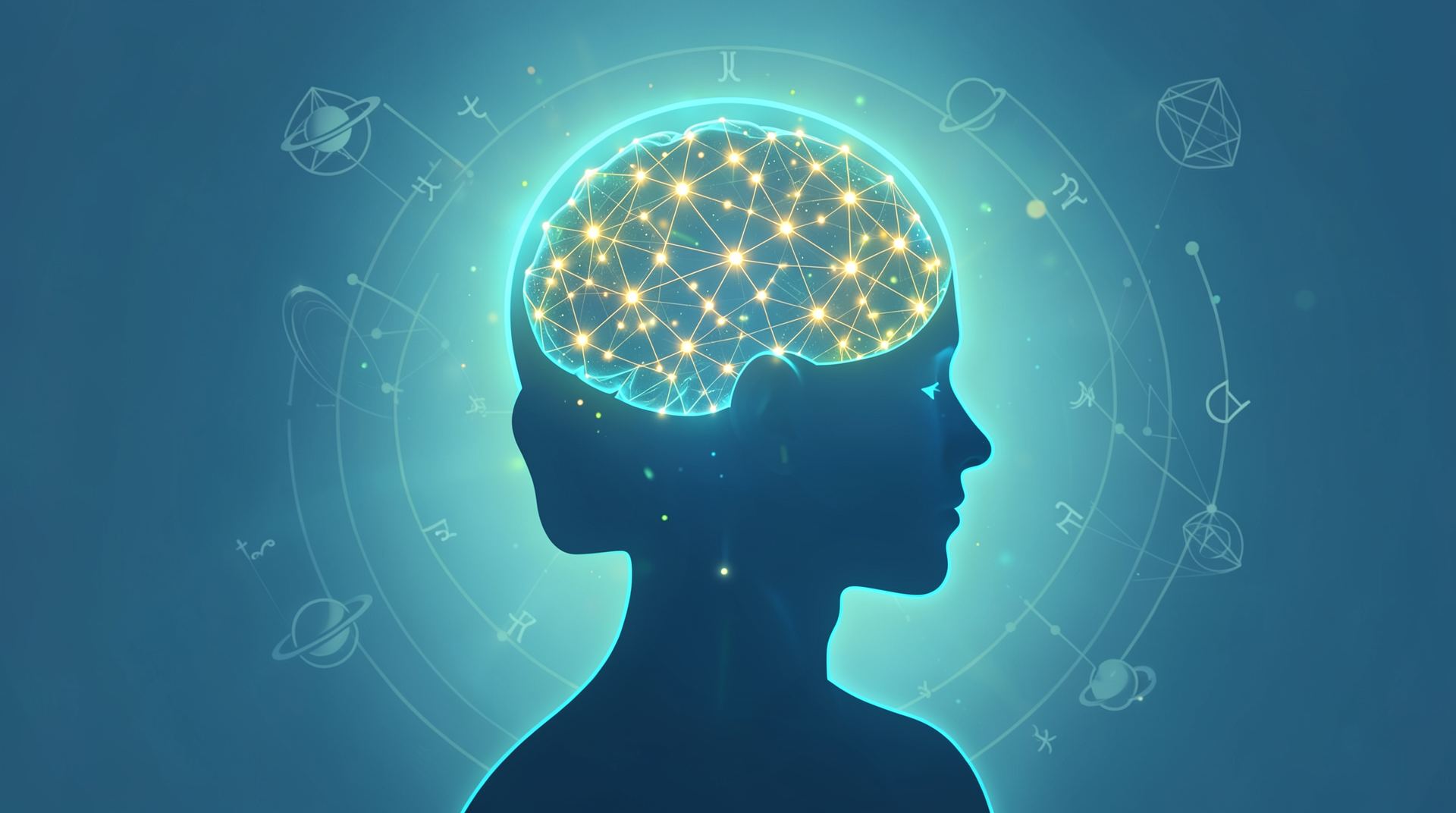
On the heels of one of the most profound medical-technology milestones in modern memory, Neuralink has announced the completion of its first speech-to-thought beta: a paralyzed patient who communicated through a computer using only a brain-chip interface. For the first time, a person whose body had lost its voice was able to express words directly from neural intent — no keyboard, no switch, no caregiver-mediated typing. Just thought, translated.
It is the kind of breakthrough that feels lifted from speculative fiction. And for those who read the sky, the timing is almost too perfect. As the Sun and Mercury converge in meticulous Virgo and Uranus activates air-sign communication, the heavens are performing a chart that mirrors the technology itself: the marriage of mind and message, consciousness and code.
What Actually Happened
The beta trial involved a volunteer with severe motor impairment — an individual unable to speak or use their limbs after a neurological event. After surgical implantation of Neuralink's ultra-thin electrode threads into the motor and speech-related cortical regions, the patient was asked to intend words silently.
Within the trial, the system decoded these intended speech patterns — the neural signals that precede vocalization — and rendered them as text on a screen. Caregivers reported that the patient could compose sentences, express needs, and even make jokes. The words were generated not from muscle movement, but from the electrical language of thought itself.
Regulators have approved the trial under an expanded compassionate-use framework, and Neuralink has signaled that larger controlled studies will follow. The implications are staggering: for millions of people living with locked-in syndrome, ALS, severe stroke, or spinal injury, the technology offers a potential return to conversation, autonomy, and connection.
The Sky at the Moment of Breakthrough
Looking at the transit sky over Fremont, California, on the day of the announcement, several placements stand out as almost eerily aligned with the event's themes:
☀️ Sun in Virgo (10th house) — Precision in the public sphere. Virgo is the sign of analysis, health, and service. A Sun at the midheaven degree region speaks to a public achievement rooted in healing and practical mastery. This is not a flashy, theatrical victory — it is a clinician's triumph, measured, refined, and reproducible.
☿ Mercury in Virgo, conjunct the Sun — Thought made manifest. Mercury, the ruler of speech, language, and the nervous system, sits beside the Sun in Virgo. In astrological symbolism, Mercury governs how we translate inner cognition into outward expression. This placement is a literal signature of "speech-to-thought": the conversion of silent neural activity into articulated words. Mercury in Virgo is precise, technical, and grounded — a perfect emblem for decoding brainwaves into sentences.
♅ Uranus in Gemini (7th house) — The technology of dialogue. Uranus is the planet of radical innovation and electricity, and Gemini rules communication, exchange, and the mind. Uranus in Gemini has long been associated with revolutions in how we transmit information — the telegraph, the internet, and now, neural decoding. Its placement in the 7th house (the house of the other, partnership, and the doctor-patient relationship) suggests a transformation in how human beings connect and converse across the divide of disability.
♆ Neptune in Aries, retrograde — The dissolving of boundaries. Neptune rules the dissolution of boundaries and the merging of self with something greater. A retrograde Neptune in fiery Aries blurs the line between self and machine, reminding us that consciousness is not a solid, isolated thing — it is fluid, extensible, and capable of reaching beyond the physical body.
♇ Pluto in Aquarius, retrograde — Deep collective transformation. Pluto in Aquarius is the slow-burning signature of technological power reshaping society itself. Its retrograde motion asks us to integrate rather than rush — to think carefully about what this power means before we unleash it fully.
The Brighter Side: What This Era Promises
For those who see planetary cycles as currents rather than commands, the late-August sky carries genuinely promising themes for neurotechnology and human augmentation:
- Virgo Sun + Mercury favors breakthroughs that improve daily life for the most vulnerable — medicine, accessibility, and practical healing tools.
- Uranus in Gemini is a long-term cycle (spanning years) associated with explosive advances in communication tech and neural interfaces. This is not a one-off event; it is a wave.
- Pluto in Aquarius (a 20-year cycle) points toward a collective reckoning with how technology redistributes power — including the power of speech itself.
If you're involved in tech, healthcare, accessibility design, or neuroscience, the astrological winds are broadly supportive of patient, rigorous, service-oriented work. Virgo rewards the grind: the careful calibration, the clinical trials, the repeated iteration.
The Shadow Side: Doubts, Risks, and Hard Questions
Astrology is never one-sided, and neither is this milestone. The same sky that blesses the breakthrough carries cautionary signatures that deserve honest weight:
Retrograde Neptune and Saturn in Aries. Both are moving backward in the sign of the self, and both touch themes of identity and trust. Neptune retrograde can obscure judgment — hype, marketing narratives, and overpromising are real risks here. Saturn retrograde in Aries, meanwhile, challenges impulsive action; it warns against rushing regulatory approvals, skipping safety protocols, or declaring victory before long-term data exists.
The 8th house Mars in Cancer. Mars in emotional Cancer, placed in the 8th house of endings, transformation, and shared resources, is a delicate signature. It can signal deep emotional stakes — hope that can be shattered, trust that must be handled gently. For patients and families, the emotional weight of this technology is immense, and setbacks will land hard.
Ethical and safety concerns. Brain implants carry risks of infection, electrode displacement, signal degradation, and surgical complications. Data privacy is a looming question: if a device reads your thoughts, who owns that data? The cynical reading of the chart — Mercury conjunct an overconfident Sun in Virgo — warns against a "fix-it-all" narrative that ignores systemic inequity. This technology will initially be expensive, scarce, and available only to a few. The gap between who benefits and who doesn't is itself a form of astrology's shadow: the same planet that illuminates can also blind.
Astrological Warnings for the Neurotech Era
For investors, researchers, and patients weighing this news, a few sky-based cautions are worth heeding:
- Mercury retrograde cycles will scramble communication. Expect announcement-adjacent confusion, misreported results, and "breakthrough" headlines that later need correction during the regular Mercury retrograde periods. Verify claims against primary sources.
- Saturn retrograde demands patience. The mature read of this chart is slow and steady wins the race. Anyone jumping to "this will cure everything by next year" is reading the stars wishfully rather than wisely.
- Pluto retrograde warns against concentrated power. Watch for monopolies forming around neural data, and be alert to legal and ethical battles over who controls the "thought stream." This is a Pluto-in-Aquarius theme that will unfold over years, not weeks.
- Neptune retrograde blurs fact and fiction. Marketing will lean into miracle language. Separate documented outcomes from hopeful speculation before making life-altering decisions.
A Balanced Perspective
The astrology here is evocative, but it is not deterministic. The stars do not cause a brain-chip breakthrough any more than they cause a stock market rally — they describe a climate, a mood, a set of tendencies. The actual outcome depends on human choices: the rigor of researchers, the honesty of reporters, the wisdom of regulators, and the courage of patients.
For a paralyzed person to speak again through thought alone, no astrological symbol is required to see that as remarkable, touching, and profoundly human. The sky merely offers a lens through which to contemplate it — a lens that reminds us to celebrate the wonder while staying clear-eyed about the work still ahead.
Conclusion: The Word Made Circuit
As the Sun and Mercury align in Virgo and Uranus dances through Gemini, we find ourselves at the threshold of a new kind of communication — one where the boundary between the inner mind and the outer world grows thin. Neuralink's speech-to-thought beta is a landmark, but it is also a beginning. The technology will mature, stumble, improve, and reshape lives in ways no chart can fully predict.
Whether you read the stars or only the headlines, one thing is certain: the conversation between humanity and its machines has just found a new voice. And for the first time, that voice belongs to those who were told they would never speak again.
Disclaimer: This article is for informational and entertainment purposes. Astrology is a symbolic interpretive framework, not a predictive science, and should not be used as the sole basis for medical, financial, or life-altering decisions. Clinical outcomes depend on medicine, engineering, and regulation — not planetary positions. Consult qualified professionals for guidance on any real-world decision.
Related Articles

First Quarter Moon in Capricorn (Oct 18): The Week's "Commit or Release" Moment
October 14, 2026
The First Quarter Moon in Capricorn (Oct 18, 2026, 16:10 UTC) squares the Libra Sun — a cosmic checkpoint asking you to commit or release. Plus Venus retrograde cautions, Pluto's station, and a do/don't guide for the week.
Venus Retrograde in Scorpio Squares Pluto All Week: The Love-and-Power Test Peaking Around Oct 20
October 13, 2026
Retrograde Venus in Scorpio squares Pluto all week, exact around Oct 19–20 as Pluto stations direct. How to survive the love-and-power test — what to avoid, who feels it, and how to pass it.
Scorpio to Capricorn by Way of Sagittarius: Your Day-by-Day Lunar Weather for Oct 12–18
October 12, 2026
The Moon travels from Scorpio through Sagittarius into Capricorn Oct 12–18, 2026. Your day-by-day lunar weather, key aspects, and caution zones — including the First Quarter Moon on Oct 18 and Pluto's direct station.
The Fixed-Sign Fortress: Leo Mars–Jupiter, Scorpio Venus–Mercury and Why This Week Has No Quick Fixes
October 8, 2026
Why the fixed-sign fortress of Leo Mars–Jupiter and Scorpio Venus–Mercury makes October 8–11, 2026 a week with no quick fixes — and how to work with the sky instead of against it.