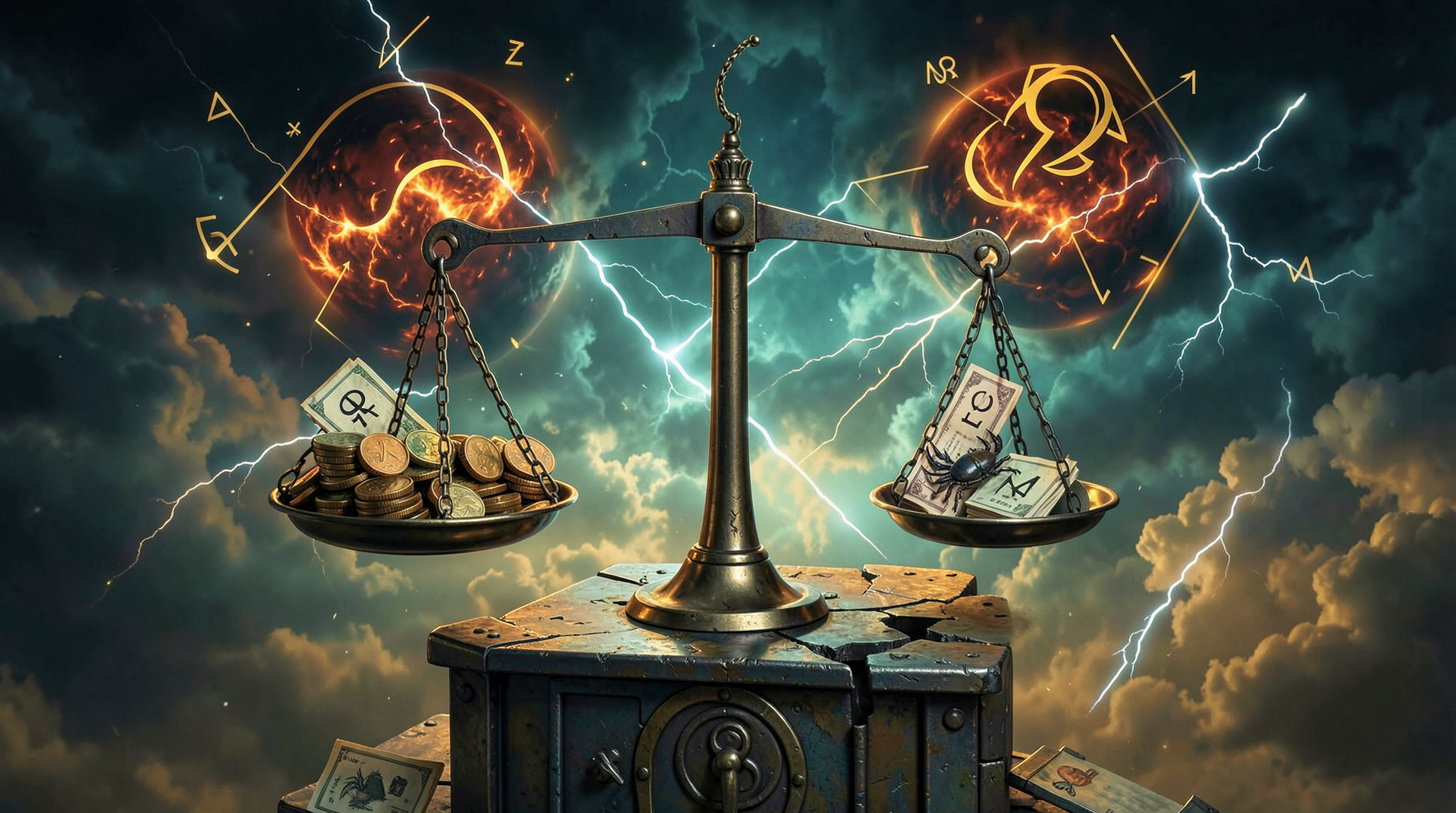
Markets Rattled: High Government Debt and Prolonged Inflation Under a Tense September Sky
September 4, 2026 — Global markets are waking to a familiar but unsettling refrain: towering government debt and inflation that refuses to cool. Bond yields are creeping higher, equity indices are choppy, and currency traders are bracing for volatility. Beneath the economic data, however, there is a deeper current running through the collective mood — one that reads remarkably like the astrological weather of early September 2026.
A Heavy Fiscal Backdrop
The math is stark. Sovereign balance sheets across the developed world remain bloated after years of crisis spending, and investors are asking uncomfortable questions about sustainability. When borrowing costs rise faster than growth, the arithmetic of debt service turns unforgiving. Central banks, once the market's safety net, now face a credibility bind: ease too quickly and inflation reignites; stay restrictive and risk tipping fragile economies into recession.
This is not a new story — but the timing feels different. The market's anxiety is sharpening precisely as the planets arrange themselves into a configuration that astrologers associate with institutional strain, restructuring, and hard accountability.
The Astrological Weather: September 4, 2026
For those who read the skies as a mirror of collective psychology, the current chart is unusually evocative of the fiscal stress in the headlines.
Mars in Cancer in the 8th House — House of Debt and Shared Resources
Mars, the planet of drive, conflict, and pressure, is moving through emotional, defensive Cancer — and it is sitting in the 8th house, the sector traditionally tied to debt, taxes, inheritances, other people's money, and financial entanglements.
This is a textbook signature for anxious negotiations over borrowed funds. When Mars activates the 8th house, there is a feeling of being trapped by obligations, a defensive posture around resources, and a tendency for financial disputes to escalate quickly. Governments may become protective and territorial about their budgets, while investors grow combative about yields and creditworthiness.
The emotional nature of Cancer suggests that market reactions may be driven by fear and sentiment as much as by fundamentals. Flight-to-safety behavior, nervous hedging, and sudden shifts in risk appetite are all consistent with this placement.
Saturn Retrograde in Aries — The Debt Collector
Saturn, the planet of limits, consequences, and structure, is retrograde in Aries — the sign of initiation, boldness, and self-reliance. Retrograde Saturn turns inward, forcing a re-examination of the rules we rely on.
In financial terms, this is a period of reckoning with structural debt. Saturn retrograde often coincides with delayed repayments, renegotiated terms, and a collective sense that "the bill has come due." Aries adds a combative edge: governments may resist external pressure, defaults may be met with defiance, and creditors may push back aggressively. The conjunction-like pressure in Aries suggests that fiscal discipline — or its absence — will be a central theme.
Pluto Retrograde in Aquarius — The Systemic Overhaul
Pluto, the planet of transformation, power, and hidden forces, remains retrograde in Aquarius — the sign of systems, technology, and collective welfare. This is a long-term signature for the restructuring of financial systems themselves: digital currencies, central bank frameworks, and the architecture of global debt.
Pluto retrograde often brings subterranean pressures to the surface. Corruption scandals, hidden liabilities, or off-balance-sheet obligations may emerge. The markets may react not just to the data that is visible, but to the fear of what is not yet disclosed.
Uranus Stationing Direct in Gemini — The Wild Card
Perhaps the most destabilizing influence of early September is Uranus stationing direct in Gemini. A planetary station is a period of heightened intensity, and Uranus is the planet of sudden shocks, reversals, and lightning-fast change. In Gemini — the sign of communication, information, and news — this points to news-driven volatility.
Expect headlines to move markets rapidly. Rallying inflation surprises, debt-auction hiccups, or a sudden central-bank pivot could trigger sharp, whipsaw moves. Uranus is the planet that reminds us that forecast is not destiny — and that markets can turn on a dime.
Mercury in Virgo in the 10th House — The Analyst in the Spotlight
Mercury, the planet of analysis and communication, is in detail-oriented Virgo, stationed in the 10th house of public authority and government. This is the voice of the technocrat — the central banker, the treasury official, the data analyst. Expect a flood of numbers, projections, and official statements, but also the risk of over-analysis and nitpicking.
Mercury in Virgo can be brilliant at identifying flaws in a plan. The markets will be parsing every decimal point of inflation prints and every nuance of policy language. But Virgo's perfectionism can also breed paralysis and anxiety — a sense that no solution is quite good enough.
What This Means for Investors
While astrology offers a lens on collective psychology rather than a prediction of specific price levels, the symbolic themes of early September align with practical market cautions:
- Expect heightened volatility. Uranus stationing direct, Mars in the 8th, and Saturn retrograde all point to sharp, sentiment-driven swings.
- Watch debt-sensitive assets. The 8th-house Mars focuses attention on bonds, credit spreads, and currencies of heavily indebted nations.
- Beware of news-driven reversals. Uranus in Gemini signals that rapid headlines — not slow analysis — may dominate trading sessions.
- Look beneath the surface. Pluto retrograde in Aquarius suggests hidden liabilities and systemic pressures that may not yet be priced in.
Caution: The Shadow Side of This Sky
It would be irresponsible to present this configuration as purely ominous — or purely predictive. Every transit has multiple expressions, and markets are driven by human choices, not celestial fiat. Still, the challenging aspects deserve respect:
- Mars in the 8th can amplify fear-driven selling and financial disputes. Avoid panic reactions to single headlines.
- Saturn retrograde is a poor time for reckless leverage or ignoring structural risks. Debt sustainability matters.
- Uranus stationing favors the prepared, not the impulsive. Sudden moves can obliterate tight stops.
Astrological guidance is not financial advice. The stars describe a mood, not a mandate. No planetary position determines whether a bond defaults or a stock rallies; that is the domain of policy, data, and human decision-making. Use this sky as a tool for awareness and timing, not as a substitute for due diligence, diversification, and professional financial counsel.
A Broader Perspective
For those who read the celestial cycles, September 2026 is a moment of collective reckoning — a time when the debts we have accumulated, both financial and systemic, demand acknowledgment. The tension in the sky mirrors the tension on the trading floor. But it is also a moment of potential clearing: Pluto's long transit through Aquarius points toward the eventual rebuilding of more transparent, resilient systems.
In the short term, the market's jitters are real, and the astrological weather suggests they may persist. The prudent path is the one astrology has always counseled during heavy transits: slow down, study the details, secure your defenses, and avoid impulsive decisions. The storm will pass — but only for those who are patient enough to weather it.
Disclaimer: This article combines financial commentary with astrological interpretation for entertainment and reflective purposes. It is not investment advice. Markets involve substantial risk, and past performance — terrestrial or celestial — is no guarantee of future results. Always consult a qualified financial advisor before making investment decisions.
Related Articles
Mars Closes to 11° of Jupiter in Leo: The Week 2026's Biggest Conjunction Starts Feeling Real
October 17, 2026
Mars hits 11° Leo this week, closing to within 11° of Jupiter — the moment 2026's biggest conjunction starts feeling real. What to expect, the shadow side, and how to work the build.
Mercury Is Tapping the Brakes in Scorpio: Finish Your Detective Work Before Its Late-October Retrograde
October 16, 2026
Mercury is slowing in late Scorpio before its October 22–24 retrograde station. A practical guide to finishing your detective work, sealing your contracts, and surviving the November rewind.
The October 15–18 Stand-Still: Pluto, the North Node, and the First Quarter Moon Line Up Their Stations
October 15, 2026
From October 15–18, 2026, Pluto's direct station at 3° Aquarius, the North Node's brake at the 29° Aquarius threshold, and the First Quarter Moon in Capricorn line up into a rare celestial standstill. Here's what the pause means — and how to work it.

First Quarter Moon in Capricorn (Oct 18): The Week's "Commit or Release" Moment
October 14, 2026
The First Quarter Moon in Capricorn (Oct 18, 2026, 16:10 UTC) squares the Libra Sun — a cosmic checkpoint asking you to commit or release. Plus Venus retrograde cautions, Pluto's station, and a do/don't guide for the week.