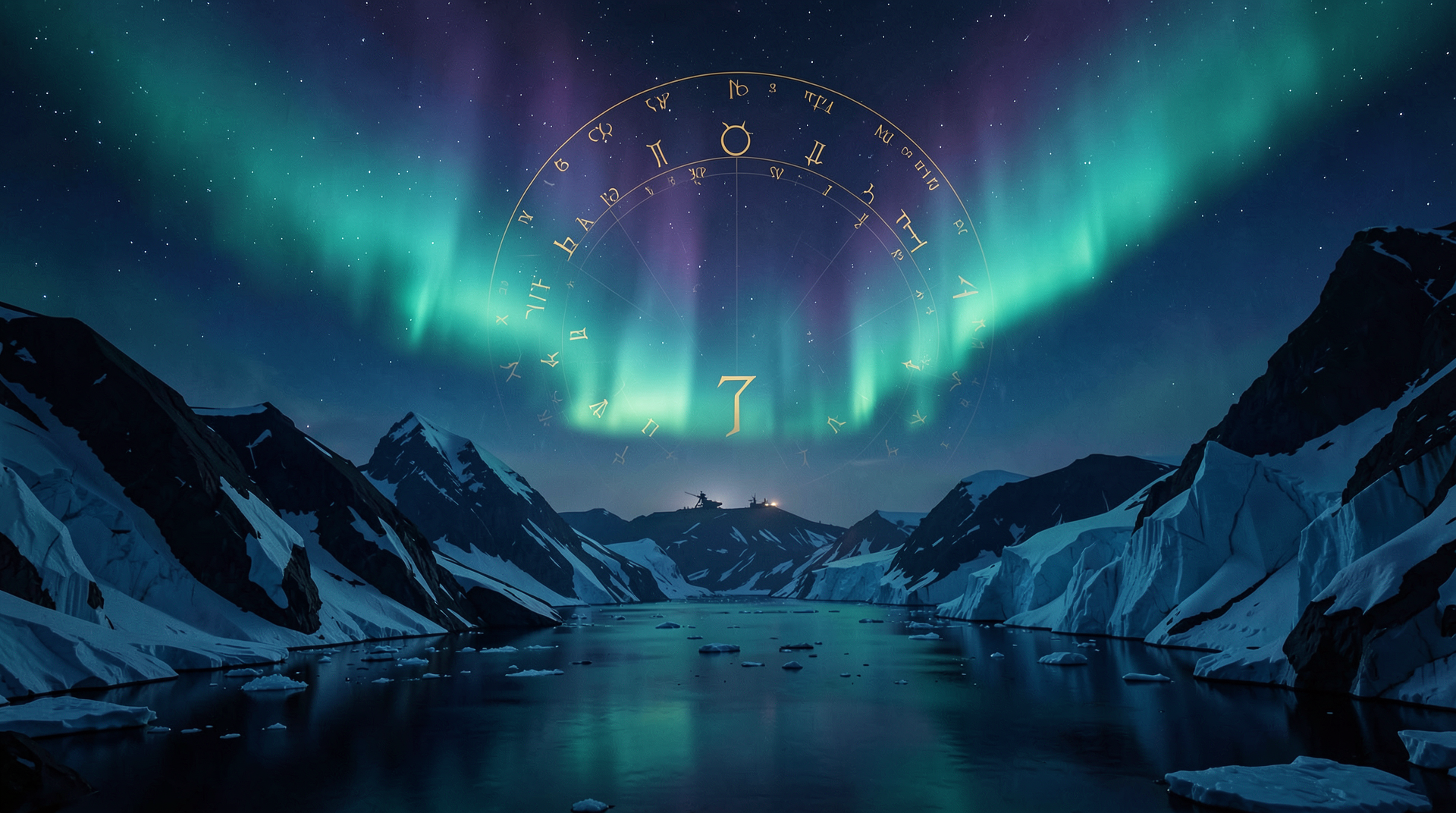
On September 19, 2026, the United States, Denmark, and Greenland announced a trilateral agreement to strengthen the American military footprint on the world's largest island. With upgraded early-warning radar at Pituffik Space Base (formerly Thule), expanded access to ports and airfields, and deeper cooperation on Arctic infrastructure and critical minerals, the deal lands at the exact moment the polar ice is retreating, the shipping lanes are opening, and great powers are redrawing the map of the Far North.
The announcement arrives under a sky that mundane astrologers would describe as charged to the point of crackling. Cast the chart for the agreement in Nuuk, Greenland — the capital where the deal was sealed — and a story emerges of homeland defense, sovereignty pride, hard bargaining, and a world order sliding into a new configuration. This is the astrology of the frozen frontier.
The Deal at a Glance
The agreement — reached after months of closed-door negotiation between Copenhagen, Washington, and the Greenlandic home-rule government in Nuuk — deepens the US security presence across the island. In practical terms, that means expanded operations at the strategic early-warning base, new investment in Arctic logistics and communications infrastructure, joint maintenance of runways and deep-water port access, and a formalized framework for cooperation on the rare-earth and mineral deposits that have made Greenland one of the most coveted territories on Earth.
For Washington, it is a hedge against a more contested Arctic — a theater where Russia has militarized its own polar flank and China has courted Greenlandic mining and research partnerships. For Copenhagen, it preserves the Kingdom's transatlantic anchor while navigating a delicate balance. And for Greenland — whose Inuit-majority population governs itself domestically while Denmark retains foreign and security policy — the deal is a lever: a way to convert geography into investment, influence, and a louder voice on the world stage.
What the press releases will not say is how emotionally tangled all of this is. That is where the sky has something to contribute.
A Chart Cast on the Ice
The agreement chart, cast for Nuuk at midday on September 19, 2026, is a study in how different layers of the zodiac stack up when nations negotiate.
The Ascendant is in Libra, with Venus rising in Scorpio. Libra presides over treaties — the very word scales — but here the morning star sits only a few degrees inside Scorpio, and Scorpio does not bargain; it calculates. Diplomacy with teeth. The agreement may be presented in the language of partnership, but the chart says every clause was weighed, every concession counted, and old grievances were not forgotten.
The Sun sits at 26° Virgo in the 11th house — the last degrees of Virgo's meticulous governance, in the house of collective agreements, alliances, and shared purpose. This is the signature of a treaty negotiated by lawyers and bureaucrats: exhaustive, technical, and obsessed with detail. It is also, tellingly, the chart of an agreement signed on the eve of the Sun's ingress into Libra — the Autumnal Equinox, the moment when day and night balance, and when the Arctic itself tilts toward six months of darkness. The equinox is the cosmic punctuation mark: a deal about balance of power, struck at the moment the Earth's own scales hang even.
Mars in Cancer, in the 9th house, is the loudest voice in the room. The 9th house is the domain of international affairs, treaties, and strategy projected across distances — and Mars in Cancer is the energy of defending the home, of territorial protectiveness, of a guardian who never fully trusts the stranger at the gate. In mundane terms, it explains why the deal is framed everywhere as defense rather than offense: because that framing is emotionally true for the parties, even when the same military assets could be described either way. Mars in Cancer also carries suspicion — the fear-based calculation that if we do not secure the ice, someone less friendly will.
Jupiter in Leo, also in the 9th house, answers Mars with pride. Jupiter is expansion, alliances, and the legitimacy of nations; Leo is sovereignty and the roar of self-assertion. Together with Mars, they describe an Arctic where every power is simultaneously claiming, defending, and posturing. For Greenland, this is the energy of a small nation discovering its leverage. For the great powers, it is the magnetism of a region suddenly worth everything.
The Moon, in Capricorn, keeps the whole enterprise grounded — institutional, budgetary, bureaucratic. But the Moon's phase matters more than its sign: this is a First Quarter Moon, the moment in the lunar cycle when a decision has been made and must now withstand its first test. Agreements signed under a First Quarter Moon are provisional by nature. They are commitments in progress, not finished architecture. The existing article on this week's First Quarter Moon in Sagittarius called it "the fire checkpoint before the Aries Full Moon" — and that checkpoint is precisely where this deal now stands.
Great-Power Competition Under Pluto in Aquarius
No mundane reading of 2026 is complete without the slow, grinding transit of Pluto in Aquarius, which will restructure global power arrangements through the 2030s and 2040s. Pluto is the planet of power, upheaval, and the transformation of systems; Aquarius is the sign of blocs, alliances, borders, and collective identity. The Arctic — one of the last shared commons on Earth — is a textbook Pluto-in-Aquarius arena: a region where old frameworks of governance (the Arctic Council, bilateral treaties, the law of the sea) are being stretched and redrawn by new hard realities.
Uranus in Gemini, retrograde, adds the disruptive techno-strategic layer: hypersonics, space-based early warning, drones, cyber operations, and the race to control the information networks above and beneath the ice. Uranus in Gemini is the planet of sudden reversals and unannounced surprises in how powers communicate — which is a polite way of saying that the geostrategic map drawn today may look very different in eighteen months.
Meanwhile, Saturn and Neptune, both retrograde in Aries, shadow the whole affair. Saturn retrograde in Aries is the review of commitments, the re-examination of autonomy and discipline — expect funding fights, timeline slippage, and renegotiation pressure before the ink is even dry. Neptune retrograde in Aries is the danger of grand narratives: the poetry of "peace through strength," the romance of the Arctic frontier, the seduction of a clean strategic story that obscures messy costs on the ground.
The Hard Truths This Chart Does Not Promise
It would be a disservice to the sky — and to the people of Greenland — to read this chart as an uncomplicated triumph. The same configurations that make the deal possible carry their own friction:
- Venus in Scorpio rising means sovereignty wounds. Scorpio remembers. Negotiations that extract concessions from a home-rule government, however politely framed, leave deposits of resentment that will resurface at the next election, the next referendum debate, the next round of talks. Greenland's self-determination movement is not a footnote; in this chart, it is a rising star.
- Saturn retrograde is a warning about implementation. Agreements signed under Saturn retrograde in Aries tend to be re-litigated. Budget cycles will slip. Commitments will be re-scoped. If the deal depends on rapid execution, it will collide with the slower rhythms of parliaments, audits, and Arctic weather windows.
- Mars in Cancer can curdle into escalation. Defensive energy, once mobilized, tends to justify more of itself. The logic of "we must secure the ice because they are securing the ice" is a feedback loop — and in mundane astrology, Mars in Cancer is the signature of that loop. Watch for the arms-race dynamic in the High North to accelerate precisely because all parties believe themselves to be acting purely in self-defense.
- Neptune retrograde asks you to check the fine print. Grand announcements are Neptune's native language, and the gap between the podium speech and the implementation annex is where retrograde Neptune does its quiet damage. Treat headline promises with healthy skepticism.
- The First Quarter Moon means the real test is coming. The Aries Full Moon later this month will be the first pressure test of this arrangement — expect a flare-up, a leak, or a public controversy around that window that forces the parties to show their hands.
- There is also the matter of the ice itself. The cosmic irony is hard to ignore: a region whose defining feature is its melt is receiving a permanent hardening of military infrastructure. Neptune in Aries, combined with the retreating poles, invites the question of what it means to fortress a landscape that cannot stay frozen. Environmental and community impacts — on caribou migration, on hunting grounds, on the quiet rhythms of Arctic towns — are the human ledger behind this strategic one.
What to Watch Next
For those reading the transits alongside the news, the next weeks offer a focused checklist:
- The Sun's ingress into Libra (the equinox): watch whether the "balance of scales" rhetoric holds, or whether the deal's symmetry proves illusory.
- The Aries Full Moon in late September: the first stress test; pay attention to sovereignty statements, protest movements in Greenland, and any "clarification" issued by any party.
- Mercury, now direct in Libra: good news for resumed dialogue — but Libra Mercury loves elegant wording, which means hard conversations can be postponed. Persist past the pleasantries.
- Jupiter's slow station and Mars's ongoing trek through Cancer: both point to escalation-sensitive windows through autumn. If tensions spike, ask whose "home" is being invoked to justify it.
A Note on Method
A word of caution, offered as a matter of intellectual honesty: mundane astrology reads currents, not destinies. A chart cannot tell you whether a treaty will hold or fail; it describes the psychological and symbolic weather in which a treaty is negotiated — the fears, ambitions, and blind spots of the collective moment. Treat any article of this kind as an invitation to think symbolically about power, not as a prediction engine for policy, markets, or military outcomes. No responsible astrologer would advise a general, a diplomat, or an investor to make decisions based on horoscopes alone. The stars illuminate; they do not decide.
Conclusion: The Far North Gets Its Own Middle
Every era gets the frontier it deserves. The twentieth century's frontier was the Space Race and the Cold War's European borderlands; the twenty-first century's may well be the ice. In this agreement, the US, Denmark, and Greenland have done something genuinely structural: they have committed, in writing, to a permanent military deepening of the Arctic's most strategically placed island — at the exact moment Pluto in Aquarius is rewriting the rules of alliance, Mars in Cancer is rewriting the meaning of home defense, and the planet itself is rewriting the geography of the polar region.
The sky over Nuuk on September 19, 2026, was not an easy sky. It was a sky of calculation, pride, suspicion, and hope — sometimes in the same breath. That is what a first-quarter agreement looks like: a decision taken seriously, but not yet hardened into reality. The testing comes next, under the Aries Full Moon, under the equinox scales, and under the long polar night that is already falling.
Watch the ice — and watch the stars. Both are moving faster than the maps.
Related Articles
Gag Order in the Stars: The Astrology of Trump's White House Ban on CNN, POLITICO & MSNBC
September 20, 2026
Astrologers read the White House ban on CNN, POLITICO and MSNBC through the Mercury–Saturn opposition, Uranus in Gemini and Pluto in Aquarius — a mundane-astrology deep dive into press power.
The Ballot and the Battlefield: The Astrology of the Vote Putin Calls a Test of the Ukraine War
September 19, 2026
As Russians vote in an election Putin calls a test of the Ukraine war, we read the sky over Moscow: Virgo's final degrees, Mercury in Libra on the leader's Sun, and Saturn & Neptune retrograde in Aries.
The Scales and the Summit: Trump–Xi, Tariffs, and the $30 Billion Question Under a Libra Sky
September 19, 2026
Expectations rise for a Trump–Xi summit on tariffs and a possible $30B deal. We read the September 2026 sky — Libra equinox, Aries Full Moon, six retrogrades — for the astrology of the trade truce and AI cooperation.
Six Planets in Reverse: A Beginner's Map to the Retrograde Sky of 2026-W38
September 18, 2026
A beginner-friendly map of the September 2026 retrograde sky: Satun, Uranus, Neptune, Pluto, Chiron and the North Node in reverse during 2026-W38 — what each one means, when they turn direct, and how to work with the week.