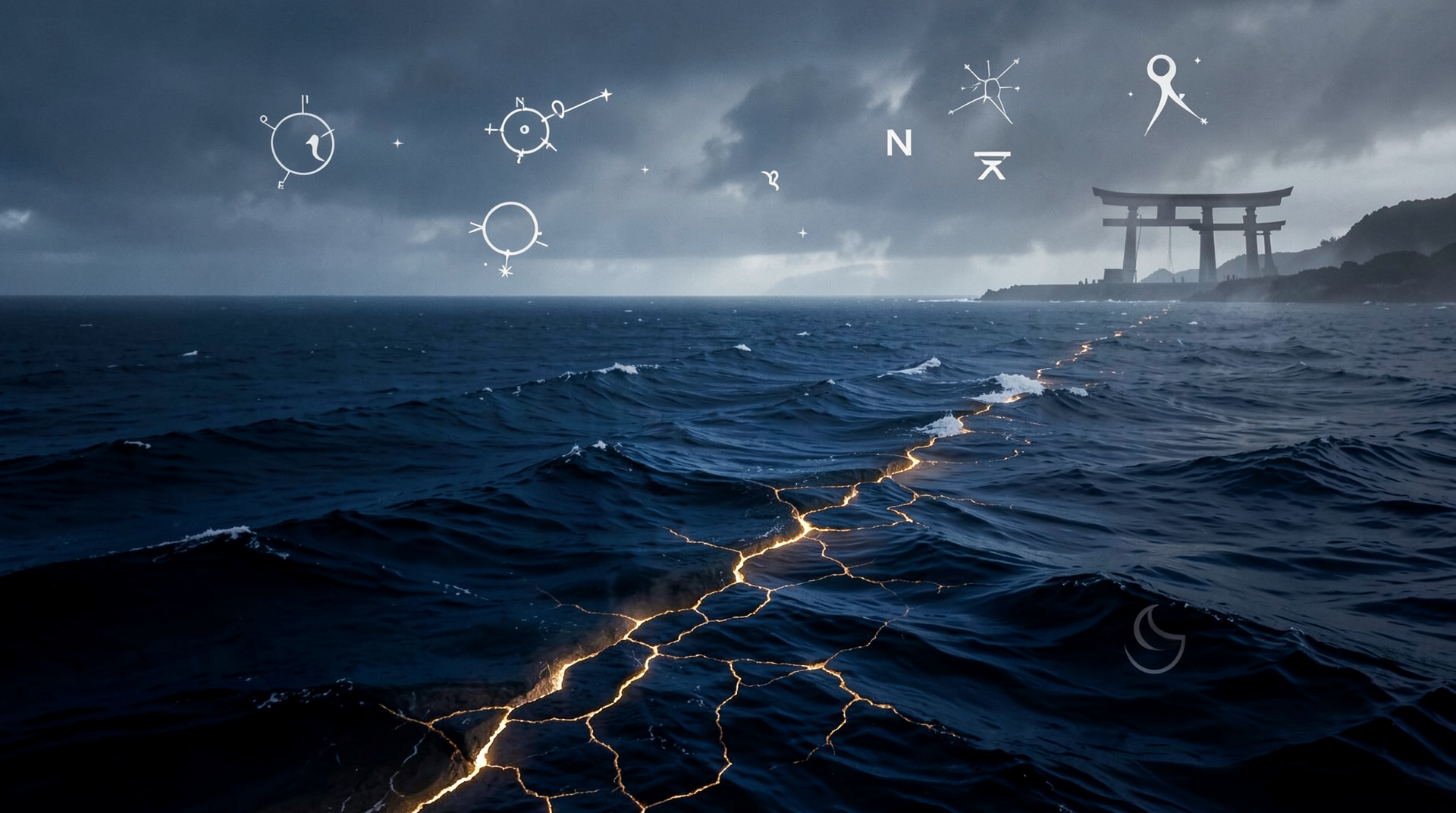
On Tuesday, August 11, 2026, a powerful 7.2-magnitude earthquake struck offshore near Fukushima, Japan, sending a shudder through the northeastern coast and rippling outward into the global psyche. In a display of the island nation's hard-won engineering and preparation, no destructive tsunami was triggered, and authorities moved quickly to reassure residents. Yet the very power of the tremor — and the memory of 2011 that it resurrected — intensified anxiety far beyond the Pacific Rim.
This is not a story astrology can predict, but it is one the sky can help us read. When the ground itself moves, we are reminded how thin the membrane is between the everyday and the extraordinary — and the transits of that exact moment offer a vivid, layered map of why the world felt so unsteady.
The Moment the Earth Shook
Japan sits atop the volatile meeting point of several tectonic plates — the Pacific, Philippine, and Eurasian — making the archipelago one of the most seismically active regions on Earth. A 7.2 event is a major earthquake by any standard, capable of causing serious damage if it strikes near populated land. That the rupture occurred offshore, and that no significant tsunami materialized, spared the country far worse.
But the tremor landed in a place with a long memory. Fukushima remains synonymous with the 2011 Tōhoku earthquake and tsunami, the catastrophic 9.0-magnitude event whose waves breached the Daiichi nuclear plant's seawall and set off the world's worst nuclear disaster since Chernobyl. For millions, the feeling of the ground moving under Fukushima is inseparable from that trauma — and it is why this tremor, though far smaller, carried outsized emotional weight.
Japan's early warning systems performed as intended, and officials emphasized that no abnormalities were detected at nuclear facilities. Yet the episode served as a stark reminder of vulnerability in an age of climate anxiety, geopolitical tension, and collective unease.
Reading the Sky Over Fukushima That Day
Let's look at what the heavens sketched over Fukushima on August 11, 2026. When we cast an event chart for the moment, a handful of placements stand out as remarkably on-theme for a seismic rupture.
A Scorpio Ascendant. The eastern horizon of the event chart rises in Scorpio — the sign of death, the underworld, the earth's hidden recesses, and profound transformation. Scorpio is classically associated with the things that crack open and reveal what lies beneath. An earthquake chart rising in Scorpio is, fittingly, a chart of the rupture itself: the sudden revelation of unseen forces.
Mars at the anaretic edge of Gemini, in the Eighth House. In the event chart, Mars sits at 29°50' Gemini in the eighth house — the very last, "anaretic" degree of the sign, a place astrologers associate with urgency, culminating pressure, and moments that demand completion. The eighth house rules death, crisis, shared destruction, and regeneration — the domain of sudden, transformative endings. Mars here, the planet of force and impulse, at the fag end of an air sign, speaks to a violent, restless discharge of tension.
Uranus in Gemini. Not far behind, Uranus — the great awakener and the classical planet of earthquakes, shocks, and sudden ruptures — rides through Gemini. Uranus is the sky's original seismometer. When it is active near points in a national chart, mundane astrologers watch for destabilizing surprises. Its presence alongside Mars here is the loudest tell in the whole sky.
The ground gives way: only 17% earth. The element distribution of the event chart is strikingly unbalanced — just 17% earth, the element of structure, stability, and the physical ground. In mundane interpretation, a deficit of earth can reflect instability in the material realm: foundations that don't hold, structures under strain. It is a poetic fit for a day when the literal ground failed to stay put.
The Transits Pressing on Japan's Natal Chart
Astrologers often cast Japan's national chart from the Meiji Constitution, proclaimed February 11, 1889, which gives Japan a Sun in Aquarius, a Moon in Gemini, and a Scorpio Ascendant of its own. Transits to that chart on the day of the quake are striking:
Transit Mars conjunct natal Moon. Transit Mars at 29° Gemini lands almost directly on Japan's natal Moon at 21° Gemini — and, crucially, this Moon sits in Japan's eighth house (the house of crisis, death, and shared trauma). Mars on the natal Moon is a classic trigger of emotional agitation, instability, and sudden events affecting the collective mood. In the eighth house, that agitation touches exactly the themes the quake awakened: mortality, fear, and collective shock.
Transit Uranus conjunct natal Pluto. This is the deepest seismic signature of all. Transit Uranus in Gemini moves near Japan's natal Pluto at 4° Gemini — the planet of deep, transformative, underground forces aligned with the planet of sudden rupture. Uranus–Pluto contacts are the epitome of "the ground beneath you changes forever" energy: tectonic in the truest sense.
Pluto crossing the Fourth House. Transit Pluto occupies Japan's fourth house — the house of homeland, foundations, and the nation's roots. Pluto here speaks to profound, slow-burning pressure beneath the surface of the country itself: constant, grinding transformation at the level of identity and security.
Chiron, the wounded healer, also sits in the event chart's sixth house, in Taurus — the earth-bound sign of physical security — quietly underscoring themes of physical vulnerability and the long work of healing.
A Season of Sudden Rupture
This earthquake did not occur in a celestial vacuum. Throughout July and August 2026, the sky has been dominated by an unusually combustible pairing: Mars and Uranus traveling together through Gemini. This is the same signature we have read in wildfires across Catalonia, a tornado over Wuhan, typhoons across East Asia, and market volatility on Wall Street — sudden, explosive, chain-reaction events in quick succession.
That Mars reached the anaretic 29th degree of Gemini on the very day of the Fukushima quake feels like the culmination of this restless, skittish, electrically charged cycle. In the days immediately following, on August 12, the Sun, Moon, Mercury and Jupiter all stack in Leo for a powerful New Moon — a fresh cycle of fire and creative ignition beginning even as the old cycle of rupture closed.
Add to this the wider backdrop: Saturn retrograde in Aries (the "Frozen Gavel" that has been a recurring motif all summer, keeping pressure locked in place), Neptune retrograde in Aries (dissolution, haziness, fear that lacks a clear object), and Pluto's long transit through Aquarius (collective transformation on a generational scale). The result is a sky that feels crowded, pressurized, and primed for release.
The Anxiety That Travels Beyond the Coast
What made this event resonate into "global anxiety" was not the numbers on the seismograph — it was the meaning we projected onto it. A major quake near Fukushima is a story the global imagination has already written. The mind leaps from tremor to tsunami to reactor to catastrophe in an instant, even when the evidence says this time was different.
This is where the astrology gets deeply human. Neptune retrograde in Aries can blur boundaries between real risk and imagined dread; the waning crescent Moon moving through the event asks us to release what no longer serves — including unprocessed fear. The Scorpio rising of the moment invites us to descend into the dark and look honestly at what we find, rather than letting anxiety do the deciding for us.
What to Watch For — and the Caveats That Matter
A responsible reading of this moment includes its challenging side and its honest limits:
- Aftershocks are physically likely. Seismically, a 7.2 event in a subduction zone frequently produces aftershocks, some of significant magnitude. Preparedness and attentiveness to official guidance are logistical realities, not superstitions — astrology is no substitute for Japan's warning systems.
- Mars–Uranus tension cautions against impulsive reactions. When Mars and Uranus are this active, the collective (and our individual selves) can be prone to rashness, panic-driven decisions, and abrupt, unconsidered action. In the days around such transits, slow down, verify information, and avoid major commitments made in a rush of fear or adrenaline.
- Emotional and psychological aftershocks are real. For those with personal ties to Fukushima or 2011, re-traumatization is a genuine concern. The kindest response to this transit is gentleness — with yourself and with others.
- Astrology is a lens, not a prophecy. The sky did not cause the fault line to slip, and no chart can predict an earthquake. What astrology offers is a symbolic mirror: a way to understand timing, collective mood, and the themes a moment activates. Use it for insight and reflection — not for forecasting disaster or making life-altering decisions.
Grounding in a Groundless Moment
There is a quiet paradox in a day when the earth itself refuses to stay still: it reminds us how much we build on borrowed stability. Every structure, every routine, every assumption rests on foundations we rarely consider until they move.
Astrologically, the antidote to this unsteady sky is not more alarm — it is grounding done deliberately. In a chart low on earth and high on electric air, we can consciously restore our own earth: tending to home, body, routine, and the people we love. The Leo New Moon that follows invites us not only to create, but to create from a place of rooted confidence rather than fear.
Japan stood and steadied itself after the shaking stopped — no tsunami, facilities secure, warning systems proven. That is not fate; it is the accumulated strength of preparation, community, and resilience. In troubled skies and troubled times alike, that is the truest horoscope of all: that which has been carefully built, lovingly tended, and honestly rehearsed is what holds when the ground lets go.
This article explores astrological symbolism for reflection and is intended as entertainment and perspective only. Astrology is not a scientific method and cannot predict earthquakes or other real-world events. For safety guidance, always follow official emergency authorities and seismological agencies. If you are experiencing distress, anxiety, or trauma related to this event, please reach out to mental-health professionals and support services.
Related Articles
Sun Opposes Saturn on October 4 — the Day After the Last Quarter Moon: Libra Season's Accountability Check
October 1, 2026
The Sun opposes retrograde Saturn on October 4, 2026 — the day after the Last Quarter Moon in Cancer. What Libra season's accountability check means for relationships, work, and money, plus who feels it most and how to use it.
Mars Races Toward Jupiter in Leo All Week: The 8th-House Power Surge Paving 2026's Biggest Conjunction
September 30, 2026
Mars enters Leo this week and begins its sprint toward Jupiter — the 8th-house power surge that paves the way for 2026's biggest conjunction on Nov 14–15. Plus Venus retrograde cautions and what to do now.

Mercury Enters Scorpio on September 30: The Diplomat Becomes a Detective
September 29, 2026
Mercury enters Scorpio on September 30, 2026, trading the diplomat's scales for the detective's magnifying glass. What the intense ingress, the Mars–Pluto face-off, and the coming Scorpio Mercury retrograde mean for communication, research, and relationships.
Venus Turns Retrograde in Scorpio on October 3: The 2026 Love & Money Re-Run Begins
September 28, 2026
Venus stations retrograde at 8°29' Scorpio on October 3, 2026 — kicking off a ~40-day love & money re-run. Full guide: dates, timelines, cautions, and how to work with it.