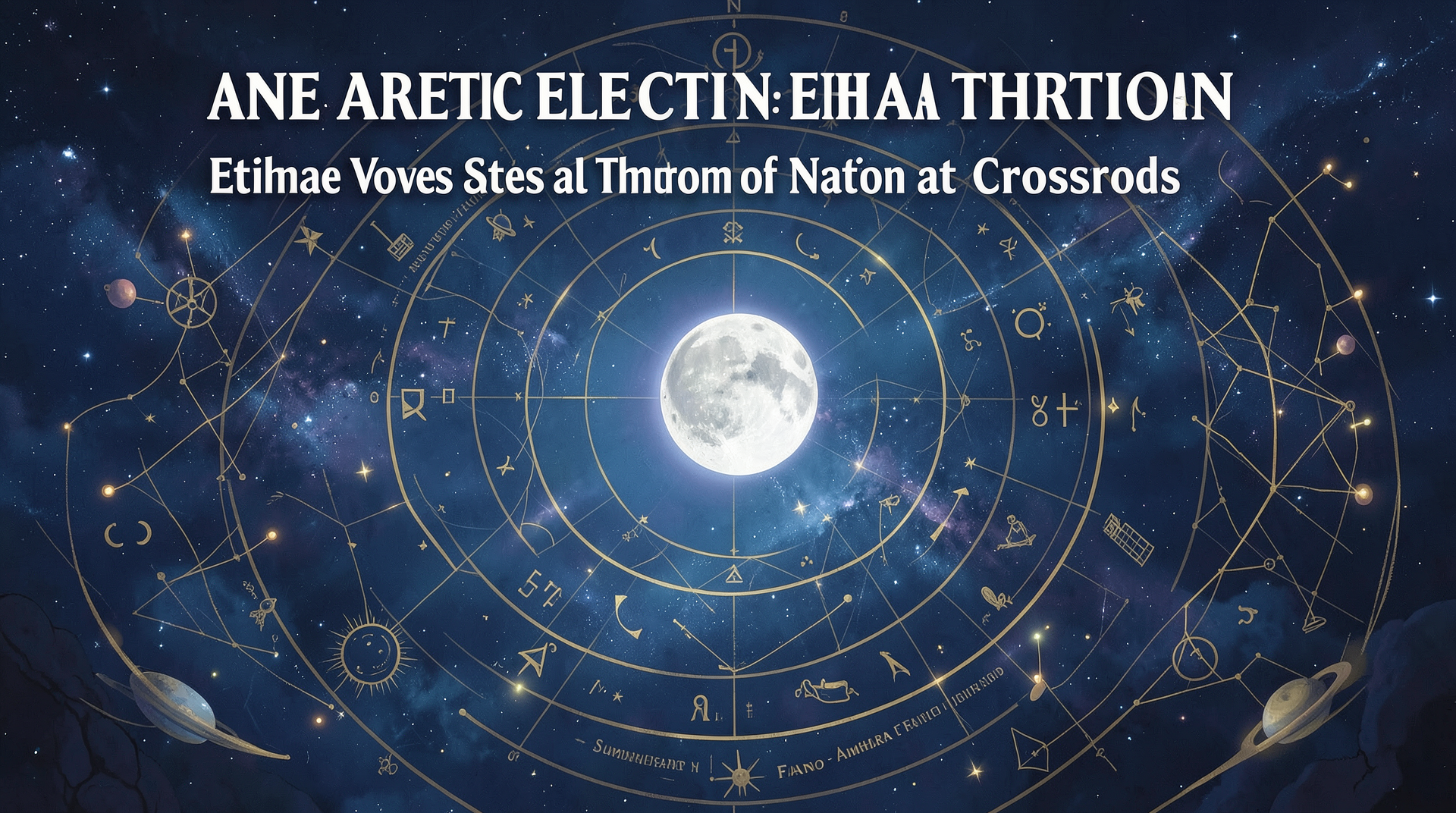
The Anaretic Election: Ethiopia Votes at the Threshold — Astrology of a Nation at the Crossroads
On June 18, 2026, millions of Ethiopians went to the polls to elect the House of Peoples' Representatives — the lower chamber of the Federal Parliamentary Assembly — in a general election shadowed by unresolved tensions in the Tigray region and the persistent Fano insurgency roiling the Amhara heartland. Coming just days before the Summer Solstice, the vote arrives at an astrological moment so thick with threshold energy that even a casual glance at the transit chart for Addis Ababa reveals a sky trembling on the edge of transformation.
This is not merely an election. It is a cosmic inflection point — one where the planetary architecture mirrors the fractures, the hopes, and the unresolved questions of Africa's second-most-populous nation.
The Astrological Landscape: June 18, 2026 at Noon in Addis Ababa
When we cast the transit chart for midday in Addis Ababa — the hour when voter turnout typically peaks — the sky speaks in urgent, unmistakable language. Here are the key positions:
| Planet | Sign & Degree | House | Notable |
|---|---|---|---|
| Sun | 27°09' Gemini ♊ | 10th (Midheaven) | Approaching anaretic degree |
| Moon | 12°39' Leo ♌ | 11th | Waxing Crescent phase 🌒 |
| Mercury | 21°29' Cancer ♋ | 11th | Steady, emotional discourse |
| Venus | 5°43' Leo ♌ | 11th | National pride, performative unity |
| Mars | 22°30' Taurus ♉ | 9th | Slow-burning anger in courts, foreign affairs |
| Jupiter | 27°30' Cancer ♋ | 11th | Anaretic — on the verge of Leo |
| Saturn | 13°31' Aries ♈ | 7th | Heavy hand in open conflicts |
| Neptune | 4°19' Aries ♈ | 7th | Fog, confusion in declared enmities |
| Uranus | 3°03' Gemini ♊ | 9th | Disruption in legal and international spheres |
| Pluto | 5°07' Aquarius ♒ | 5th (Rx) | Retrograde — subterranean power shifts |
| Chiron | 29°57' Aries ♈ | 8th | Anaretic — last gasp before Taurus |
| Ascendant | 20°11' Virgo ♍ | 1st | Practical, scrutinizing public face |
The chart's most striking feature is the sheer concentration of anaretic degrees. The Sun at 27° Gemini, Jupiter at 27° Cancer, and Chiron at 29° Aries — the very last degree of the Ram — create a sky that is figuratively and literally standing at the exit door of multiple cycles simultaneously.
Anaretic Degrees: A Nation at the Threshold
In astrology, the 29th degree (or anaretic degree) of any sign is considered a point of crisis, culmination, and urgent completion. Planets positioned here carry the accumulated wisdom — and exhaustion — of an entire sign's journey. They demand resolution before the next chapter can begin.
Three anaretic placements on a single election day is exceptionally rare.
Jupiter at 27° Cancer: The Last Breath of Protection
Jupiter has been touring Cancer since June 2025, expanding themes of homeland, belonging, ethnic identity, and maternal protection. At 27° Cancer — just days from its ingress into Leo — Jupiter asks: What have we built that is worth carrying forward? What must be released?
For Ethiopia, Jupiter's presence in the 11th house of collective aspirations and parliamentary bodies is deeply symbolic. The planet of expansion and law-making sits directly atop the nation's house of legislation. But Jupiter at the anaretic degree in Cancer suggests the political class may be reaching the limits of a protectionist, ethnically-rooted model of governance — the very model codified in the 1995 constitution that established ethnic federalism.
The downside: Anaretic Jupiter can exaggerate, over-promise, and inflate expectations beyond what is deliverable. The risk is not simply that the election produces a contested result — it is that the result, whatever it is, cannot possibly satisfy the heightened emotional expectations that Jupiter in Cancer has cultivated.
Chiron at 29° Aries: The Wound of Identity, Exiting
Chiron, the Wounded Healer, sits at 29°57' Aries — mere minutes from its 50-year ingress into Taurus. This is the last gasp of a Chiron cycle that has spent nearly eight years traveling through the sign of the warrior, the pioneer, the identity-forger.
In Ethiopia's transit chart, Chiron lands in the 8th house — the house of shared resources, debt, trauma, and transformation. The anaretic Chiron in Aries speaks to the raw, unhealed wound of who gets to define what it means to be Ethiopian. The Tigray war (2020–2022), the Fano insurgency, the ethnic violence in Oromia — all of these are expressions of a Chiron-in-Aries wound: the agony of competing identities within a single national body.
Astrological warning: Chiron at the anaretic degree often triggers a last, painful flare-up of the wound it represents before the shift into new terrain. The election itself may become a flashpoint — not because the vote is inherently violent, but because it forces every faction to confront the question of national identity one more time before Chiron moves into Taurus, where the wound shifts from identity to worth.
Mars in Taurus and the Fano Insurgency
Mars at 22°30' Taurus in the 9th house is one of the most stubborn and immovable Mars placements imaginable. Taurus is the sign of Mars' detriment — the planet of war, speed, and aggression is forced to operate at the sluggish pace of earth, in a sign that resists change and digs in.
This directly reflects the Fano insurgency in Amhara. Fano — an ethno-nationalist Amhara militia that once fought alongside the federal government against the Tigray People's Liberation Front (TPLF) — has since turned against Addis Ababa. The movement is rooted in grievances over land, identity, and perceived marginalization. It is, in astrological terms, a textbook Mars in Taurus phenomenon: entrenched, territorial, unwilling to negotiate, and operating in the 9th house of law, ideology, and foreign relations.
Mars in Taurus does not strike quickly and retreat. It holds ground. The Fano insurgency has proven remarkably resilient precisely because it embodies this Taurean Mars quality — it is a slow-burning fire that refuses to be extinguished, fueled by deep attachments to land (Taurus) and ideology (9th house).
What this means for the election: Mars in the 9th house can also indicate legal disputes over the electoral process itself. With Mars squaring Ethiopia's natal Sun in Leo (see below), there is a real risk that results in contested regions — particularly Amhara — become the subject of prolonged legal battles, street protests, or worse.
Saturn-Neptune in Aries: The Tigray Fog
Perhaps the most complex and concerning feature of the election chart is the Saturn-Neptune conjunction in Aries, sitting in Ethiopia's 7th house of open enemies, declared conflicts, and peace treaties.
The Saturn-Neptune Dynamic
Saturn and Neptune are fundamentally incompatible. Saturn is structure, boundary, reality, and limitation. Neptune is dissolution, illusion, transcendence, and deception. When they conjoin in Aries — the sign of war, assertion, and identity — the result is a fog of war in the most literal sense.
In the Tigray context, this conjunction speaks to the unresolved status of the Pretoria Peace Agreement (November 2022), which formally ended the two-year Tigray war but left enormous questions unanswered: the return of internally displaced persons, the status of Western Tigray (occupied by Amhara forces), the disarmament and reintegration of TPLF fighters, and the political future of the region.
Saturn demands a hard reckoning with these realities. Neptune — in the 7th house of peace treaties — dissolves clarity, making it nearly impossible to distinguish between genuine reconciliation and performative peace. The Pretoria Agreement may exist on paper, but under this transit, its implementation remains spectral.
Caution: Saturn-Neptune in Aries in the 7th house can also manifest as scapegoating — the projection of national problems onto a designated enemy, whether the TPLF, Eritrea (which backed the federal government during the Tigray war), or external actors. Elections held under this influence are vulnerable to propaganda, foreign interference narratives, and the weaponization of confusion.
Ethiopia's Natal Chart Under Siege
To understand what this election truly means, we must examine how the transit sky interacts with Ethiopia's birth chart. For this analysis, we use the chart of the Federal Democratic Republic of Ethiopia, established on August 21, 1995, when the current constitution came into force. Cast for 10:00 AM in Addis Ababa, this chart features:
- Sun at 27°46' Leo (11th house)
- Moon at 2°17' Cancer (9th house)
- Mars at 18°58' Libra (12th house)
- Saturn at 23°07' Pisces (6th house)
- Pluto at 27°52' Scorpio (2nd house)
- Ascendant at 23°10' Libra
Transit Sun Sextile Natal Sun (Applying)
The transit Sun at 27°09' Gemini forms a sextile to Ethiopia's natal Sun at 27°46' Leo. This is the most hopeful aspect of the election chart. Sextiles are aspects of opportunity — they open doors but require conscious effort to walk through. In the context of the 10th house (transit Sun) connecting to the 11th house (natal Sun), this suggests that the election can produce a legitimate outcome that aligns with the national character — if the opportunity is seized.
But a sextile is not a guarantee. It is an invitation.
Transit Mars Square Natal Sun (Applying)
The same transit Mars at 22°30' Taurus that reflects the Fano insurgency forms an applying square (within 5° orb) to Ethiopia's natal Sun. This is the election's most dangerous aspect.
A Mars-Sun square to the natal Sun of a nation is the astrological signature of direct challenge to sovereignty. It describes a moment when the nation's core identity is under physical threat — not necessarily from external invasion, but from internal fracture. Mars in Taurus squaring the Leo Sun is the astrological equivalent of a bulldozer pushing against a throne.
This square will perfect in the days following the election. Whatever the outcome announced at the polls, the real test of legitimacy is likely to come in the window between June 19 and June 25, as Mars closes the gap to exactitude.
Ethiopia's Natal Mars Opposition Transit Saturn (Applying)
Ethiopia's natal Mars at 18°58' Libra in the 12th house (hidden enemies, collective unconscious, institutions of confinement) is moving into opposition with transit Saturn at 13°31' Aries in the 7th house.
Mars-Saturn oppositions are among the most frustrating aspects in mundane astrology. They describe situations where action (Mars) is blocked by an immovable obstacle (Saturn). Here, Ethiopia's own martial impulse — its military institutions, its history of armed resistance, its deep-seated warrior ethos — confronts the cold, hard limit of Saturn in the house of open conflict.
This is the astrology of a military stretched too thin. Ethiopia's armed forces have been engaged in multiple theaters — Tigray, Amhara, Oromia — and this opposition suggests that the capacity to impose order through force has reached a Saturnian ceiling. The election exposes, rather than resolves, this reality.
Ethiopia's Natal Pluto Opposition Transit Mars (Applying)
Deepening the Mars crisis, Ethiopia's natal Pluto at 27°52' Scorpio in the 2nd house (national resources, economic foundation) forms an applying opposition to transit Mars in Taurus.
Pluto-Mars oppositions are volcanic. They describe the eruption of subterranean pressures — the kind that build silently over years before exploding into visibility. In the 2nd house, Ethiopia's Pluto speaks to the profound resource pressures that have fueled its internal conflicts: competition over land, the economic devastation of the Tigray war, the staggering cost of reconstruction, and the ethnic dimension of resource distribution.
Transit Mars opposing this Pluto suggests that the election is not merely a political event — it is a pressure-release valve for accumulated economic rage. The question is whether the valve opens cleanly or bursts.
Pluto Retrograde in Aquarius: The People's Power
Pluto stationed retrograde at 5°07' Aquarius — sitting in Ethiopia's 5th house of creative expression, youth, and national morale. Pluto retrograde turns power inward. It transforms from the inside out rather than imposing change from above.
In Aquarius, Pluto retrograde asks profound questions about who constitutes "the people." Ethiopia's 1995 constitution established an ethnic federal system that was intended to recognize the country's extraordinary diversity — over 80 ethnic groups — but has also been criticized for hardening ethnic identities into political factions.
Pluto in Aquarius transiting the 5th house suggests that a generational shift is underway. Ethiopia is one of the youngest countries on Earth, with a median age of approximately 19. The youth who voted in this election have grown up in the shadow of the Tigray war, the Fano insurgency, ethnic violence, and the dizzying promise — and disappointment — of the reforms that followed Prime Minister Abiy Ahmed's rise to power in 2018.
Pluto retrograde in the 5th house whispers: the people are transforming, even if the institutions have not caught up.
The Waxing Crescent Moon: A Beginning, Not an End
The Moon phase on election day is a Waxing Crescent — the slender silver after the New Moon, when the first light returns but the full shape is still invisible. The Moon at 12°39' Leo in the 11th house sits among a stellium of planets (Mercury, Venus, Jupiter) in the house of parliament and collective vision.
In lunar astrology, the Waxing Crescent is the phase of first steps, tentative commitment, and the courage to act before the path is clear. It is not the phase of culmination — that belongs to the Full Moon. It is the phase of beginning.
This is perhaps the most honest astrological statement about the 2026 Ethiopian election. Whatever results are announced, the vote is not an ending. It is not the resolution of the Tigray question. It is not the settlement of the Fano insurgency. It is not the healing of ethnic wounds. It is, at best, a beginning — and beginnings are fragile, uncertain, and easily undone.
Cautions and Astrological Warnings
It would be irresponsible to present this analysis without clear cautions:
Mars-Sun Square (June 19–25 window): The applying square between transit Mars and Ethiopia's natal Sun is the single most volatile aspect in the chart. History shows that Mars-Sun squares to national charts frequently correlate with eruptions of violence, contested leadership, and challenges to constitutional order. This does not predict such outcomes — astrology is not prophecy — but it signals a period of elevated risk that all observers should take seriously.
Chiron at 29° Aries: The anaretic Wounded Healer can manifest as a "last wounding" before healing becomes possible. In the 8th house, this may involve traumatic revelations — about war crimes, about hidden agreements, about the true human cost of the conflicts that preceded this election.
Saturn-Neptune Conjunction in the 7th: This aspect is notorious in mundane astrology for producing peace processes that are not what they seem. The Pretoria Agreement and any post-election negotiation framework should be scrutinized with extreme care. Neptune dissolves the boundary between truth and fiction, and Saturn in Aries hardens positions rather than softening them.
Anaretic Stacking: When multiple planets occupy anaretic degrees simultaneously, the collective psyche is strained. Decisions made under anaretic conditions often prove to be overcorrections — reactions to accumulated pressure rather than considered choices. The incoming government, whatever its composition, will inherit this anaretic quality: an urgent mandate to act, with limited room for the deliberation that Ethiopia's complexity demands.
A Responsible Disclaimer
Astrology offers symbolic insight — not certainty. The correlations between planetary positions and earthly events are patterns of meaning, not mechanisms of causation. No astrological configuration causes an election to succeed or fail, a conflict to escalate or de-escalate, or a nation to heal or fracture.
What astrology can offer — and what this article attempts to provide — is a framework for understanding the quality of the moment: the pressures at play, the opportunities available, and the risks worth watching. Ethiopia's future will be determined not by the stars, but by the choices of its people, its leaders, and its neighbors.
Conclusion: The Vote Before the Solstice
Ethiopia's 2026 general election takes place at a moment of extraordinary astrological intensity. The Sun approaches the Summer Solstice and the anaretic degree of Gemini. Jupiter hovers at the exit door of Cancer, carrying the weight of national belonging and ethnic identity. Chiron prepares to leave Aries after an eight-year transit through the sign of the wound of selfhood. Mars in Taurus burns stubbornly, mirroring insurgencies that refuse to be extinguished. And Saturn-Neptune in Aries casts a fog over the very conflicts this election is meant to help resolve.
The Waxing Crescent Moon reminds us: this is a beginning, not an ending. Whatever government emerges from the House of Peoples' Representatives, it will inherit a nation standing at the threshold — not just politically, but cosmically. The anaretic degrees do not promise resolution. They promise that the old chapter is ending, and the new one has not yet been written.
The stars do not decide Ethiopia's next chapter. Ethiopians do. But the sky on June 18, 2026, offers a vivid, urgent, and sobering reflection of just how much is at stake.
This article was published on June 19, 2026. Astrological data was calculated for June 18, 2026 at 12:00 PM East Africa Time (UTC+3) in Addis Ababa, Ethiopia. Natal chart data for the Federal Democratic Republic of Ethiopia is based on the adoption of the 1995 Constitution on August 21, 1995.
Related Articles
The Scales and the Summit: Trump–Xi, Tariffs, and the $30 Billion Question Under a Libra Sky
September 19, 2026
Expectations rise for a Trump–Xi summit on tariffs and a possible $30B deal. We read the September 2026 sky — Libra equinox, Aries Full Moon, six retrogrades — for the astrology of the trade truce and AI cooperation.
Six Planets in Reverse: A Beginner's Map to the Retrograde Sky of 2026-W38
September 18, 2026
A beginner-friendly map of the September 2026 retrograde sky: Satun, Uranus, Neptune, Pluto, Chiron and the North Node in reverse during 2026-W38 — what each one means, when they turn direct, and how to work with the week.

Monday's Moon–Venus Conjunction in Scorpio: The Emotional Tone-Setter for the Whole Week
September 17, 2026
On Monday Sept 14, 2026, the Moon met Venus at 2° Scorpio — and quietly set the week's emotional weather. Here's the day-by-day map of that intensity, plus the cautions.

First Quarter Moon in Sagittarius (Sept 18): The Fire Checkpoint Before the Aries Full Moon
September 16, 2026
The First Quarter Moon in Sagittarius on Sept 18 squares the Virgo Sun — a fiery checkpoint of faith vs. facts on the runway to the Aries Full Moon. Transit guide, cautions, and sign-by-sign tips.