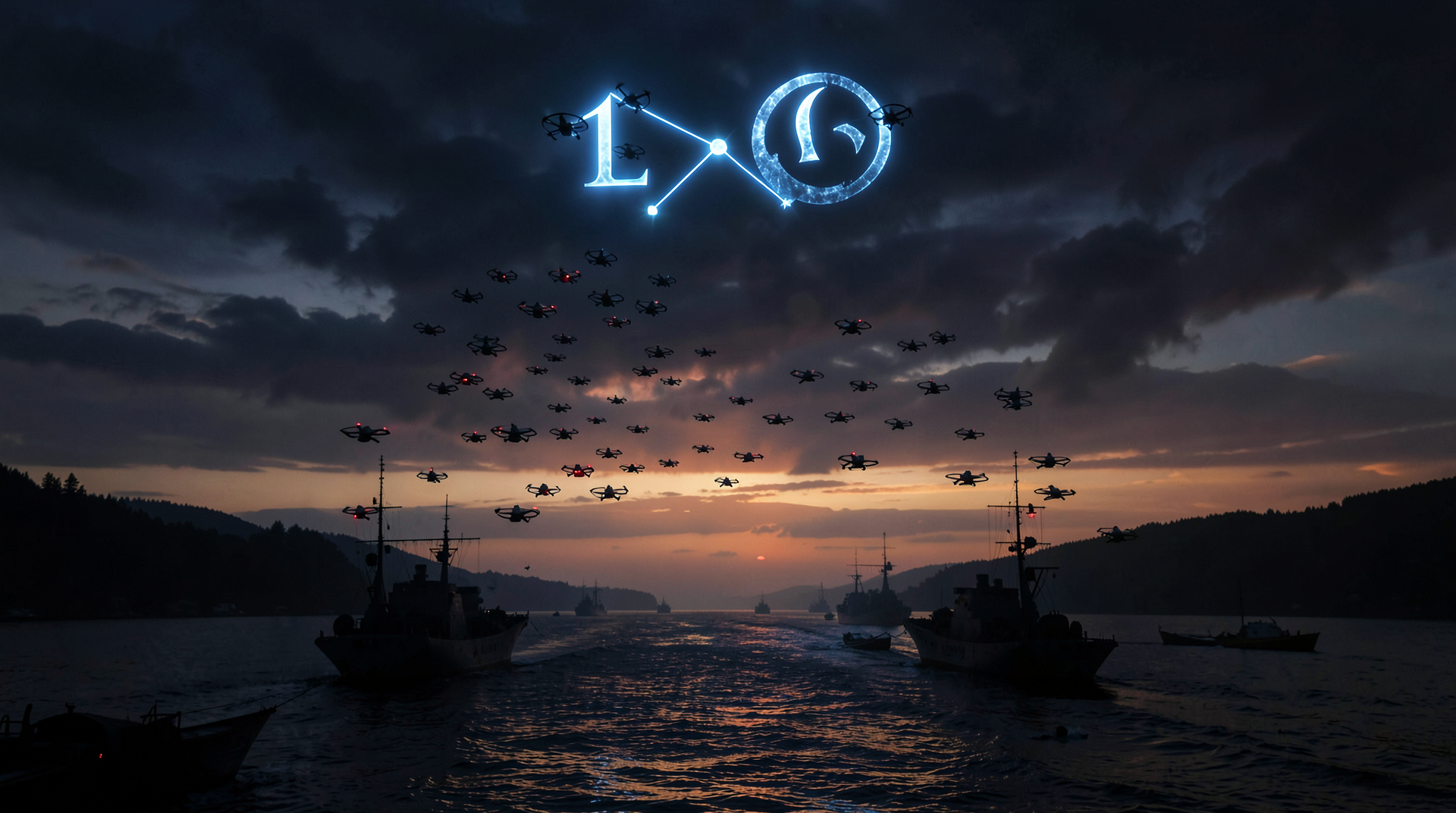
The Strait at Dawn: What Happened
In the early morning hours of July 24, 2026, a coordinated swarm of autonomous drones descended upon Iranian naval vessels in the Strait of Hormuz, disabling multiple warships and marking what military analysts are calling the most significant battlefield deployment of autonomous swarm intelligence in naval history.
The attack — attributed to U.S. forces operating from Gulf-based platforms — reportedly involved over 200 low-observable drones operating with decentralized, AI-driven coordination. Unlike traditional remotely piloted systems, these drones communicated among themselves in real time, adapting their attack patterns without direct human intervention. At least three Iranian fast-attack craft and one larger patrol frigate were rendered inoperable, with initial reports indicating significant casualties among Iranian Navy personnel.
The strait, through which roughly one-fifth of the world's oil supply transits, was temporarily closed to maritime traffic. Oil prices spiked 14% in early trading before settling at an 8% gain as insurance markets scrambled to reprice risk in one of the world's most critical chokepoints.
Mars and Uranus in Gemini: The Astrology of the Swarm
No astrological signature could be more precisely tuned to this event than the presence of both Mars and Uranus in Gemini — the sign of signals, short-distance travel, small flying objects, communication networks, and multiplicity itself. Gemini doesn't send one thing when it can send many. It doesn't operate through hierarchy when it can operate through distributed intelligence.
Mars — the planet of war, aggression, sharp metal, and direct attack — entered Gemini on July 6, 2026 and has been gathering momentum. At 17° Gemini on the morning of the attack, Mars represents the blade, the strike, the will to disable.
Uranus — the planet of electricity, technology, autonomy, sudden disruption, and the unprecedented — has been in Gemini since July 2025, a seven-year transit that will fundamentally rewrite how humanity wages war in the information age. At 4° Gemini, Uranus supplies the technological soul of the swarm: the AI, the decentralized coordination, the very concept of machines making kill-chain decisions without a human in the loop.
These two planets, though 13 degrees apart, are still operating within the same sign — a Mars-Uranus conjunction by sign that is one of the most volatile, unpredictable, and technologically charged configurations in astrology. When Mars and Uranus meet in an air sign, particularly Gemini, the result is lightning war — fast, networked, and shockingly novel.
The two planets last conjoined exactly (at the same degree) on July 4, 2026 at 4° Gemini, the same degree Uranus now occupies and where it will remain for weeks. The exact conjunction has passed, but the fusion of Mars-driven aggression with Uranian technology remains intensely active. What we witnessed on July 24 is, in astrological terms, the discharge of that July 4 conjunction — the physical manifestation of an energy pattern laid down three weeks earlier.
Saturn Stationary on Iran's Sun: The Frozen Gavel Falls
The most devastating astrological aspect of this event, however, is not the Mars-Uranus signature in the sky — it is what that sky is doing to Iran's natal chart.
The Islamic Republic of Iran was proclaimed on April 1, 1979, with the Sun at 11° Aries — a placement that speaks to the nation's fiery, pioneering, combative self-image. Iran's natal Sun sits in the 8th House of the republic's chart: the house of death, transformation, shared resources, and the wealth of others (oil). This is a nation whose identity has always been intimately entangled with themes of mortality, power-through-crisis, and resource warfare.
On July 24, 2026, transiting Saturn sits at 14° Aries — within 3 degrees of Iran's natal Sun. But it gets worse. Saturn is stationary, moving at a barely perceptible 0.0046 degrees per day. In astronomical terms, Saturn has stopped. Its retrograde station occurs on July 28, and the planet is now in the deepest part of its pause — what astrologers call the "stationary zone."
A Saturn-Sun conjunction by transit is one of the heaviest, most sobering configurations in mundane astrology. It represents the crushing of vitality, the weight of consequence bearing down on the national identity, a moment when the bill for decades of choices comes due. When Saturn is stationary during this transit — when the planet of karma, limitation, and structural collapse is literally frozen in place on a nation's Sun — the pressure does not merely intensify. It becomes existential.
This transit sits in Iran's 9th house of foreign affairs, international law, and long-distance enemies. Saturn's frozen weight here suggests a foreign-imposed reckoning that the nation cannot maneuver around, cannot outpace, cannot outlast.
The Transit-to-Natal Web: A Nation Under Pressure
Beyond the Saturn-Sun conjunction, the transit chart for the Strait of Hormuz at dawn on July 24 reveals a web of difficult aspects to Iran's natal chart:
Transit Mars (17° Gemini) in Iran's 10th House of public standing: Military humiliation on the world stage. Mars here does not simply attack — it attacks Iran's reputation, its standing among nations, its image of strength. Mars also squares Iran's natal North Node (17° Virgo), suggesting a karmic correction — a forced pivot in the nation's evolutionary path.
Transit Pluto (4° Aquarius) in Iran's 6th House, opposing natal Jupiter (29° Cancer) in the 11th: Pluto, the planet of destruction-and-rebirth, sits in the house of armed forces, civil service, and daily operations, while opposing the natal Jupiter that represents Iran's allies, its ideological expansion, its sense of protected growth. The opposition from Pluto suggests not merely a military setback but an unraveling of the alliance networks and ideological confidence that have sustained the regime.
Transit Neptune (4° Aries retrograde) in Iran's 8th House, conjunct its natal Mercury (27° Pisces): Fog in the house of death and shared resources. Neptune here suggests incomplete intelligence, confusion about the true nature of the threat, and perhaps the most chilling possibility — that Iran did not see this coming, or saw it through a distorting lens. Neptune on natal Mercury in the 8th house is the astrological signature of a failure of strategic perception at the worst possible moment.
Transit Moon (0° Sagittarius) conjunct Iran's IC (4th House cusp): The Moon at the anaretic (final) degree of Scorpio, about to enter Sagittarius, sits directly on Iran's Imum Coeli — the root of the chart, the homeland, the psychological foundation. The nation's emotional body is being struck at its most vulnerable point.
The Waxing Gibbous Moon: Building Toward a Reckoning
The attack occurred under a Waxing Gibbous Moon — the lunar phase that follows the First Quarter and builds intensity toward the Full Moon. In mundane astrology, the Waxing Gibbous phase represents escalation, the accrual of tension, the sense that events are accelerating toward a climax that has not yet arrived.
The Full Moon arrives on July 28-29, 2026 — precisely when Saturn will make its retrograde station. The Moon at that time will be in Aquarius, opposing the Sun and Jupiter in Leo. Whatever was set in motion in the Strait of Hormuz on July 24 is building toward something larger, something that the Full Moon will illuminate with harsh, undeniable clarity.
Caution: The days between a Waxing Gibbous Moon and the Full Moon are astrologically volatile. Tensions escalate rapidly, and decisions made in this window — especially under a stationary Saturn — carry unusually heavy and lasting consequences. This is not a time for impulsive responses.
The Technology Question: Gemini's Double Edge
The autonomous drone swarm represents a threshold moment in military history — and Gemini, the sign of duality, reminds us that every threshold cuts both ways.
On one hand, swarm autonomy represents a technological achievement of staggering sophistication: machines that collaborate, adapt, and execute complex tactical objectives without centralized human control. This is Uranus in Gemini at its most Promethean — the fire of the gods brought down to the realm of signals and silicon.
On the other hand, the deployment of lethal autonomous weapons raises profound ethical questions that no military doctrine has fully resolved. When a drone swarm makes a targeting decision without a human in the loop, who bears responsibility for the outcome? What happens when the same technology proliferates — as it inevitably will — to actors far less constrained than the United States?
Gemini's shadow is not malice but dispersion. The same networked intelligence that enables a coordinated attack also enables the loss of accountability, the diffusion of responsibility across so many nodes that no single person can be said to have made the decision. This is the astrological warning embedded in the Mars-Uranus conjunction: what is unleashed in the name of tactical advantage cannot easily be called back.
Mercury's Station Direct: Words After the Strike
It is worth noting that Mercury — the planetary ruler of both Gemini and the very concept of communication, signals, and small flying machines — stationed direct in Cancer just hours before the attack, on July 23-24.
A Mercury station direct is a moment when the messenger planet, having been retrograde since July 6, finally begins to move forward again. But stations — whether direct or retrograde — are moments of maximum Mercury intensity. The planet's energy is concentrated, exaggerated, and often manifests as information events: revelations, communications, messages delivered with unusual force.
That this attack occurred at the Mercury station — and that Mercury rules the Gemini sign where Mars and Uranus are operating — suggests that the swarm was not merely a military event but an information event. A message. A demonstration not only of capability but of intent, designed to be read, analyzed, and responded to by Tehran and the watching world.
Astrological Warnings and Cautions
Several factors make the coming days particularly dangerous:
Saturn's retrograde station (July 28): When Saturn appears to stop and reverse direction, events set in motion during the stationary period tend to have long, grinding consequences. Retaliation launched under a Saturn station rarely goes as planned. Structures that seem solid may prove brittle.
Mars square Venus (July 25-26): Mars in Gemini squares Venus in Virgo at 19° of the mutable signs. This aspect, exact within 24-48 hours of the attack, describes a clash between the impulse to act (Mars) and the impulse to assess, discriminate, and exercise restraint (Venus in Virgo). Rash action under this square often produces results that look very different from what was intended.
The approaching Full Moon (July 28-29): As noted, the Full Moon in Aquarius opposed to the Sun-Jupiter conjunction in Leo will illuminate the consequences of this week's actions with maximum intensity. Emotions will run high. Public opinion will crystallize. What is hidden now will be revealed.
Mercury's post-retrograde shadow: Mercury stationed direct but remains in its "shadow period" — the degrees it will retrace before reaching the point where it first turned retrograde. During this phase (through approximately August 7), misunderstandings, technical failures, and communication breakdowns remain more likely than usual. For military command-and-control systems — the very infrastructure that drone swarms depend upon — this represents a non-trivial risk factor.
The Larger Pattern: A World Under Saturn's Gavel
It would be a mistake to view this event in isolation. The attack on the Iranian Navy occurs within the context of a planetary configuration that has defined July 2026: Saturn stationary at 14° Aries, a rare and ponderous transit that has coincided with a cascade of world-altering events — the Venezuela earthquake, the Geneva Peace Accord, the escalating US-Iran confrontation in the Strait of Hormuz, and now a paradigm-shifting demonstration of autonomous warfare.
Saturn in Aries is the disciplinarian in the sign of impulse. It represents the moment when the consequences of unchecked aggression — individual, national, civilizational — can no longer be deferred. The drone swarm that darkened the skies over the Strait of Hormuz is, in astrological terms, a Saturn event as much as it is a Mars-Uranus event. It is the weight of technological inevitability meeting the hard edge of geopolitical reality.
The question now is what Saturn's frozen gavel will strike next — and whether the nations involved understand that, under this transit, escalation is not a ladder but a trapdoor.
Disclaimer: Astrology is a symbolic language that offers insight into archetypal patterns and collective rhythms. It is not a predictive science, and no astrological analysis should be used as the sole basis for military, political, or personal decisions. The interpretations offered here are intended for reflective and educational purposes only. In times of geopolitical tension, astrology can help us understand the emotional and symbolic dimensions of events, but it cannot and should not substitute for factual reporting, expert analysis, or prudent judgment.
Related Articles
Mars Closes to 11° of Jupiter in Leo: The Week 2026's Biggest Conjunction Starts Feeling Real
October 17, 2026
Mars hits 11° Leo this week, closing to within 11° of Jupiter — the moment 2026's biggest conjunction starts feeling real. What to expect, the shadow side, and how to work the build.
Mercury Is Tapping the Brakes in Scorpio: Finish Your Detective Work Before Its Late-October Retrograde
October 16, 2026
Mercury is slowing in late Scorpio before its October 22–24 retrograde station. A practical guide to finishing your detective work, sealing your contracts, and surviving the November rewind.
The October 15–18 Stand-Still: Pluto, the North Node, and the First Quarter Moon Line Up Their Stations
October 15, 2026
From October 15–18, 2026, Pluto's direct station at 3° Aquarius, the North Node's brake at the 29° Aquarius threshold, and the First Quarter Moon in Capricorn line up into a rare celestial standstill. Here's what the pause means — and how to work it.
First Quarter Moon in Capricorn (Oct 18): The Week's "Commit or Release" Moment
October 14, 2026
The First Quarter Moon in Capricorn (Oct 18, 2026, 16:10 UTC) squares the Libra Sun — a cosmic checkpoint asking you to commit or release. Plus Venus retrograde cautions, Pluto's station, and a do/don't guide for the week.