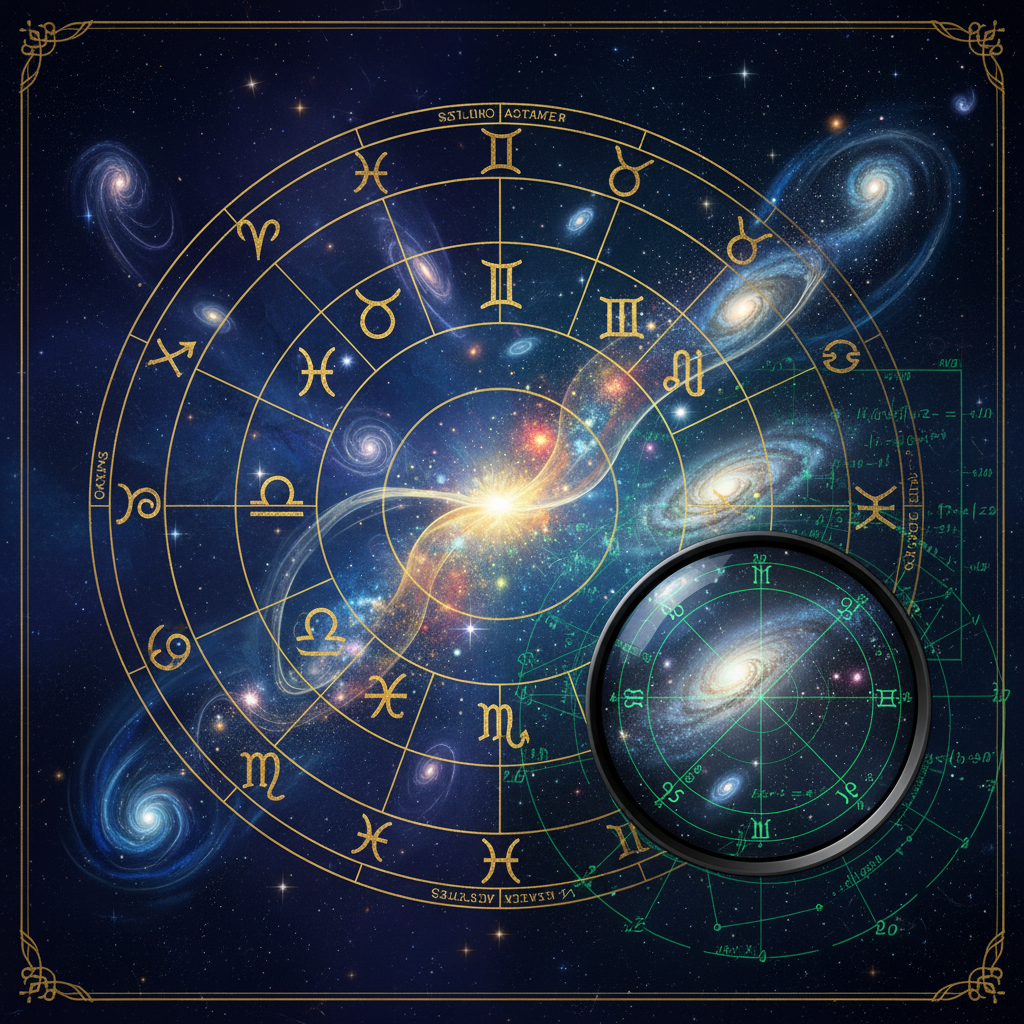
Astrology vs. Astronomy: Understanding the Cosmic Connection and the Divide
For thousands of years, humans have looked up at the night sky with a mix of wonder and curiosity. We have tracked the movement of the planets, named the constellations, and sought to understand our place in the vastness of the cosmos. In our modern world, the study of the stars has split into two distinct disciplines: Astronomy and Astrology.
While the names sound similar and both deal with celestial bodies, they serve very different purposes today. Astronomy is the scientific study of the universe, focusing on the physics and chemistry of celestial objects. Astrology, on the other hand, is a symbolic language that interprets the positions of these objects to offer insight into human affairs and terrestrial events.
However, these two fields were not always separate. To understand their relationship, we must look back at their shared history and understand how they diverged into the distinct practices we know today.
The Shared Roots: When Science and Spirit Were One
In ancient Babylon, Egypt, and Greece, there was no distinction between an astronomer and an astrologer. The person who calculated the position of Mars was the same person who interpreted what its presence meant for the King or the harvest.
Claudius Ptolemy, a 2nd-century scholar whose work influenced scientific thought for over a thousand years, wrote the Almagest (a treatise on the motions of stars and planetary paths) and the Tetrabiblos (a foundational text on astrological philosophy). For the ancients, observing the mechanics of the sky was inextricably linked to understanding the meaning of the sky. The premise was simple: if the Moon affects the tides and the Sun affects the seasons, surely the other wandering stars (planets) must influence life on Earth as well.
The Great Divergence
The split began during the 17th century with the advent of the Scientific Revolution. As thinkers like Galileo, Kepler, and Newton began to unlock the physical laws of gravity and motion, the focus shifted entirely to the mechanical universe.
Astronomy became the pursuit of empirical data—measurable, testable, and strictly physical. It asked "How?" and "What?"
Astrology, which deals with quality, meaning, and the human experience, was gradually relegated to the realm of superstition or pseudo-science by the academic elite because its mechanisms couldn't be proven in a laboratory.
By the time of the Age of Enlightenment in the 18th century, the divorce was largely finalized. Astronomy became a recognized hard science, while astrology became a metaphysical or spiritual practice.
Astronomy: The Science of the Universe
Today, astronomy is defined as the scientific study of celestial bodies such as stars, planets, comets, and galaxies, as well as the phenomena that originate outside the Earth's atmosphere.
Astronomers rely on the scientific method. They use telescopes, satellites, and complex physics to understand:
- Composition: What is a star made of?
- Mechanics: How do galaxies rotate?
- Origins: How did the universe begin (The Big Bang)?
Astronomy is objective. It doesn't ask if Mars being in a certain sector of the sky will make you feel angry today; it asks what the soil composition of Mars is, or calculates its precise orbit to land a rover on its surface.
Astrology: The Language of Meaning
Astrology remains the study of the correlation between astronomical positions and life on Earth. It operates on the principle of "As above, so below"—the idea that the macrocosm (the universe) reflects the microcosm (human life).
Astrologers view the solar system as a clock or a map. Just as a clock doesn't create time but tells you what time it is, astrologers believe planets don't necessarily "cause" events through physical force (like gravity), but rather signal the quality of time.
Astrology is subjective and interpretive. It looks at the precise astronomical data and asks:
- Symbolism: What does Saturn (representing structure and limitation) opposing the Sun (representing ego and vitality) imply for a person's current challenges?
- Timing: When is a favorable time to start a business based on planetary cycles?
- Self-Discovery: How does a birth chart reflect an individual's psychological makeup?
Astraia: Where Precision Meets Interpretation
It is a common misconception that astrology ignores science. In reality, accurate astrology is impossible without precise astronomy.
To cast a birth chart (horoscope), an astrologer needs the exact position of every planet down to the degree and minute. This requires complex mathematical calculations derived from NASA's jet propulsion data and historical ephemerides (tables of planetary positions).
At Astraia, we bridge this gap by utilizing rigorous astronomical algorithms. When you generate a chart on our platform, our system calculates the planetary longitudes, latitudes, and house cusps with the same level of precision used by astronomical software. We respect the science of the celestial spheres as the foundation upon which the art of interpretation is built.
Conclusion
The difference between astrology and astronomy is the difference between measurement and meaning. Astronomy gives us the awe-inspiring facts of our universe—the distance to the stars, the age of the galaxies, and the physics of black holes. Astrology gives us a way to relate to that universe personally, offering a framework to understand the cycles of our lives.
Neither negates the other. We can marvel at the physical reality of Saturn's rings through a telescope (Astronomy) while simultaneously reflecting on the lessons of discipline and maturity that Saturn symbolizes in our charts (Astrology). By respecting both, we gain a fuller, richer appreciation of the cosmos and our place within it.
Related Articles
The Moon's Wane Across 2026-W40: Aries Fire, Taurus Ground, Gemini Air, Cancer Water — Into the Last Quarter
October 4, 2026
Week 40 of 2026 sees the waning Moon tour all four elements — Aries fire, Taurus earth, Gemini air, Cancer water — reaching the Last Quarter on Oct 3 alongside Venus turning retrograde. Here's how to ride the release.
Chiron Hovers at 29° Aries: The Anaretic Degree on the Final Fall of the Aries Wound-Healing Era
October 3, 2026
On Oct 3, 2026, Chiron retrogrades to the anaretic degree of 29° Aries — the final fall of the eight-year Aries wound-healing era before its 2027 homecoming to Taurus.
The North Node Stations Direct at 29° Aquarius (Oct 3): A Karmic Pivot at the Threshold of Pisces
October 2, 2026
On Oct 3, 2026, the North Node stations direct at 29° Aquarius — the anaretic threshold crossing into Pisces. What this karmic pivot (and the Venus retrograde on the same day) means for you.
Sun Opposes Saturn on October 4 — the Day After the Last Quarter Moon: Libra Season's Accountability Check
October 1, 2026
The Sun opposes retrograde Saturn on October 4, 2026 — the day after the Last Quarter Moon in Cancer. What Libra season's accountability check means for relationships, work, and money, plus who feels it most and how to use it.