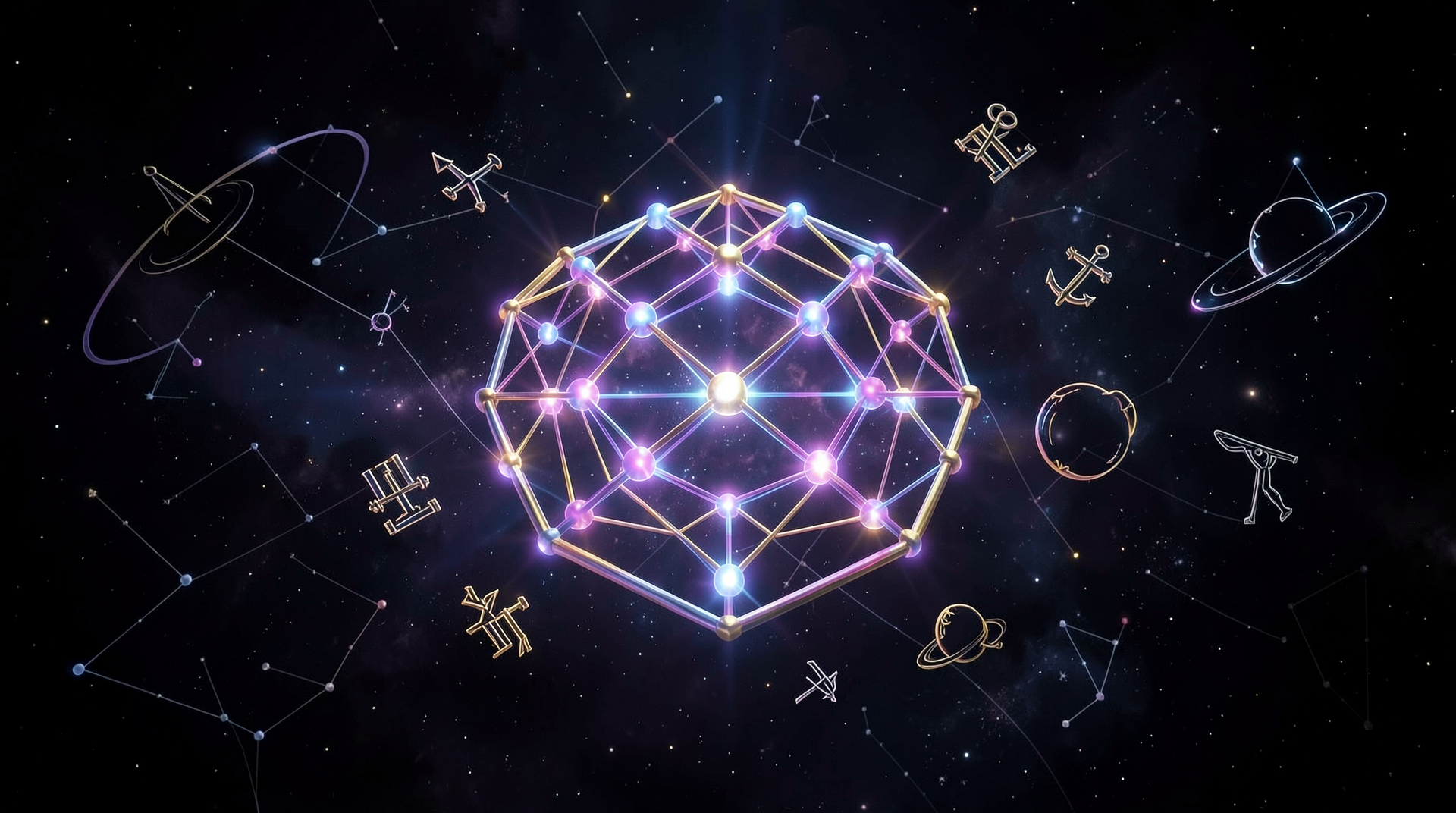
On September 1, 2026, researchers reported something that sounds almost like a paradox: they stabilized a 78-qubit quantum processor by deliberately feeding it controlled random pulses. Instead of fighting the noise that makes quantum machines so fragile, the new method learns to ride it — keeping nearly eighty qubits coherent long enough to matter. It is the kind of quiet, technical milestone that rarely makes headlines in the way a "quantum supremacy" stunt does, yet it may matter far more.
And it arrived on a date the sky seems to have scheduled for it. September 1, 2026 is the very day Uranus — planet of sudden leaps, electricity, and paradigm-shattering insight — ground to a halt at 5° Gemini before snapping back into direct motion. If any technology deserves a Uranian birthday, it is the quantum computer.
What "Controlled Random Pulses" Actually Means
To understand why this matters, picture a qubit as a spinning top that can point up, down — or, impossibly, both at once. That "both at once" state (superposition) is where quantum power lives. But the moment the outside world so much as glances at a qubit, it collapses into an ordinary bit: a 1 or a 0. This is decoherence, the great enemy of quantum computing, and the reason today's machines are called noisy.
The classic strategy has been to shield qubits from noise completely. This new approach flips the logic: instead of hiding from the environment, the researchers fire sequences of random (but carefully controlled) microwave pulses at the processor. Randomness, counterintuitively, cancels out systematic interference — the way white noise can mask a repetitive hum. The pulses scramble the errors before they can accumulate, buying the qubits precious extra microseconds of coherent life.
The result: 78 qubits held stable long enough to run meaningful operations — a scaling milestone that pushes back the day when quantum processors can outrun classical supercomputers at real-world tasks. For context, qubit counts have been climbing for years, but the reliability per qubit — not the raw number — is the true story. Stability at 78 qubits is a strong signal.
Uranus Stations Direct at 5° Gemini: The Breakthrough Signature
Cast the sky for September 1, 2026, and one detail towers over all others: Uranus, moving at barely 0.008° per day, is parked at 5° Gemini — effectively motionless, at its station, before swinging back to direct.
Astrologically, this is the archetype of the quantum leap made visible:
- Uranus rules sudden breakthroughs, electrical current, and revolutions in thought — inventions that arrive "from nowhere" and change the rules of the game.
- Gemini rules information, communication, and the two-stated world of bits: 0 and 1, on and off, this and that.
- The quantum computer sits precisely at their intersection: a machine that runs on both-and (superposition), entanglement, and probability — Gemini's duality taken to its logical extreme.
A stationing planet is like a held breath before the exhale. Breakthroughs that occur under a Uranus station often feel electric, destabilizing, and undeniable all at once. That the 78-qubit announcement broke on the station day is the kind of synchronicity astrologers quietly savor — and it suggests this moment is a hinge, not just a headline: the first durable click of a larger mechanism beginning to turn.
A Chart Cast at the Lab: September 1, 2026, Yorktown Heights
Casting the moment for the region where much of this hardware has long been developed — Yorktown Heights, New York, home of a major quantum research center — adds more layers:
- Sun at 9° Virgo in the 9th house — the breakthrough emerges from deep research and higher learning, and its character is pure Virgo: meticulous, incremental, measured. This is not a trumpet blast; it is an exquisitely tuned calibration.
- Mercury at 14° Virgo in the 10th house — the field's public statement is in the domain of reputation, and Mercury in Virgo insists on verification. Peer review, reproducibility, pin-point accuracy: this is the right Mercury for the job. It is also moving fast — claims, good and bad, will spread rapidly.
- Pluto retrograde at 3° Aquarius in the 2nd house — the transformation of the computing economy (what computation is worth, who owns it) is deep and ongoing, and Pluto retrograde likes to dig. Expect buried problems to surface — especially the long-known threat quantum machines pose to classical encryption ("Q-Day").
- Neptune retrograde at 3° Aries in the 4th house — at the foundation of this breakthrough glows a fog. The glamour of quantum computing has always outrun its reality; Neptune here warns that hype is baked into the substrate, and the truly foundational piece — full error correction — is still being dreamt, not delivered.
- Saturn retrograde at 13° Aries in the 5th house — quantum research is, at heart, creative play (the 5th house of experimentation), and Saturn in Aries demands courage and rigor. Its retrograde motion means the audit is coming: promises made in momentum will be reviewed, revised, or quietly withdrawn.
- Mars at 13° Cancer in the 8th house — shared resources, other people's money, and security are charged territory. Quantum computing is becoming an arms race for both breakthroughs and defenses, and Mars in Cancer on the 8th house speaks to emotionally charged maneuvering around investment, secrecy, and cryptographic vulnerability.
- Jupiter at 13° Leo in the 9th house — grants, universities, and grand visions are swelling — but Jupiter in Leo loves a bold stage and can inflate a claim. Enjoy the spectacle; keep the grain of salt nearby.
Feynman's Ghost in the Machine
No one who reads a quantum headline should forget who pointed the way. In 1981, physicist Richard Feynman proposed — almost as a throwaway — that if you want to simulate nature, you'd better build a computer that behaves like nature: one that is itself quantum. "Nature isn't classical, dammit," he said, "and if you want to make a simulation of nature, you'd better make it quantum mechanical."
Feynman's chart (a noon chart; his birth time was never recorded, so houses are approximate while planet-to-planet aspects remain solid) makes the September 1 sky feel almost scripted:
- Transiting Uranus at 5°39' Gemini sits within a hair's breadth of Feynman's natal Moon at 5°19' Gemini. The Awakener stands exactly on the instincts of the man who dreamed the quantum machine — a nearly exact conjunction between the planet of revolutionary technology and the Moon of imagination in the sign of information.
- Transiting Mercury, the messenger and the ruler of computation, conjoins Feynman's natal Mars at 15° Virgo — the planet of pioneering drive meeting the planet of messages, both in the sign of meticulous craft. It is as if the news itself were passing through his hands.
- The transiting North Node conjoins his natal Uranus in Aquarius — the collective's leading edge is converging, at last, on his signature genius.
Feynman also warned that "if you think you understand quantum mechanics, you don't understand quantum mechanics." The 78-qubit result honors his optimism — and his humility.
The Shadow of the Leap: Why 78 Qubits Is Not Yet a Revolution
For all the glow, a responsible reading must include the shadow side:
- 78 physical qubits is not fault tolerance. The processor is more stable, not yet error-proof. The leap from "stable noisy qubits" to "logical qubits that correct their own errors" remains the true mountain.
- Uranus stations are volatile. The same sky that blesses sudden breakthroughs also produces erratic claims, hasty announcements, and manufactured drama. Expect rival labs and corporate PR to escalate — and expect some headlines to outrun the data.
- Neptune retrograde in Aries is a hype detector's friend. Under Neptune retrograde, glamour fades and truth emerges — but slowly. Verification will take months of peer review, replication, and independent testing. Treat any "we've already won" narrative with Virgo-grade skepticism.
- Pluto retrograde in Aquarius keeps the security conversation raw. Every step toward quantum advantage is also a step toward the moment classical encryption begins to crack. Institutions that wait to migrate to post-quantum cryptography are gambling — and retrograde Pluto loves exposing gamblers.
- Saturn retrograde in Aries delays the reckoning. The structural audit (who really achieved what, and whether the method scales) arrives later in the cycle, often around the planet's direct station. Successes claimed in September may be quietly re-framed by the season's end.
Astrology here is a lens on timing and temperament — not a guarantee. The sky did not compute the pulses; the researchers did. What the sky does is describe the weather in which such work unfolds: electric, promising, noisy, and in need of careful verification.
What to Watch Next
- Around September 7–8, the Moon meets Mars in Cancer in the 8th house — expect the emotional weather around quantum funding, security, and "who holds the keys" to heat up as this story digests.
- The Virgo New Moon in mid-September plants seeds for measurement, quality control, and the next round of careful, undramatic progress — the kind that actually moves the field.
- Mercury's fast run through Virgo into Libra will test how claims hold up in dialogue, partnership, and standards-setting. Watch for clarifying — and occasionally retracting — statements.
- The real milestone to wait for is fault-tolerant logical qubits. When a machine reliably corrects its own errors at scale, that — not any single qubit count — will be the true quantum leap. Until then, admire the craft, stay curious, and keep your encryption posture updated.
The Bottom Line
A 78-qubit processor stabilized by controlled random pulses is a wonderful paradox made real: a machine that achieves order by welcoming chaos, that rides the noise instead of hiding from it. That is also, in a way, the lesson of the Uranus station — the breakthrough that arrives not by controlling everything, but by learning to dance with the unpredictable.
The sky on September 1, 2026 was a sky built for exactly this kind of story: Uranus the Awakener, halted at the doorstep of Gemini the communicator, whispering to the ghost of Feynman. The next chapter belongs to the engineers, the skeptics, the auditors, and the dreamers. We'll be watching.
This article uses astrology as a symbolic and contemplative lens on current events, not as a predictive or scientific tool. Quantum computing results, like all technological claims, should be evaluated by evidence, peer review, and replication — not by horoscopes. Astrological timing should never be the sole basis for major financial, professional, or security decisions.
Related Articles
Mars Closes to 11° of Jupiter in Leo: The Week 2026's Biggest Conjunction Starts Feeling Real
October 17, 2026
Mars hits 11° Leo this week, closing to within 11° of Jupiter — the moment 2026's biggest conjunction starts feeling real. What to expect, the shadow side, and how to work the build.
Mercury Is Tapping the Brakes in Scorpio: Finish Your Detective Work Before Its Late-October Retrograde
October 16, 2026
Mercury is slowing in late Scorpio before its October 22–24 retrograde station. A practical guide to finishing your detective work, sealing your contracts, and surviving the November rewind.
The October 15–18 Stand-Still: Pluto, the North Node, and the First Quarter Moon Line Up Their Stations
October 15, 2026
From October 15–18, 2026, Pluto's direct station at 3° Aquarius, the North Node's brake at the 29° Aquarius threshold, and the First Quarter Moon in Capricorn line up into a rare celestial standstill. Here's what the pause means — and how to work it.

First Quarter Moon in Capricorn (Oct 18): The Week's "Commit or Release" Moment
October 14, 2026
The First Quarter Moon in Capricorn (Oct 18, 2026, 16:10 UTC) squares the Libra Sun — a cosmic checkpoint asking you to commit or release. Plus Venus retrograde cautions, Pluto's station, and a do/don't guide for the week.